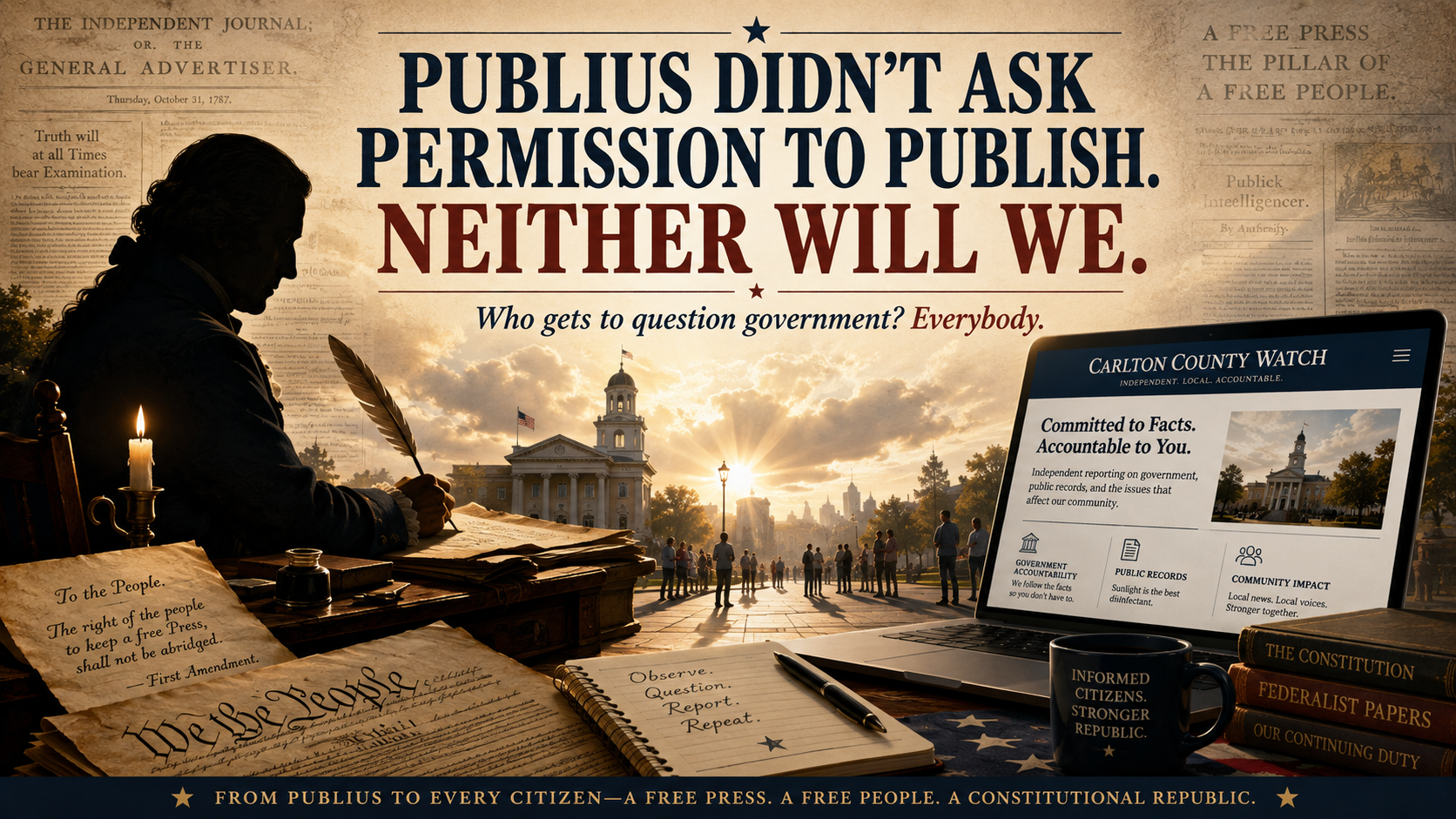
Publius Didn't Ask Permission to Publish. Neither Will We.
Who gets to question government? Who gets to publish? Who gets to call themselves the press? The American answer has been with us since before the Constitution was ratified: the people do.
by Carlton County Watch
A note about terminology before we begin: When this article uses words such as republic, republican government, Federalist, or Democratic-Republican, we are discussing constitutional principles and political movements of the Founding era — not today's Republican and Democratic parties.
The United States is a constitutional republic in which governmental authority ultimately derives from the people. James Madison explained the concept in Federalist No. 39 by describing republican government as one deriving its powers directly or indirectly from the great body of the people. The Constitution itself guarantees every state a “Republican Form of Government.”
That is the sense in which those words are used here.
This is not a Republican article.
This is not a Democratic article.
This is an article about the constitutional relationship between the governed and those entrusted to govern them.
And about the indispensable right of ordinary citizens to question both government and one another.
Pine Knot Has Every Right to Criticize Us
Let's begin somewhere that may surprise some readers.
The Pine Knot has every right to criticize Carlton County Watch.
So does Pine Knot editor Jana Peterson.
If Pine Knot believes our reporting is mistaken, incomplete, unfair, irresponsible, amateurish, sensational, or flat-out wrong, it should say so.
Loudly, if necessary.
Carlton County Watch will defend that right to our last keystroke.
Because freedom of the press cannot mean freedom only for publications with which we agree.
Freedom of speech cannot mean freedom only for conclusions we find comfortable.
And public debate cannot mean debate in which one side decides who possesses sufficient institutional pedigree to participate.
But freedom works both ways.
If Pine Knot believes Carlton County Watch got something wrong, our response is equally simple:
Tell us what we got wrong.
Identify the sentence.
Identify the quotation.
Identify the document.
Identify the map.
Identify the meeting.
Identify the factual proposition.
Show our readers the evidence.
And Carlton County Watch will publish, examine, discuss, correct when warranted, and debate the issue openly.
The answer to an argument is an argument.
Not credentials.
Not institutional pedigree.
Not indignation.
Not access to government officials.
Evidence.
What Started This Discussion
Following Carlton County Watch's reporting concerning the Carlton County 2050 Comprehensive Plan, Pine Knot described Carlton County Watch as an “anonymous website purporting to report the truth about Carlton County”and reported that county officials believed Carlton County Watch “didn't get the story right.”
We answered the question.
Carlton County Watch does not disclose the identities of individuals who research, write, edit, contribute information to, or otherwise assist with its reporting.
We also explained something far more important than the identity of any writer:
Our reporting should be evaluated by its evidence.
Government records.
Meeting materials.
Public officials' statements.
Maps.
Agendas.
Minutes.
Recordings.
Statutes.
Source documents.
And wherever practicable, Carlton County Watch provides those materials so readers can examine the evidence themselves.
We additionally invited Pine Knot to identify any particular statement it believed was inaccurate so that we could examine it.
That invitation remains open.
Because the question raised by this disagreement is much larger than either Carlton County Watch or Pine Knot.
Who gets to be the press?
America has been debating that question since before America had a Constitution.
Meet Publius
Between 1787 and 1788, Alexander Hamilton, James Madison and John Jay undertook one of the most consequential acts of political journalism in American history.
They wanted Americans to ratify the proposed United States Constitution.
So they wrote.
And wrote.
And wrote some more.
Eighty-five essays eventually became what we now call The Federalist Papers.
But the newspaper readers encountering those arguments didn't initially see articles signed:
Alexander Hamilton.
James Madison.
John Jay.
They saw another name:
PUBLIUS
The three men published under a shared pseudonym.
And they weren't alone.
Opponents of the proposed Constitution answered under names such as Brutus, Cato, Centinel, and Federal Farmer.
More than two centuries later, the United States Supreme Court specifically looked back upon this tradition in McIntyre v. Ohio Elections Commission.
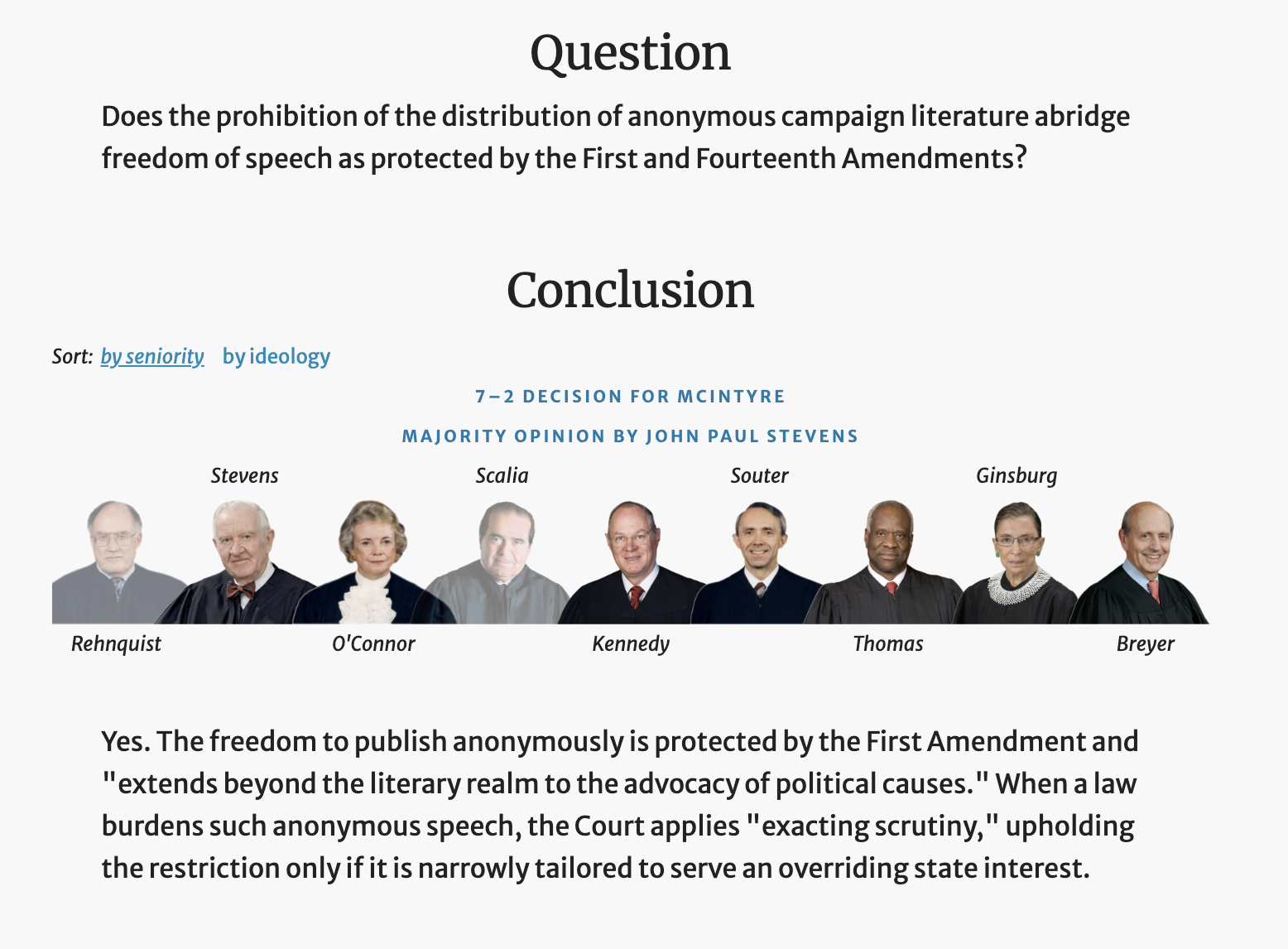
The Court observed that the Federalist Papers were written by Hamilton, Madison and Jay but signed “Publius,” while Anti-Federalists likewise frequently published pseudonymously. The Court recognized anonymous political advocacy as an “honorable tradition of advocacy and of dissent.”
Consider what that means.
Some of the most important political arguments in American history entered public debate without the reader first receiving a résumé of the writer.
The ideas had to compete.
The arguments had to withstand criticism.
The claims had to persuade.
Publius didn't ask permission to publish.
Neither did Brutus.
Neither did Cato.
And there was no governmental board deciding which one deserved to be called a journalist.
The Idea Matters More Than the Identity
The Supreme Court made another observation in McIntyre that deserves particular attention.
Anonymity can allow readers to evaluate an argument without prejudging it merely because they like — or dislike — the person making it. The Court specifically connected this history to the Federalist Papers and the broader American tradition of pseudonymous political advocacy.
That concept resonates deeply with Carlton County Watch.
We do not ask readers:
Trust us because of who we are.
We ask something different:
Look at the evidence.
Open the agenda.
Read the comprehensive plan.
Examine the land-use map.
Watch the meeting.
Read the public record.
Listen to what the official actually said.
Then decide for yourself.
Maybe you will agree with Carlton County Watch.
Maybe you will agree with Pine Knot.
Maybe you will agree with Carlton County government.
Maybe you will conclude that all three missed something.
That is your right.
Indeed, that is the point.
A constitutional republic doesn't require citizens to surrender their judgment to government.
Nor does it require them to surrender their judgment to newspapers.
Madison Understood That Liberty Produces Disagreement
In Federalist No. 10, Madison confronted the problem of factions — groups of citizens holding competing interests, passions and beliefs.
His observation remains extraordinary:
“Liberty is to faction what air is to fire.”
Think about that statement for a minute.
Madison wasn't writing a treatise about modern journalism. But the constitutional principle is difficult to miss.
The existence of disagreement is not proof that liberty has failed.
Disagreement is one of liberty's inevitable consequences.
Madison rejected eliminating liberty merely because liberty permits factions to arise.
Apply that principle to public discourse today.
A free society will produce uncomfortable questions.
Competing interpretations.
Angry editorials.
Independent publications.
Government critics.
Government defenders.
Citizens who think the newspaper is wrong.
Newspapers that think citizens are wrong.
And, yes, publications that think other publications are wrong.
The noise isn't necessarily evidence that representative government is malfunctioning.
The noise can be evidence that representative government is alive.
The danger begins when someone concludes that only certain approved voices should participate.
Hamilton's Remarkable Warning About Freedom of the Press
Perhaps the most remarkable connection appears in Alexander Hamilton's Federalist No. 84.
Hamilton was discussing objections concerning the absence of an enumerated bill of rights in the proposed Constitution. His broader argument must be understood in its historical context; the First Amendment had not yet been adopted.
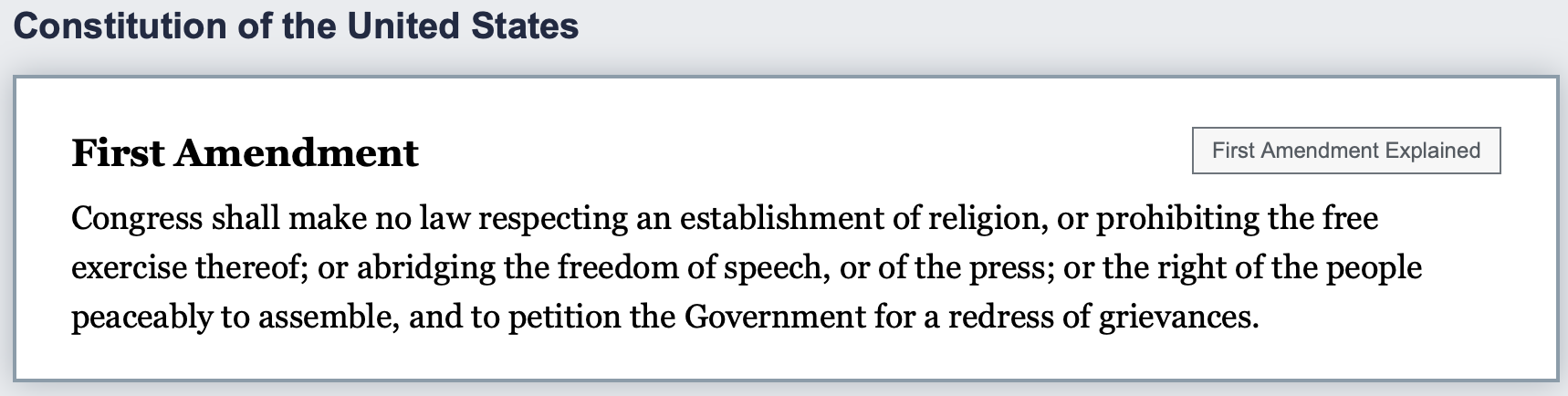
But in discussing liberty of the press, Hamilton made an observation that reaches across 238 years.
He wrote that its security ultimately depended upon:
“public opinion, and on the general spirit of the people and of the government.”
He called that spirit the solid basis upon which rights ultimately depended.
Think about that.
We can write FREEDOM OF THE PRESS on parchment.
We can engrave it into courthouse walls.
We can recite the First Amendment.
But constitutional liberty requires something more.
It requires a people willing to exercise those rights.
And a governmental culture willing to tolerate their exercise.
Hamilton goes even further in Federalist No. 84 when discussing how distant citizens would learn what their representatives were doing.
He envisioned information moving through correspondence and public publications, describing newspapers as “expeditious messengers of intelligence” to citizens far from the seat of government.
In 1788, that meant printed newspapers traveling across roads and countryside.
In 2026, the technology has changed.
A newspaper may arrive on paper.
A government meeting may appear on YouTube.
A document may arrive by email.
A citizen may publish analysis on a website.
A public record may travel throughout Carlton County in seconds.
The technology changed.
The constitutional principle didn't.
The Press Is More Than an Institution
This is where the history of Publius becomes particularly important.
When Americans today hear the words “the press,” they may imagine a newsroom.
A printing plant.
A television network.
A masthead.
Paid reporters.
Press credentials.
A corporation.
But that is not what the entire Founding-era information ecosystem looked like.
In McIntyre, Justice Thomas's historical analysis observed that the Founding generation did not envision only today's large newspaper and television organizations when discussing the press. Independent printers circulated newspapers, pamphlets and political arguments throughout the colonies and early Republic.
The pamphleteer mattered.
The printer mattered.
The citizen writer mattered.
The anonymous political essay mattered.
The dissenting voice mattered.
That history should make us extremely cautious about any suggestion that a person somehow requires institutional permission before participating in public journalism.
Carlton County Watch does not claim that being independent makes us correct.
It doesn't.
Pine Knot's longevity does not automatically make Pine Knot correct.
Carlton County Watch's independence does not automatically make Carlton County Watch correct.
A government title does not automatically make a government official correct.
Evidence makes an assertion persuasive.
That standard applies to everybody.
Including us.
1798: When Criticism Became Too Uncomfortable
American history also contains darker lessons.
Only a few years after adoption of the First Amendment, the Federalist-controlled Congress enacted the Alien and Sedition Acts of 1798.
The Sedition Act criminalized certain writings attacking the federal government. According to the National Archives, the only journalists prosecuted under the law were editors of Democratic-Republican newspapers, and the controversy helped produce a fierce national reaction.
Again, a historical clarification matters.
The Democratic-Republican Party of the 1790s is not today's Democratic Party or Republican Party.
Likewise, the Federalist Party of John Adams and Alexander Hamilton is not today's Republican Party.
Trying to squeeze an eighteenth-century constitutional struggle into today's red-team-versus-blue-team politics misses the lesson entirely.
The lesson is about power.
Political power changes hands.
Today's governing majority becomes tomorrow's opposition.
Today's favored newspaper becomes tomorrow's critic.
Today's critic may someday become powerful.
That is precisely why constitutional liberty cannot depend upon whether we trust the people currently exercising governmental authority.
The rules must survive the players.
And an extraordinary feature of this history is that James Madison — one of the authors writing as Publius — later became a leading opponent of the Sedition Act. The National Archives notes Madison's authorship of the Virginia Resolutions attacking the Alien and Sedition Acts.
History is complicated.
Constitutional principles should be stronger than political teams.
A Minnesota Warning: Near v. Minnesota
Minnesota itself occupies an important place in American freedom-of-the-press history.
In Near v. Minnesota, decided in 1931, the United States Supreme Court considered a Minnesota law used to restrain publication of a newspaper characterized under state law as malicious, scandalous and defamatory.
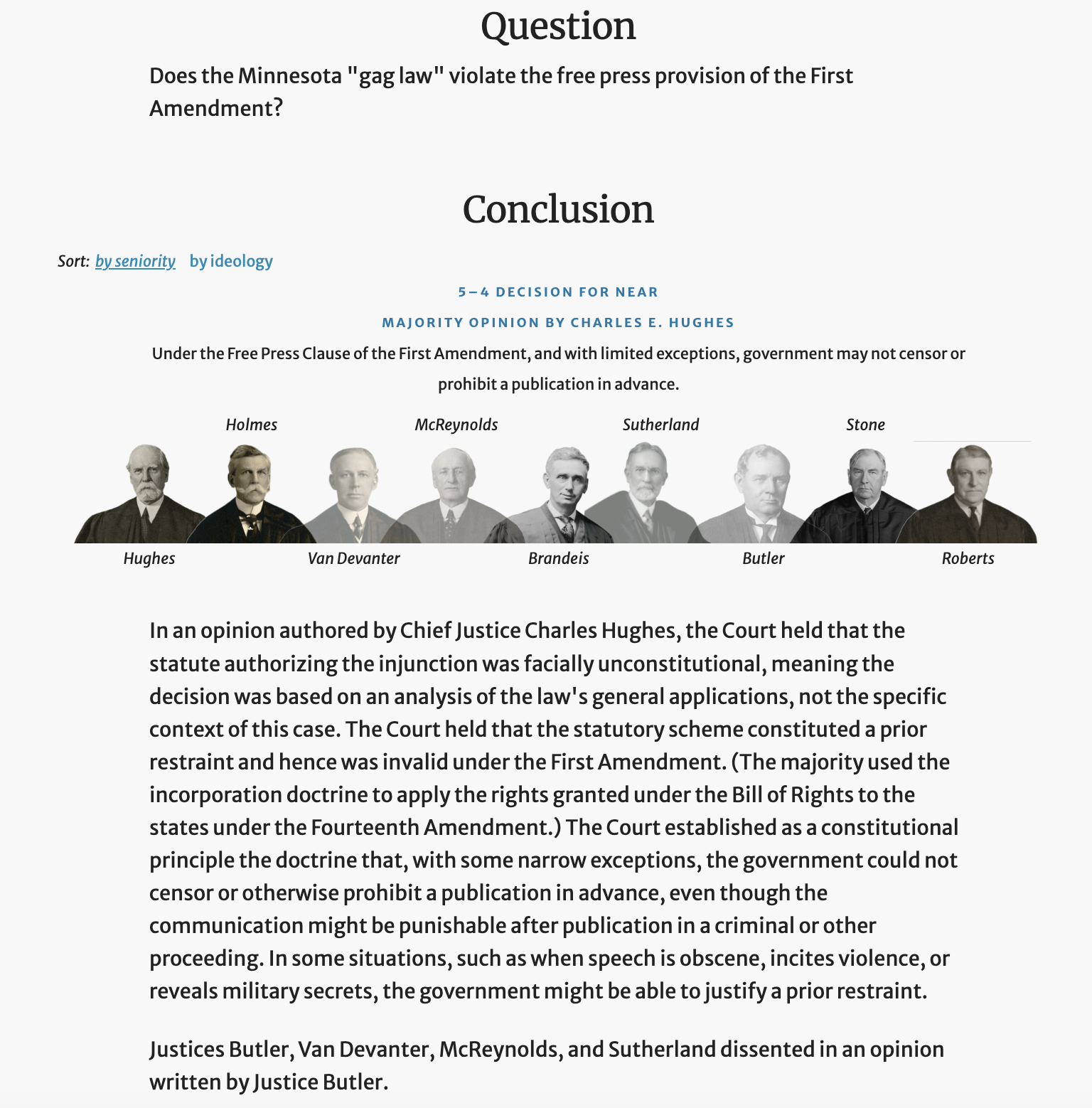
The Supreme Court struck down the restraint.
The decision became a foundational First Amendment precedent concerning prior restraint — governmental suppression of publication before it occurs. Congress's Constitution Annotated continues to identify Near as a landmark in the doctrine governing prior restraints.
Now, let's make an important distinction.
Carlton County Watch is not claiming that Pine Knot's criticism is another Sedition Act.
It isn't.
We are not claiming that Near v. Minnesota describes the present disagreement.
It doesn't.
Pine Knot is exercising its own speech rights.
That distinction matters.
Historical analogies become useless when they become exaggerations.
But history nevertheless teaches a principle worth remembering:
Unpopular publications do not need to become popular before their freedom matters.
The constitutional test cannot be whether government officials like what a publication prints.
And it cannot be whether another newspaper considers the publication sufficiently respectable.
So Let's Debate
Carlton County Watch therefore extends an invitation to Pine Knot.
Not an ultimatum.
Not a demand for silence.
An invitation.
Challenge us.
If our interpretation of the Carlton County 2050 Comprehensive Plan is wrong, explain why.
If we misrepresented the preliminary land-use map, show readers where.
If we quoted an official incorrectly, provide the complete quotation.
If we omitted material context, provide it.
If another government record changes the story, send it.
And Carlton County Watch will examine it.
We reserve exactly the same right.
We will read Pine Knot.
We will critique Pine Knot.
We will challenge Carlton County officials.
We will praise them when praise is deserved.
We will criticize them when criticism is warranted.
And when someone demonstrates that Carlton County Watch made a factual mistake, we should correct it.
That is not weakness.
That is journalism.
What We Will Not Do
We will not accept the premise that the identity of a writer answers the substance of an argument.
We will not accept the premise that longevity creates a monopoly on journalism.
We will not accept the premise that access to government officials establishes factual correctness.
And we will not accept the premise that citizens should wait quietly for established institutions to decide which government activities deserve their attention.
Nor, without evidence, will Carlton County Watch accuse Pine Knot of secretly coordinating with Carlton County government.
Suspicion is not proof.
If evidence of coordination ever exists and is lawfully obtained, we can examine the evidence and report what it shows.
Until then, the existing public record is enough to sustain the question actually before us:
Did Carlton County Watch get the facts wrong?
If so, tell us where.
Bring Receipts
There is a phrase used frequently in modern debate:
Bring receipts.
We rather like it.
Because beneath the colloquialism lies a profoundly old idea.
Do not ask citizens simply to trust authority.
Do not ask them simply to trust Carlton County Watch.
Do not ask them simply to trust Pine Knot.
Show them.
Hamilton, Madison and Jay made their arguments.
Brutus made his.
Cato made his.
Federal Farmer made his.
Readers judged.
More than two centuries later, Americans possess technologies the Founding generation could scarcely have imagined.
But our responsibility remains remarkably similar.
Read.
Question.
Investigate.
Argue.
Publish.
Answer.
Correct.
Debate.
And then allow free citizens to reach their own conclusions.
We Will Defend Pine Knot's Right to Criticize Us
So let there be no misunderstanding.
Carlton County Watch will defend Pine Knot's right to criticize this publication.
We will defend Jana Peterson's right to question us.
We will defend Carlton County officials' right to disagree with us.
We will defend residents who think Carlton County Watch is wrong.
And we will defend residents who think Pine Knot is wrong.
To our last keystroke.
Because the freedom we demand for ourselves is meaningless if we are unwilling to extend it to our critics.
But we ask something in return.
Not agreement.
Not approval.
Not deference.
Argument.
Tell us what is wrong.
Show us the evidence.
Put it before the people.
And let the discussion occur where disagreements in a constitutional republic belong:
In the open forum of public debate.
Publius Didn't Ask Permission
Perhaps that is the enduring lesson.
Alexander Hamilton did not need a press credential before writing Federalist No. 1.
James Madison did not need the government's approval before writing Federalist No. 10.
John Jay did not need an established newspaper to certify that his arguments were worthy of consideration.
They wrote.
Their opponents answered.
The people read.
And history remembers the debate.
Carlton County Watch makes no claim to be Hamilton, Madison or Jay.
That isn't the point.
The point is that the principle they exercised belongs to everyone.
The farmer in Mahtowa.
The business owner in Cloquet.
The retiree in Moose Lake.
The county commissioner.
The newspaper editor.
The government employee.
The anonymous pamphleteer.
The blogger.
The citizen with a question nobody else thought to ask.
And, yes:
Pine Knot.
Jana Peterson.
Carlton County Watch.
Who gets to question government?
Everybody.
Who gets to publish?
Everybody.
Who decides which arguments ultimately deserve to be believed?
In a constitutional republic worthy of the name —
We the People do.
Publius didn't ask permission to publish.