The Question Carlton County Still Hasn't Answered: Was Carlton County Sheriff’s Deputy Mike Soderstrom Ever Referred for Criminal Review?
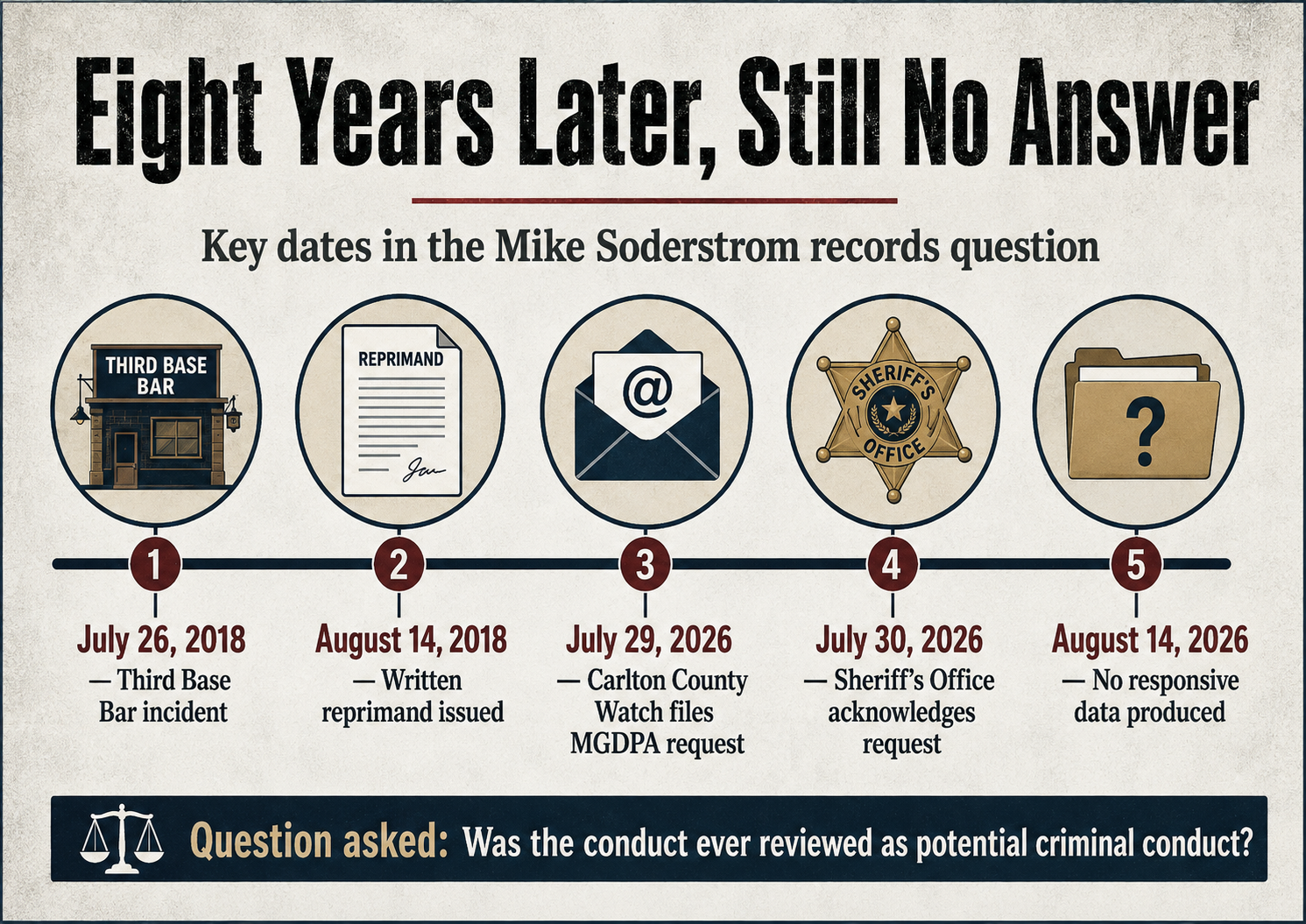
After Carlton County’s own records documented corroborated threatening conduct by a sheriff’s deputy and a written reprimand, Carlton County Watch asked whether the incident was ever investigated or referred as potential criminal conduct. The Sheriff’s Office acknowledged the request on July 30. As of August 14, no responsive data have been produced.
By Carlton County Watch
Eight years after a Carlton County sheriff’s deputy (Michael “Mike” Soderstrom, now Mayor of Carlton) repeatedly threatened members of the public during an off-duty confrontation at a Carlton bar, an important question remains unanswered:
Was the conduct ever investigated or reviewed as possible criminal conduct?
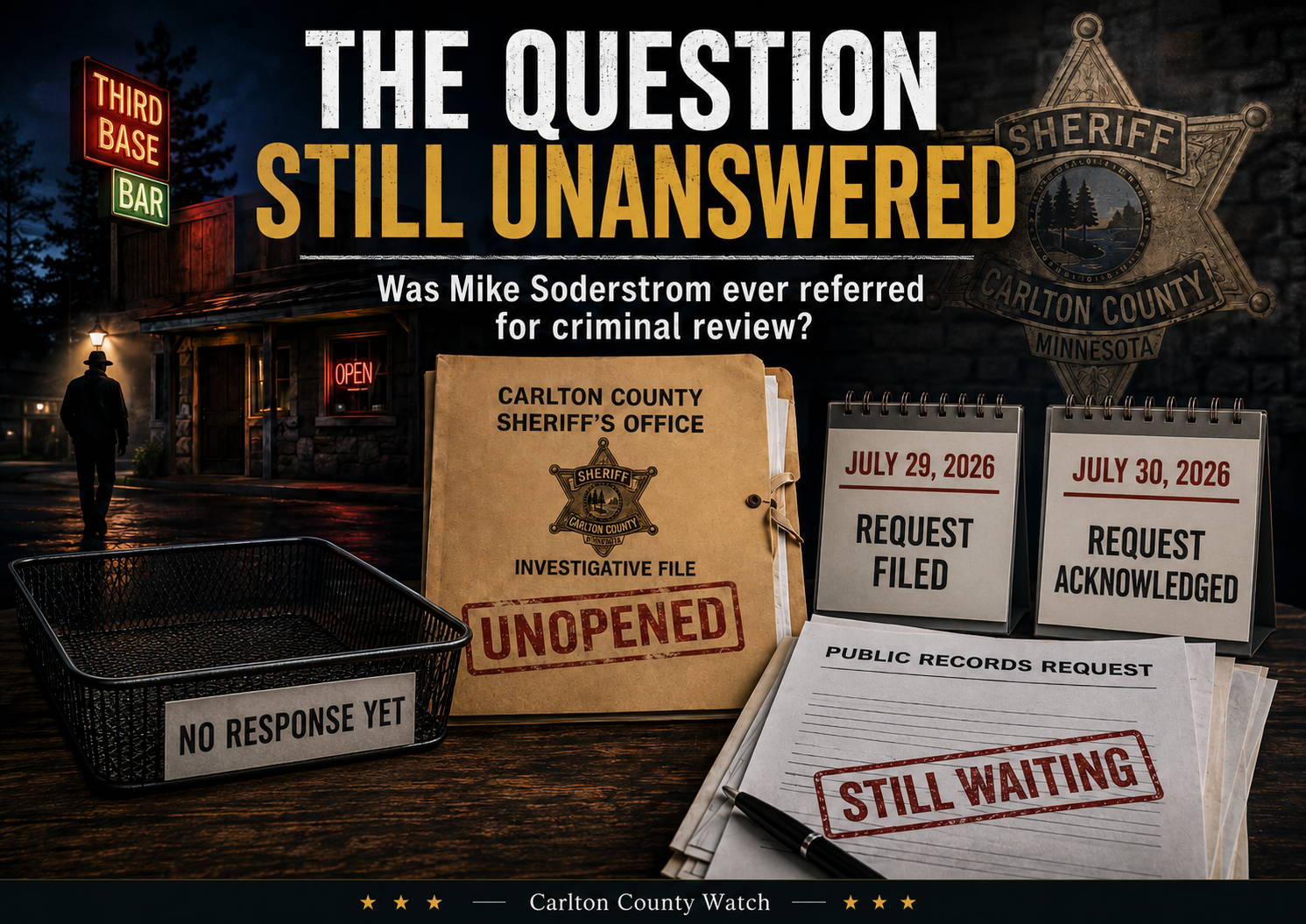
Carlton County Watch has now formally asked the Carlton County Sheriff’s Office that question through the Minnesota Government Data Practices Act.
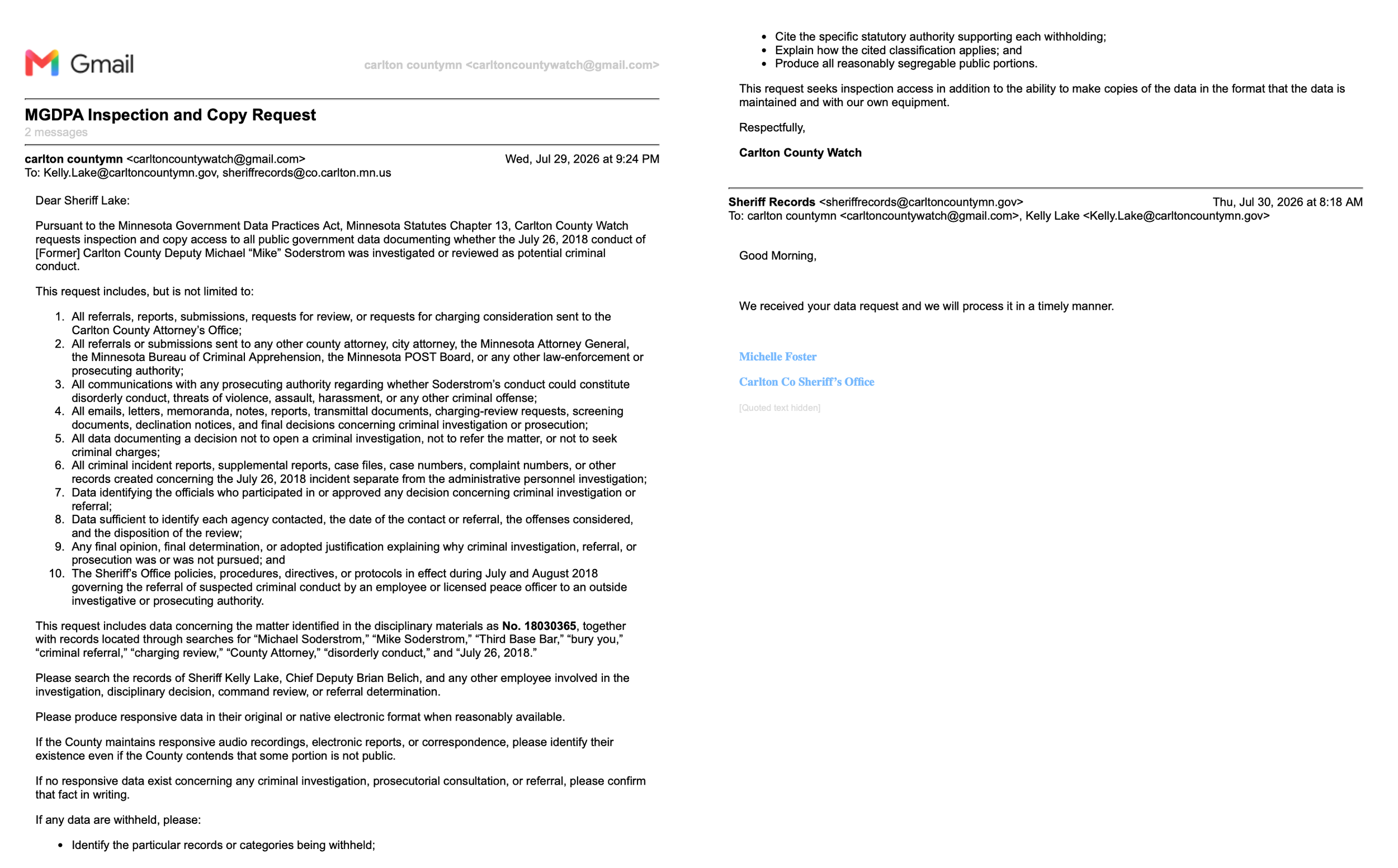
The request was submitted to Sheriff Kelly Lake and the Sheriff’s Office records department on July 29, 2026.

Carlton County Sheriff Kelly Lake. Source: Carlton County website
The following morning, the Sheriff’s Office acknowledged receiving it.
“We received your data request and we will process it in a timely manner.”
That acknowledgment was sent July 30 by Michelle Foster of the Carlton County Sheriff’s Office.
As of August 14, Carlton County Watch has received no responsive records and no substantive determination concerning the request.
That does not establish that no criminal review occurred.
It does mean that an important question about how Carlton County handled alleged misconduct by one of its own law-enforcement officers remains unanswered.
And there are only a few possible answers.
What Carlton County’s Own Records Already Show
Those records describe Soderstrom repeatedly telling a member of the public that he was going to “bury” him, along with other angry and intimidating statements.
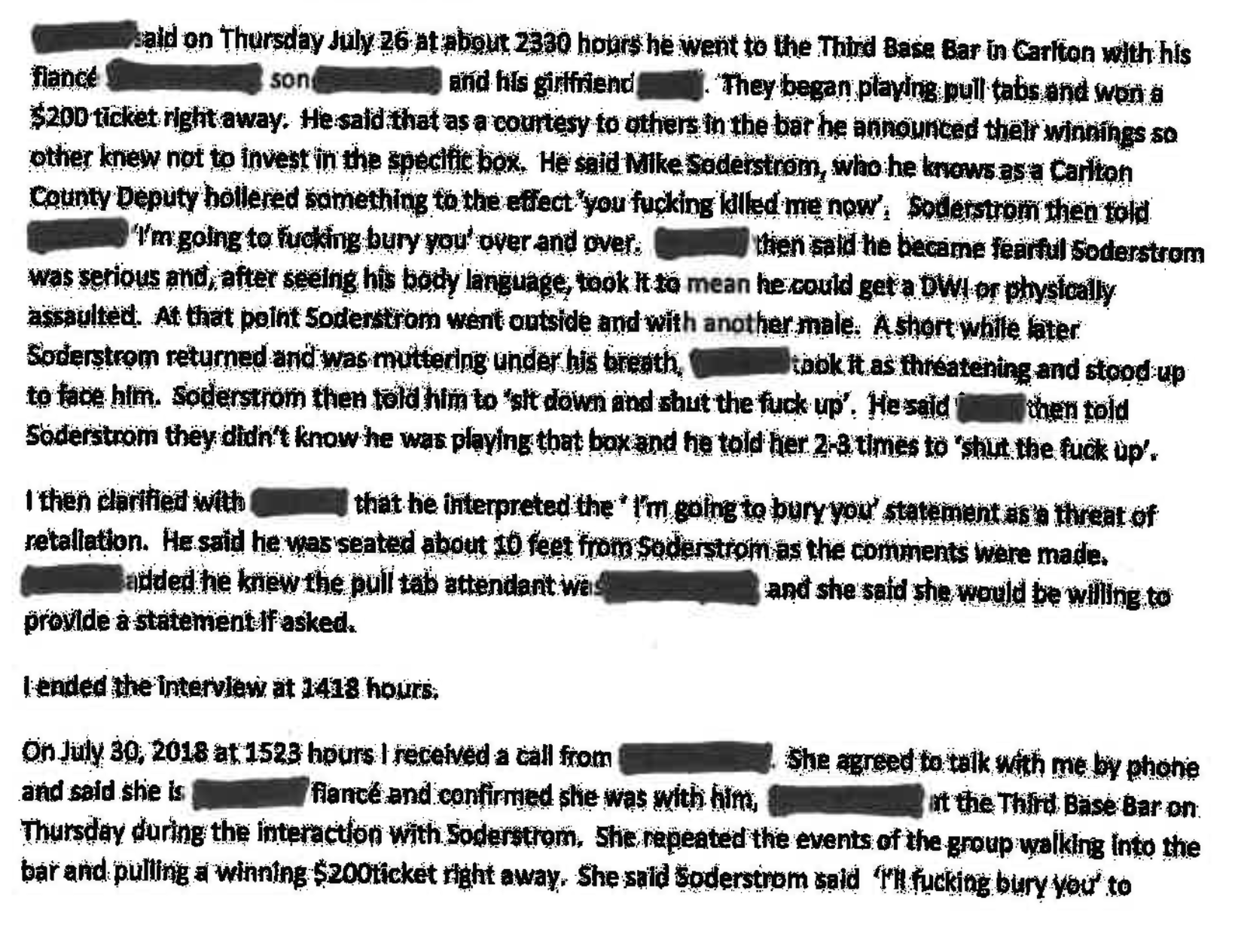
Victims recorded police statement. July 27, 2018. Source: Carlton County Sheriff
Multiple witnesses corroborated significant portions of the conduct.
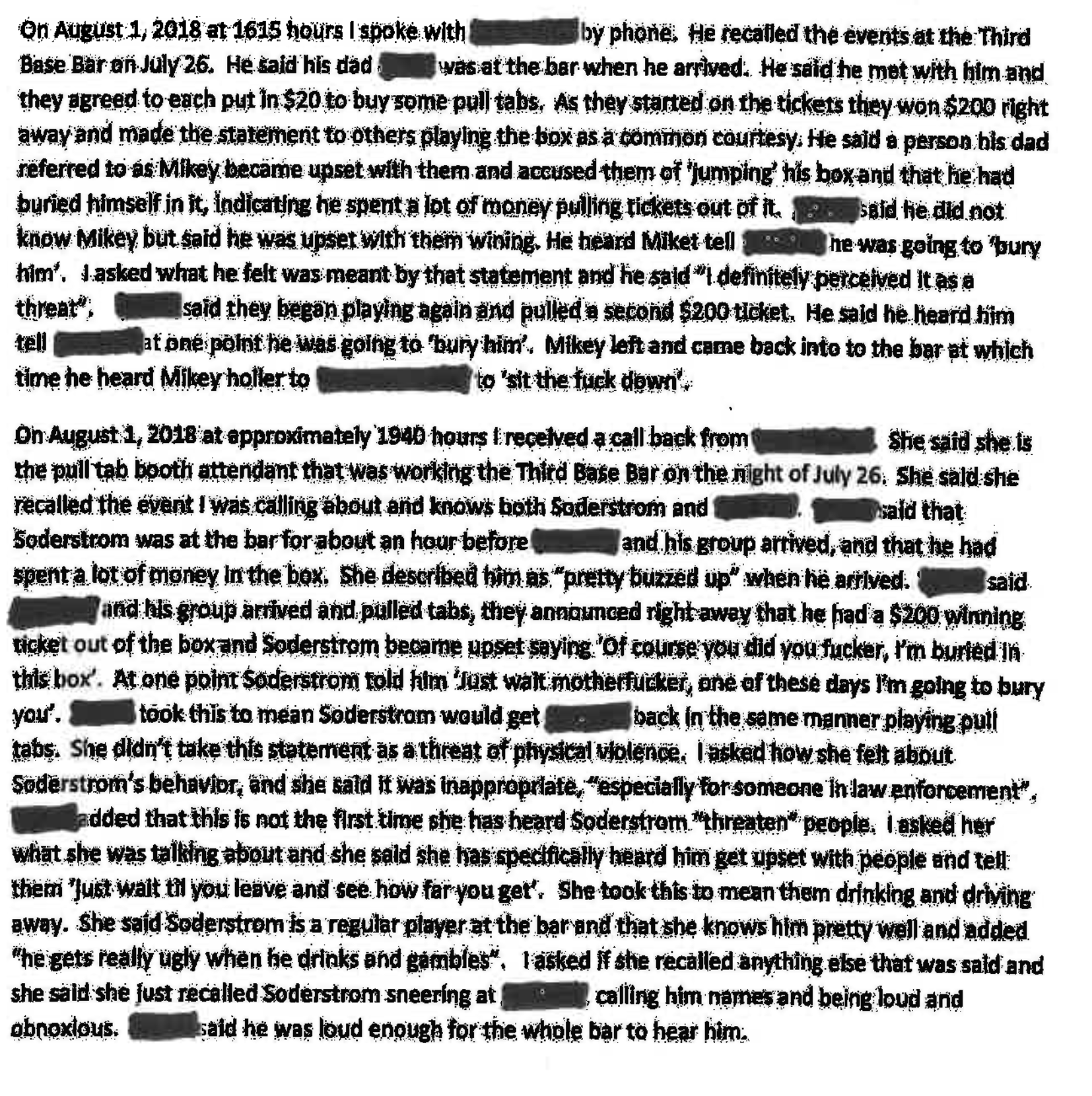
Corroborating witness recorded police statements. August 1, 2018. Source: Carlton County Sheriff
The complainant told investigators that his concern extended beyond the possibility of a physical confrontation. Because Soderstrom was a Carlton County sheriff’s deputy, the complainant feared that Soderstrom could retaliate by using his law-enforcement authority.
The Sheriff’s Office’s written reprimand … the only discipled imposed on [former] Deputy Soderstrom … itself recognized that concern.
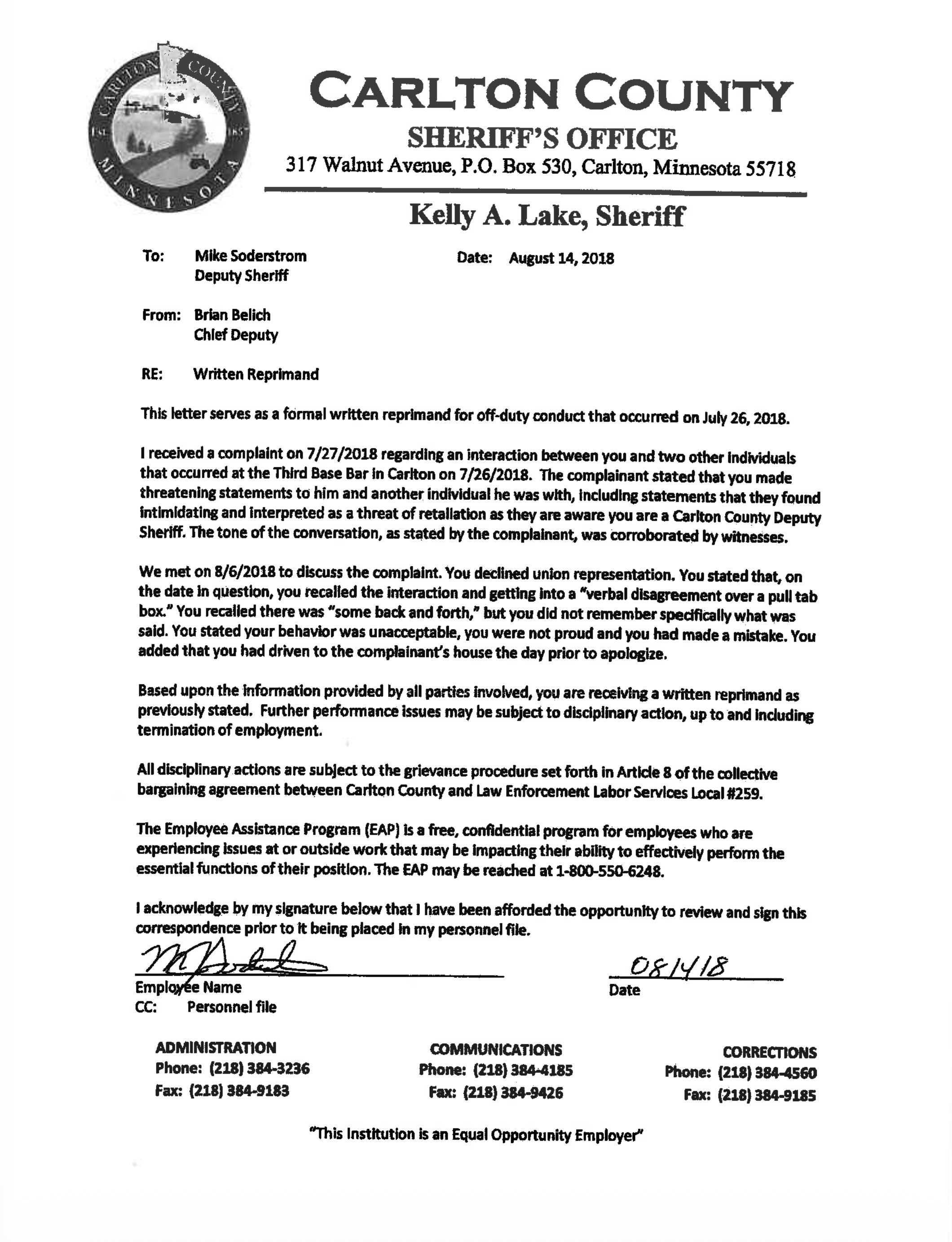
Soderstrom later acknowledged that he had consumed too much alcohol, that his behavior was unacceptable and that he had no reason to question the witnesses’ accounts.
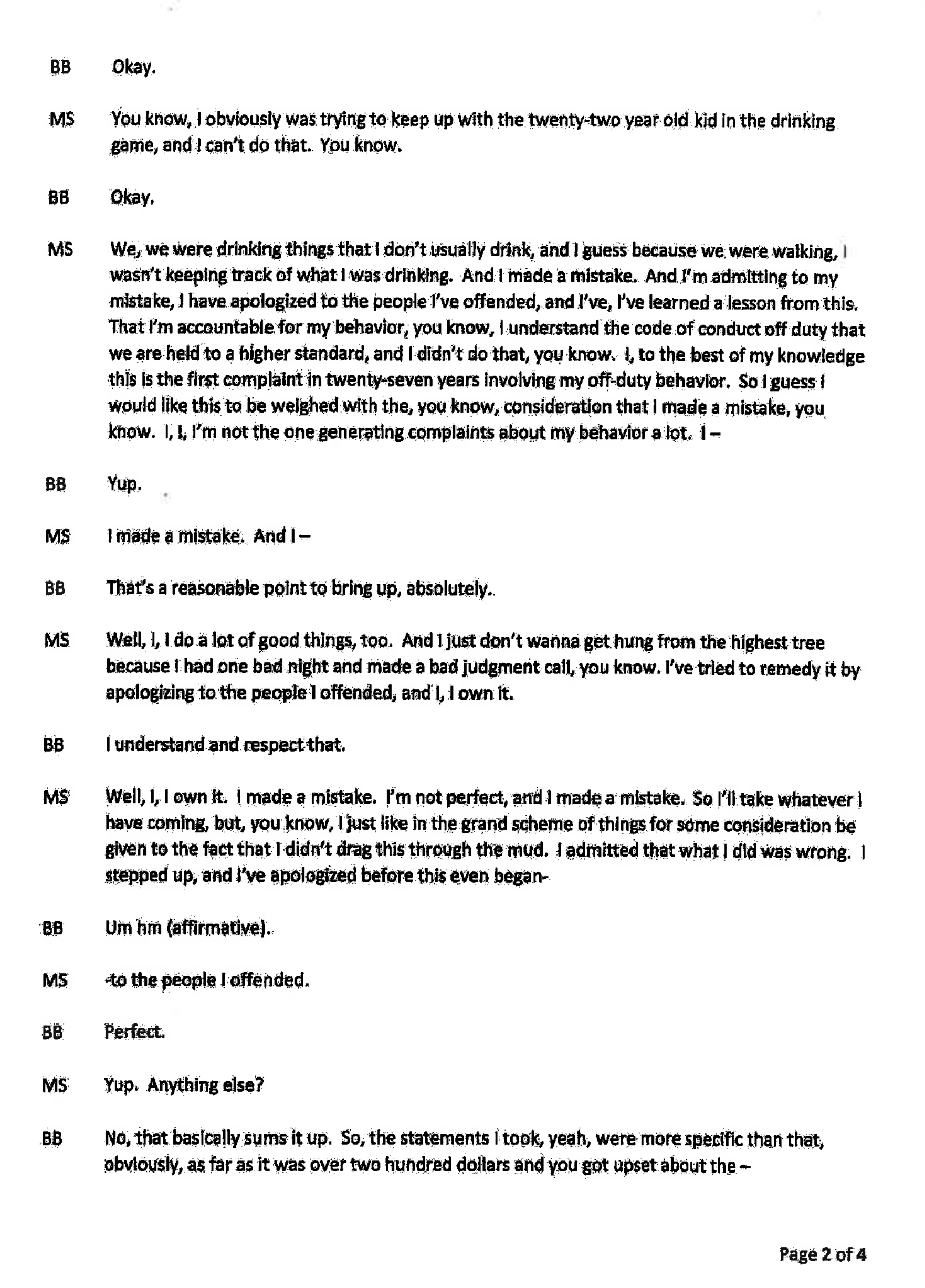
The documented disciplinary outcome … the ONLY discipline … was a written reprimand dated August 14, 2018.
But the disciplinary records produced to Carlton County Watchdid not document whether the incident was separately investigated as possible criminal conduct or referred to a prosecuting authority for review.
That absence did not prove that no criminal referral occurred.
Carlton County Watch said so plainly in its original reporting.
So we asked.
Carlton County Watch Asked a Very Specific Question
On July 29, Carlton County Watch submitted a targeted Minnesota Government Data Practices Act request seeking:
“all public government data documenting whether the July 26, 2018 conduct of [Former] Carlton County Deputy Michael ‘Mike’ Soderstrom was investigated or reviewed as potential criminal conduct.”
This was not a vague request asking the County to search generally for records relating to Soderstrom.
The request identified ten specific categories of government data.
Among them were records of:
Referrals or charging-review requests sent to the Carlton County Attorney’s Office;
Referrals to another prosecutor, the Minnesota Attorney General, Minnesota Bureau of Criminal Apprehension, Minnesota POST Board or another law-enforcement authority;
Communications concerning whether Soderstrom’s conduct might constitute disorderly conduct, threats of violence, assault, harassment or another offense;
Charging-review documents, screening decisions and prosecutorial declinations;
Decisions not to open a criminal investigation or make a criminal referral;
Separate criminal incident reports or case numbers;
Officials involved in deciding whether criminal investigation or referral should occur;
Agencies contacted and the disposition of any review;
Final opinions or adopted justifications explaining why criminal investigation or prosecution was or was not pursued; and
Sheriff’s Office policies governing referrals of suspected criminal conduct by an employee or licensed peace officer.
Carlton County Watch also identified the Sheriff’s Office disciplinary matter number — No. 18030365 — and provided specific search terms including “Mike Soderstrom,” “Third Base Bar,” “bury you,” “criminal referral,” “charging review,” “County Attorney,” “disorderly conduct” and “July 26, 2018.”
The request specifically asked that the records of Sheriff Kelly Lake, Chief Deputy Brian Belich and others involved in the investigation or referral decision be searched.
And importantly, Carlton County Watch expressly addressed the possibility that there might be nothing to produce:
“If no responsive data exist concerning any criminal investigation, prosecutorial consultation, or referral, please confirm that fact in writing.”
The Sheriff’s Office therefore does not need to guess what Carlton County Watch is asking.
The question could hardly be more specific.
What Has Been Produced?
As of August 14, 2026:
Nothing responsive to the July 29 request has been produced to Carlton County Watch.
The only communication received is the July 30 acknowledgment stating that the request had been received and would be processed “in a timely manner.”
Carlton County Watch has not received records showing that a criminal referral occurred.
We have not received records showing that an outside agency investigated the incident.
We have not received records showing that a prosecutor screened the conduct for possible criminal charges.
We have not received a decision explaining why criminal investigation or prosecution was declined.
We have not been told that responsive records are being withheld as nonpublic data.
And we have not been told that no responsive data exist.
The request remains substantively unanswered.
What Minnesota Law Requires
The Minnesota's Data Practices Act requires government entities to respond to actual requests for government data. The Minnesota Commissioner of Administration has repeatedly emphasized the importance of government entities communicating clearly when responsive public data do not exist, when responsive data exist but are classified as nonpublic, or when data can be provided.
If government data are withheld from public inspection, §13.03 also requires the government entity to identify the determination and cite the specific statutory or federal-law authority upon which the denial is based.
Carlton County Watch's request anticipated that possibility as well.
We specifically asked the County, if records were withheld, to identify what was being withheld and cite the statutory authority supporting the decision.
No such determination has been received.
There Are Only a Few Possible Answers
This investigation does not require speculation about what happened in 2018.
The records will tell us.
There are essentially several possible outcomes.
1. A criminal investigation or prosecutorial review occurred.
If so, the responsive government data may show who reviewed Soderstrom’s conduct, what potential offenses were considered, whether an outside agency was involved and what ultimately happened.
That information would provide important context that was absent from the disciplinary packet initially produced to Carlton County Watch.
If such records exist and are public, they should be produced.
2. Responsive records exist, but Carlton County believes some or all of them are not public.
If that is the County's position, Minnesota law provides a mechanism for saying so.
The County can identify the data it is withholding and identify the law supporting that classification.
Carlton County Watch expressly requested exactly that information.
3. No responsive records exist.
That answer would also be important.
It would not, standing alone, prove an illegal cover-up.
It would not prove that Sheriff Lake or another County official deliberately protected Soderstrom.
But it would establish a significant fact:
Carlton County possesses no responsive records documenting the criminal-investigation, prosecutorial-consultation or referral process described in the July 29 request.
And that would create another serious public-accountability question.
Why?
If There Was No Criminal Review, Why Not?
Carlton County's own administrative records did not describe a trivial workplace disagreement.
They documented alleged threatening statements toward members of the public.
Multiple witnesses corroborated significant portions of Soderstrom's conduct.
The complainant reported fear that Soderstrom's status as a law-enforcement officer could be used against him.
Soderstrom acknowledged drinking excessively and behaving unacceptably.
And the Sheriff's Office formally disciplined him — with only a written reprimand.
Whether those facts would ultimately have supported a criminal charge is a legal determination that Carlton County Watch is not making.
The question is whether anyone outside — or even separately within — the administrative disciplinary process was asked to make that determination.
There is an important difference between deciding:
This employee violated departmental standards.
and deciding:
This conduct does or does not warrant criminal investigation or prosecution.
One is an employment decision.
The other involves the criminal-justice system.
When the person accused of misconduct is himself a licensed law-enforcement officer, the distinction becomes particularly important.
Would an Ordinary Citizen Have Been Treated the Same?
There is another question Carlton County residents are entitled to consider.
What would have happened if the person accused of this conduct had not been a Carlton County sheriff’s deputy?
Imagine an ordinary citizen at a Carlton bar being accused of repeatedly threatening another person.
Imagine multiple witnesses corroborating significant portions of the conduct.
Imagine the person targeted by the statements reporting that he was genuinely concerned about what the individual might do.
And imagine the person accused later acknowledging excessive alcohol consumption and admitting that his behavior was unacceptable.
Would the government's response have ended with an employer placing a written reprimand in that citizen's personnel file?

Of course, an ordinary citizen does not have an internal law-enforcement disciplinary process. The question is whether law enforcement would instead have considered opening a criminal investigation, creating an incident report, referring the matter to a prosecutor, or evaluating whether Minnesota criminal statutes applied.
Minnesota law in effect in 2018 included the misdemeanor offense of disorderly conduct, which applied in certain circumstances to offensive, abusive or boisterous conduct or language tending reasonably to cause alarm, anger or resentment. Minn. Stat. §609.72 (2018).
Minnesota law also criminalized certain threats of violence where the statutory elements — including the nature of the threatened conduct and the required intent or reckless disregard — were established. Minn. Stat. §609.713 (2018).
Carlton County Watch is not asserting that Michael Soderstrom necessarily committed either offense.
Nor are we asserting that a prosecutor necessarily would — or should — have charged him.
That determination belongs to law enforcement and prosecutors after applying the law to the evidence.
But all the proper elements seem o be in place.
But was anyone ever asked to make that determination?
That is the question.
And it leads to an uncomfortable but unavoidable issue of equal treatment:
Would the same conduct have been handled the same way if the person accused had carried no badge, worked for no sheriff's office and had no professional connection to the Carlton County criminal-justice system?
If the answer is yes, the government records should help demonstrate that.
If the answer is no, Carlton County residents deserve to know why.
A badge should not provide immunity from criminal scrutiny.
But neither should a badge create a presumption of guilt.
The standard should be the same: investigate the facts, apply the law and document the decision.
That is why Carlton County Watch's unanswered July 29 data request matters.
The issue is no longer merely whether Soderstrom received an appropriate employment sanction.
The issue is whether Carlton County applied the same criminal-justice process to one of its own that it would have applied to everyone else.
And until the Sheriff’s Office produces the records — or confirms that no such records exist — the public has no way of knowing.
Eight Years Later, Investigative Data May Not Simply Disappear Behind the Word “Investigation”
Minnesota law also contains specific provisions governing law-enforcement investigative data.
Under Minn. Stat. §13.82, active criminal investigative data receive significant protection. But inactive criminal investigative data are generally public, subject to statutory exceptions such as circumstances in which disclosure could jeopardize another ongoing investigation or reveal protected identities.
The statute also addresses when investigative data become inactive and provides rules governing access to final decisions and investigative records.
Carlton County Watch does not presently know whether any responsive criminal investigative file ever existed.
That is the very reason the July 29 request was submitted.
But the age of the incident, standing alone, does not answer the question.
Neither does the existence of a personnel investigation.
This Is Not About Re-Litigating a Bar Argument
It would be easy to dismiss an incident from 2018 as old news.
That misses the point.
The question Carlton County Watch is examining is not whether Mike Soderstrom behaved badly during one evening eight years ago.
The Sheriff's Office already investigated his conduct.
Witnesses were interviewed.
Soderstrom was interviewed.
The Sheriff's Office reached findings.
And discipline was imposed — a slap on the wrist written reprimand.
The unanswered institutional question is different:
When a Carlton County sheriff’s deputy was accused of threatening citizens — and the Sheriff's Office itself substantiated conduct serious enough to warrant formal discipline — was the possibility of criminal conduct evaluated independently from the employment investigation?
That is a question about government accountability.
And it remains relevant today.
The Public Should Not Have to Guess
Carlton County Watch is not asking Sheriff Kelly Lake to retry the disciplinary case.
We are not asking the Sheriff’s Office to manufacture records that do not exist.
And we are not presuming that criminal charges should have been filed.
We are asking something much more fundamental:
What did Carlton County do?
If the matter was referred for criminal review, release the public records showing what happened.
If responsive data exist but are legally protected, identify the applicable law.
If no criminal investigation, prosecutorial consultation or referral records exist, say so.
Those are materially different answers.
Any one of them would move the public record forward.
Silence does not.
An Opportunity to Answer
Carlton County Watch believes government officials should have a fair opportunity to explain their actions.
Accordingly, Carlton County Watch is providing Sheriff Kelly Lake and the Carlton County Sheriff’s Office an opportunity to address three straightforward questions:
Does the Sheriff’s Office possess records responsive to Carlton County Watch's July 29, 2026 data request?
Was the July 26, 2018 Soderstrom matter ever referred to a prosecuting authority or outside law-enforcement agency for review as potential criminal conduct?
What is the current status of Carlton County Watch's pending data request?
Any substantive response will be fairly reported.
The Question Remains
Carlton County Watch's original investigation stopped short of claiming that no criminal referral occurred because the disciplinary packet did not establish that fact.
That distinction mattered then.
It matters now.
Rather than speculate, Carlton County Watch requested the government records necessary to determine what actually happened.
The Sheriff’s Office acknowledged that request on July 30.
As of August 14, those records have not been produced.
So the question remains:
Was Mike Soderstrom's conduct ever investigated or referred for criminal review?
If the answer is yes, the public deserves to understand what happened.
If the answer is no, the public deserves to understand why.
And if Carlton County still has not determined what records it can produce, the public deserves to know when that determination will be made.
Accountability begins with an answer.
Document and Response Note
Carlton County Watch's July 29, 2026 Minnesota Government Data Practices Act request and the Carlton County Sheriff's Office's July 30 acknowledgment are preserved as source documents for this investigation.
This article will be updated if responsive government data are produced or if Sheriff Kelly Lake, the Carlton County Sheriff's Office, Michael Soderstrom or another relevant government official provides substantive information concerning the criminal-review question.
Carlton County Watch welcomes corrections, additional public records and documented information that may add material context to this report.