Still “In Process”: Carlton County Attorney Jeffrey Boucher Produces No Records in Assistant County Attorney Amy Voss & Simich Data Request
Carlton County's own policy says data requesters should be told approximately how long production will take. More than two weeks after an extensive public-records request concerning Assistant County Attorney Amy Voss and the dismissal of State v. Leonard Simich, County Attorney Jeffrey Boucher has provided neither records nor a completion estimate.
by Carlton County Watch
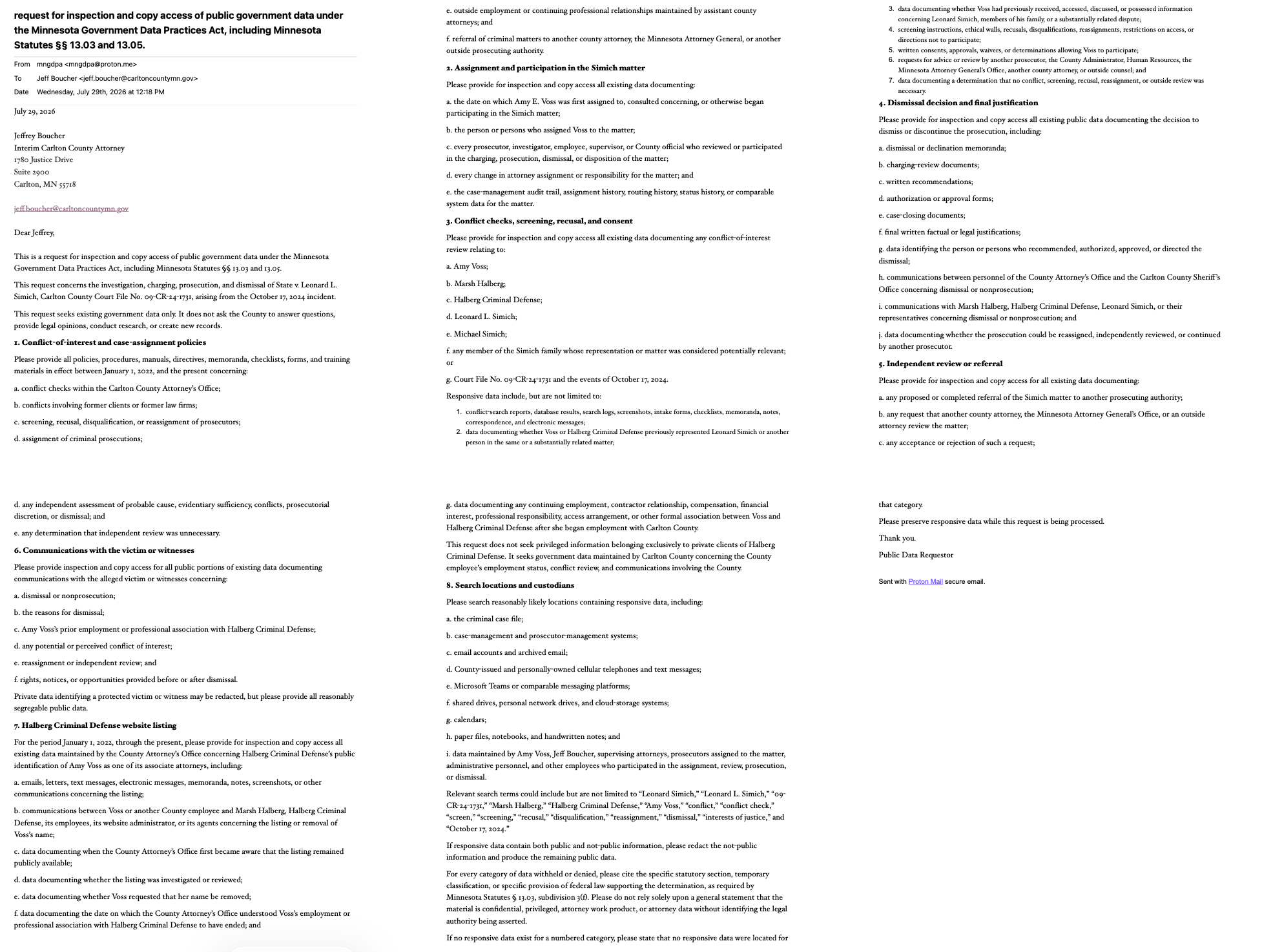
On July 29, 2026, a member of the public submitted a Minnesota Government Data Practices Act request to the Carlton County Attorney's Office seeking public government data concerning one of the most troubling unanswered questions surrounding the prosecution and dismissal of State v. Leonard L. Simich, Court File No. 09-CR-24-1731.
Carlton County Watch has been following and reporting on this issue.
The request concerns Assistant Carlton County Attorney Amy E. Voss, her prior professional relationship with Halberg Criminal Defense, the assignment of Voss to the Simich prosecution, any conflict-of-interest review conducted by Carlton County, and the decision to dismiss the criminal charges against Simich.
The request did not ask County officials to answer questions, conduct research, provide legal opinions, or create new documents.
It asked for existing government data.
Carlton County Attorney Jeffrey Boucher acknowledged receiving the request later that same day.
“I am in receipt of your request for data. We will begin processing the request.”
Sixteen days later, on August 14, Boucher was asked for an update on the request.
His response consisted of one sentence:
“Your request is in process and you will be notified promptly once responsive data is ready.”
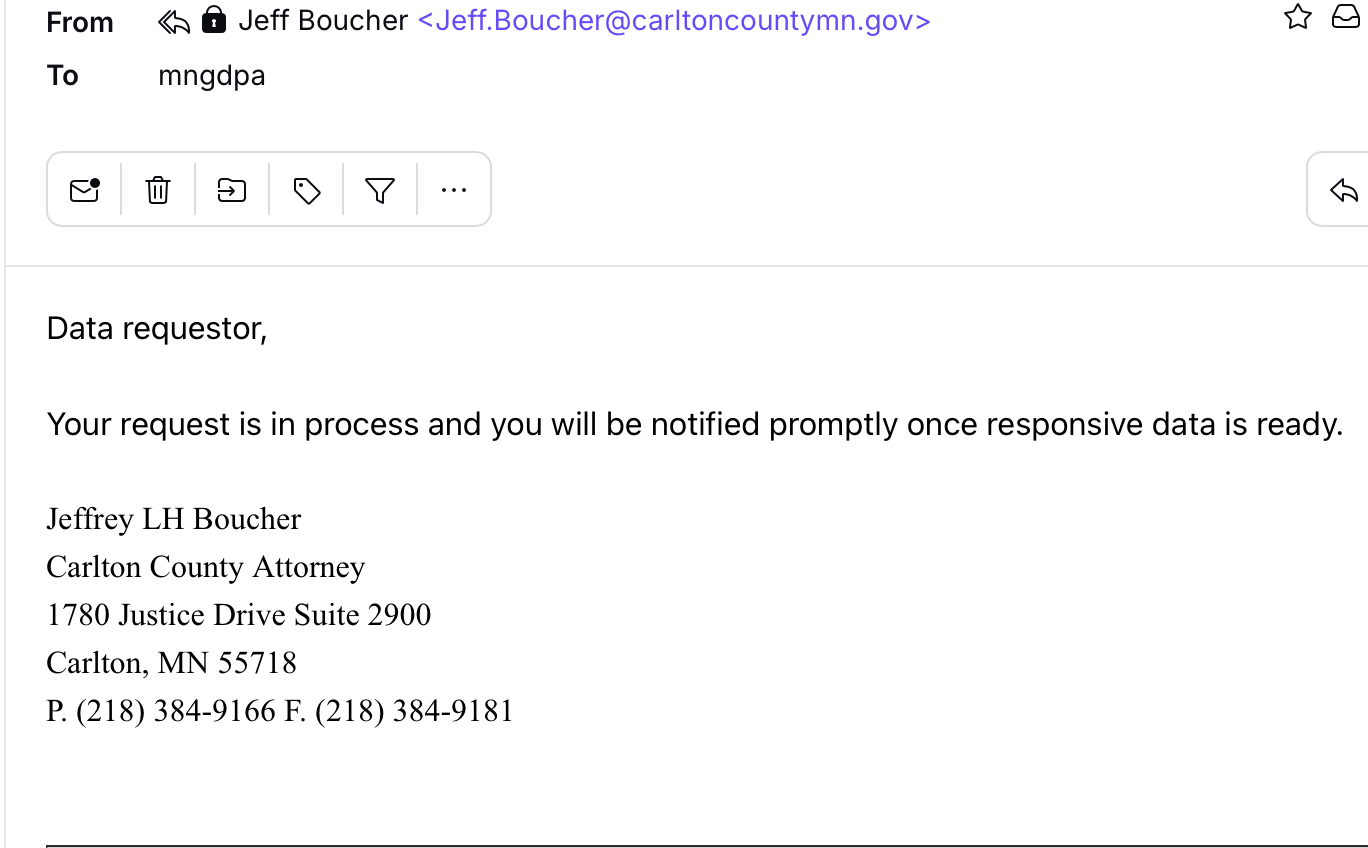
As of August 14, County Attorney Boucher had provided no responsive government data and no approximate date on which the County expected to make the requested public data available.
That raises a new question separate from the underlying Voss controversy:
Is the Carlton County Attorney's Office following Carlton County's own Data Practices Policy?
What Carlton County's own policy says
The answer matters because Carlton County has adopted written procedures governing exactly this situation.
The County's current Data Practices Policy states that copies of public data must be provided at the time of the request or “as soon as reasonably possible.”
But the policy goes further.
Under the section entitled “Procedures for Providing Data,” Carlton County instructs its responsible authority or designee to acknowledge receipt of the request and:
“indicate approximately how long it will take to provide the data.”
Page 8, Section VI (D).

The very next provision directs County personnel to allow a requester to inspect any available public data to which the requester has access.
Boucher's July 29 acknowledgment did not provide an approximate completion time.
His August 14 response did not provide one either.
It simply said the request remained “in process.”
That may describe the status of the request.
It does not answer when the County expects to provide the data.
And it does not explain why any responsive public data that may already have been located cannot be made available while other portions of the request continue to be reviewed.
What the law actually requires
Minnesota Statutes § 13.03 requires government entities to establish procedures ensuring that requests for government data are received and complied with in an “appropriate and prompt manner.” The statute also provides that public government data may be inspected and copied and that copies which cannot be provided when requested must be supplied “as soon as reasonably possible.”
Minnesota's Commissioner of Administration has repeatedly explained that there is no single numerical deadline governing every public-data request. Whether a response is appropriate, prompt and reasonable depends upon circumstances including the nature and complexity of the request and the amount of responsive data involved.
That distinction is important.
The July 29 request is not a one-line request for a single document. Some portions could require searches of email accounts, case-management systems, archived communications, shared drives, calendars, electronic messaging systems and records maintained by multiple County employees.
Those searches may legitimately take time.
But complexity does not make accountability disappear.
Nor does it explain why the County has provided no approximate timetable when its own policy specifically directs County personnel to provide one.
What exactly was requested?
The July 29 request was divided into eight categories.
Among other things, the data request sought the County Attorney's Office's policies governing:
conflict checks;
conflicts involving former clients or former law firms;
prosecutorial screening, recusal and disqualification;
assignment of criminal prosecutions;
outside employment or continuing professional relationships maintained by assistant county attorneys; and
referral of criminal matters to another prosecuting authority.
Those are not questions about the merits of a particular defendant.
They are requests for the rules governing the County Attorney's own office.
The data request also sought inspection access to records documenting when Voss became involved in the Simich prosecution, who assigned her, which prosecutors or supervisors participated in the case, and the case-management assignment and routing history.
Another category sought any existing conflict review concerning Voss, Marsh Halberg, Halberg Criminal Defense, Leonard Simich and the criminal proceeding itself.
That includes conflict-search reports, screening records, recusals, ethical walls, reassignment records, written approvals, requests for independent review and any determination that no conflict review or reassignment was necessary.
The request also sought existing public government data documenting the decision to dismiss the prosecution — including dismissal memoranda, written recommendations, case-closing records, final factual or legal justifications and data identifying who recommended, approved or directed the dismissal.
It specifically sought communications concerning dismissal between the County Attorney's Office and the Sheriff's Office, as well as communications with Marsh Halberg, Halberg Criminal Defense, Leonard Simich or their representatives.
And it asked a particularly important question through government records:
Was the Simich prosecution ever independently reviewed or considered for referral to another prosecuting authority?
Those records either exist or they do not.
Why these records matter
The significance is not merely that a prosecutor previously worked in criminal defense. Former defense attorneys routinely become prosecutors, just as former prosecutors routinely become defense attorneys.
The issue is the relationship between the attorneys involved in this particular prosecution.
Carlton County Watch previously reported that Marsh Halberg represented Leonard Simich and that Voss had worked at Halberg Criminal Defense before becoming an Assistant Carlton County Attorney. A preserved Halberg webpage from June 2026 continued to publicly identify Voss as associated with the firm's legal team.
Amy Voss occupies another unusual position
Carlton County's own Data Practices Policy adds another layer to the story.
The current policy identifies Jeffrey Boucher as the Responsible Authority for the County Attorney's Office.
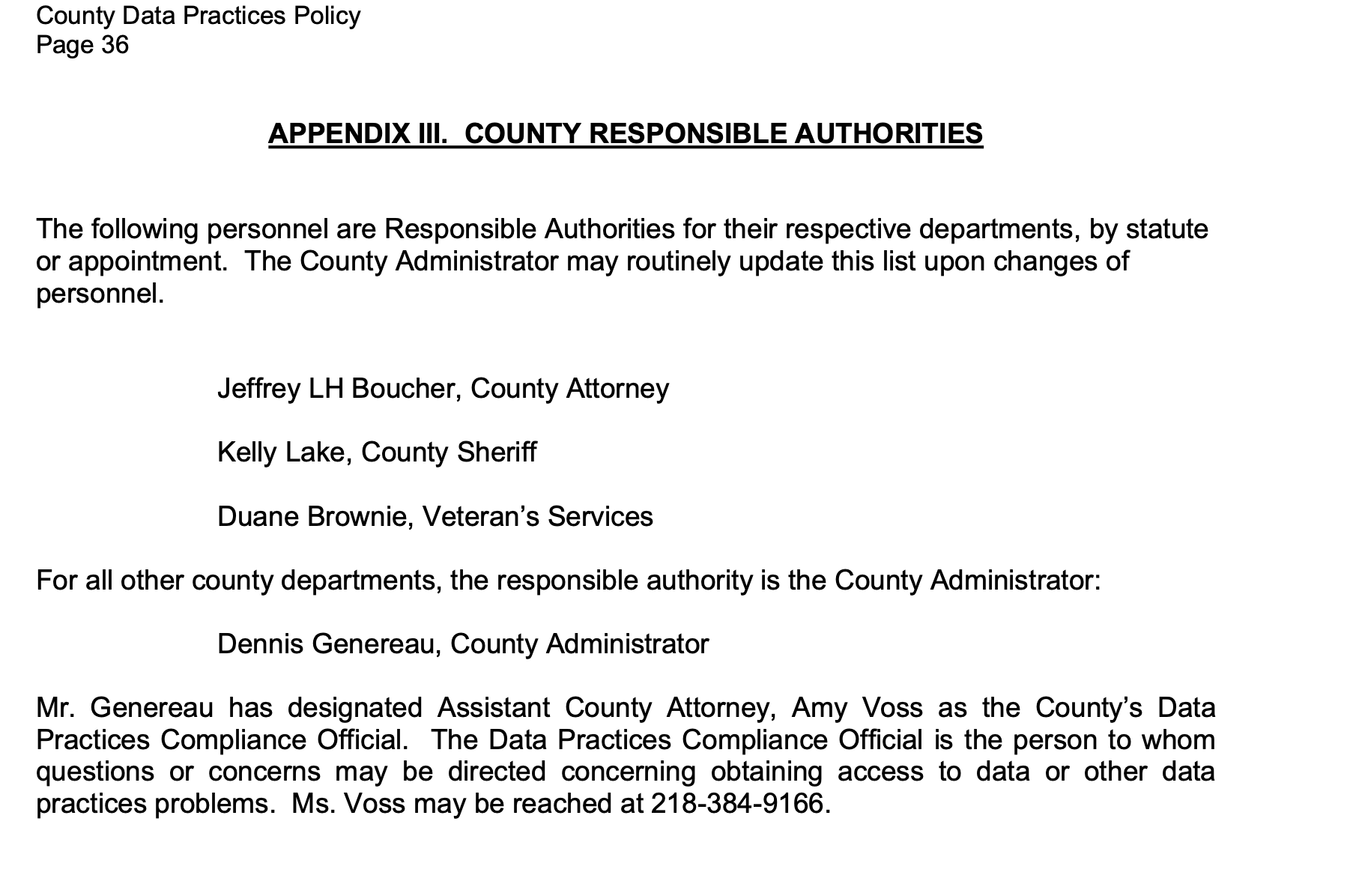
But the policy also identifies Assistant County Attorney Amy Voss as Carlton County's Data Practices Compliance Official — the official to whom questions or concerns regarding access to data and other data-practices problems may be directed.
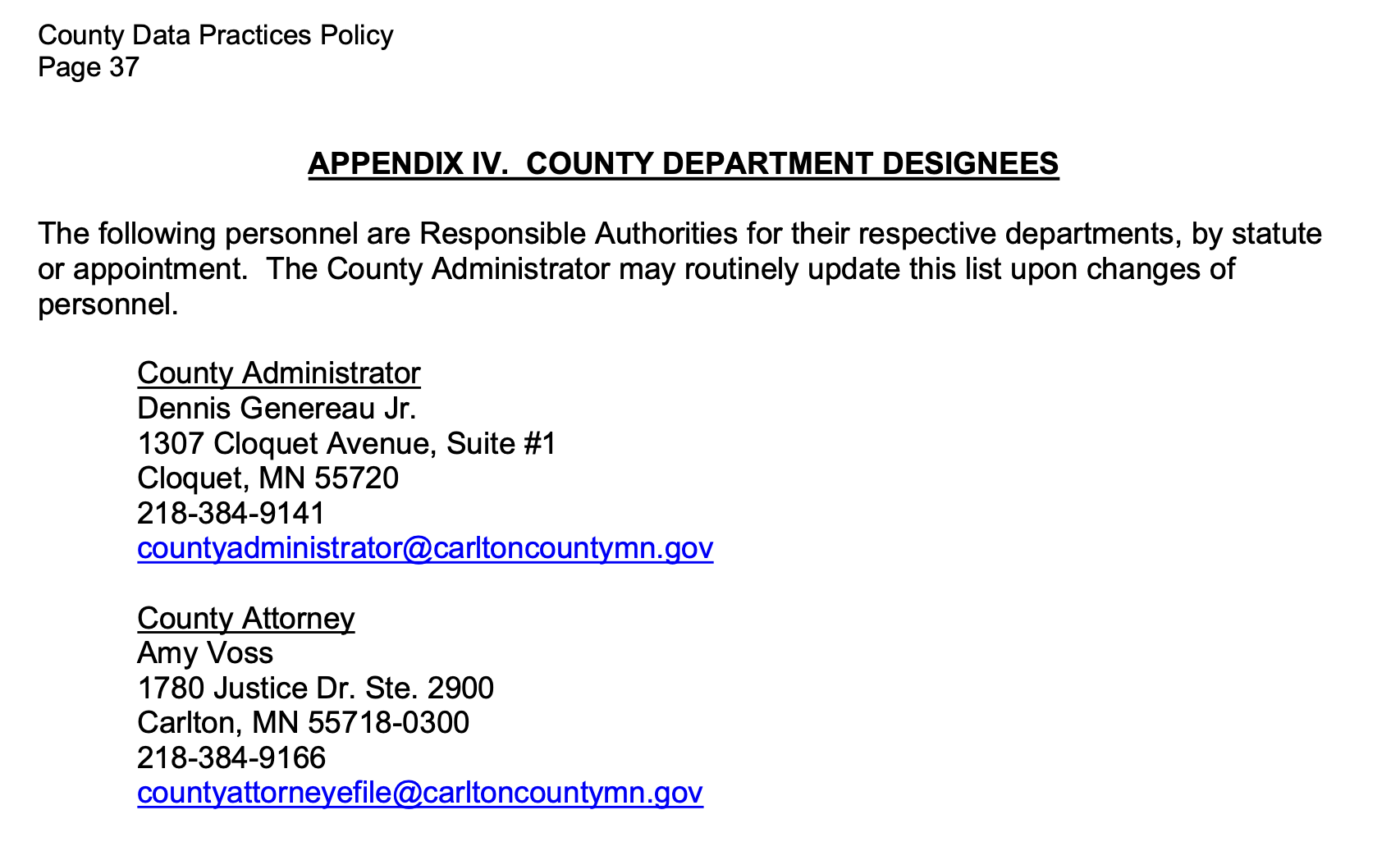
The County's appendix of department designees additionally lists Voss under the County Attorney's Office.
That creates an obvious procedural question.
Who is handling the search, review and classification of a government-data request that concerns Amy Voss herself?
Carlton County Watch is not alleging that Voss is personally processing this request. We presently have no evidence establishing that.
But because the County identifies Voss as its Data Practices Compliance Official, the public has a legitimate interest in knowing whether she has been screened from any role in locating, reviewing, classifying, redacting or producing government data concerning her own conduct or employment history.
That question can be answered easily.
So far, it has not been.
Minnesota precedent emphasizes communication
Minnesota administrative decisions also demonstrate why meaningful communication matters when a data request takes time.
In Advisory Opinion 19-010, the Commissioner discussed an earlier request that legitimately required substantial time. What helped make that response reasonable was not simply the complexity of the request. The government entity remained in continual communication with the requester, supplied estimates and provided information allowing the requester and government to work through the production.
That presents a useful comparison.
Carlton County has not explained that thousands of records were located.
It has not said additional custodians need to be searched.
It has not identified categories requiring extensive legal review.
It has not provided an estimated completion date.
It has not announced that some portions are ready for inspection while others remain under review.
Its substantive explanation as of August 14 consists of this:
“Your request is in process.”
The Minnesota Supreme Court has likewise emphasized that § 13.03 requires government entities not merely to have procedures on paper, but procedures that actually ensure government data are made available appropriately and promptly. The Commissioner quoted that principle from Webster v. Hennepin County in a 2019 advisory opinion.
Carlton County has a written procedure.
The public is entitled to ask whether Carlton County is following it.
There is an election dimension
This issue also arises at a consequential moment for the Carlton County Attorney's Office.
Jeffrey Boucher did not originally enter the County Attorney's position through election to the current term.
Carlton County Board minutes show that commissioners voted in July 2025 to appoint then-Chief Deputy County Attorney Jeffrey Boucher as County Attorney effective September 29, 2025, upon the resignation of the existing County Attorney.
Boucher is now seeking the office through the electoral process.
Official 2026 candidate-filing records from the Minnesota Secretary of State list Jeffrey Boucher as a candidate for Carlton County Attorney, with a May 19, 2026 filing date.
Carlton County Watch does not suggest that Boucher's candidacy explains the delay in responding to this request. There is presently no evidence establishing such a connection.
But the election makes transparency more — not less — important.
Voters are entitled to evaluate how the person seeking to serve as their elected County Attorney administers the office, responds to public-records requests, addresses potential conflicts of interest and handles questions concerning prosecutorial accountability.
Those are legitimate matters of public concern.
Your VOTE matters!
The unanswered questions remain
Carlton County Watch believes Boucher should provide straightforward answers to several procedural questions while the request is being processed:
Approximately when does the County Attorney's Office expect to complete the July 29 request?
Why has the County not provided that approximate timeframe as directed by its own Data Practices Policy?
Have any responsive public records already been identified that could presently be made available for inspection?
Which portions of the request, if any, are causing substantial delay?
Is Amy Voss participating in locating, reviewing, classifying, redacting or producing records responsive to a request concerning herself?
None of those questions requires the County Attorney to disclose legitimately protected information.
They concern administration of a public-data request.
“In process” cannot be the end of the conversation
Carlton County Watch recognizes that government-data requests vary enormously.
Some can be fulfilled in minutes.
Others require significant searches, legal review and redaction.
A responsible watchdog should acknowledge that reality.
But the flexibility built into the Minnesota Government Data Practices Act cannot mean that “in process” becomes an indefinite answer — particularly when the government's own policy calls for requesters to be told approximately how long production will take.
This request concerns the exercise of prosecutorial power.
It concerns the dismissal of a criminal prosecution.
It concerns whether a prosecutor's former professional relationship with the defendant's attorney was identified, reviewed, screened or independently evaluated.
And now it concerns how the County Attorney's Office itself responds when citizens use Minnesota law to request the government records capable of answering those questions.
Carlton County Watch is not asking readers to assume what those records will show.
We are asking Carlton County to show the records that are public.
If a conflict review occurred, show the public records documenting it.
If Voss was screened or cleared to participate, produce whatever public government data document that determination.
If another prosecutor independently reviewed the dismissal, show the public records demonstrating that review.
If no responsive data exist in a particular category, say so.
If records are legally protected from disclosure, identify the statutory authority supporting that determination, as Minnesota law requires when access is denied. Minnesota Statutes § 13.03, subdivision 3(f), requires the responsible authority or designee denying access to identify the specific legal basis for doing so.
And if the request genuinely requires additional time, tell the public approximately how much time.
That last requirement does not come from Carlton County Watch.
It comes from Carlton County's own policy.
The underlying Voss-Simich controversy has always presented a simple choice.
The government can answer legitimate questions with records.
Or the unanswered questions can continue.
As of August 14, 2026, Carlton County has chosen to tell the requester only that the records are still:
“in process.”
Carlton County Watch will continue following the paper trail.