“Don't Rely on Social Media”: Carlton County Administrator Dennis Genereau Responds to County’s 2050 Plan Concerns — But the County's Own Documents Raise the Questions
Six days after Carlton County officials reviewed a draft 2050 Comprehensive Plan showing future commercial development at the I-35 and County Road 4 interchange near Mahtowa, County Administrator Dennis Genereau publicly sought to calm concerns. His message: development there may never happen — and residents should not rely on social media for information about County government. Good thing we have the County’s own documents.
You can read the original article here.
A popular Government, without popular information, or the means of acquiring it, is but a prologue to a farce or a tragedy; or, perhaps, both. Knowledge will forever govern ignorance; and a people who mean to be their own governors must arm themselves with the power which knowledge gives."
Letter from James Madison to W. T. Barry (Aug. 4, 1822), in 3 Letters and Other Writings of James Madison 276, 276 (Philadelphia, J. B. Lippincott Co. 1865).
The problem?
The questions did not originate with social media. They originated with Carlton County's own planning documents.
During the August 11, 2026 regular meeting of the Carlton County Board of Commissioners, County Administrator Dennis Genereau took several minutes to address public concerns surrounding the County's developing 2050 Comprehensive Plan.
His remarks begin roughly nine minutes into the County's publicly available meeting video. The County uploaded the August 11 meeting recording the same day and identifies it as the Board of Commissioners' Regular Session.
According to Genereau, Commissioner Susan Zmyslony had asked him to address the issue publicly.
Carlton County District 4 Commissioner Sue Zymslony. Source: Carlton County website. 2026.
What followed was perhaps the clearest statement yet from Carlton County government regarding what officials currently envision for development along Interstate 35.
And it also raised some new questions.
“It Will Not Be Developed in My Lifetime”
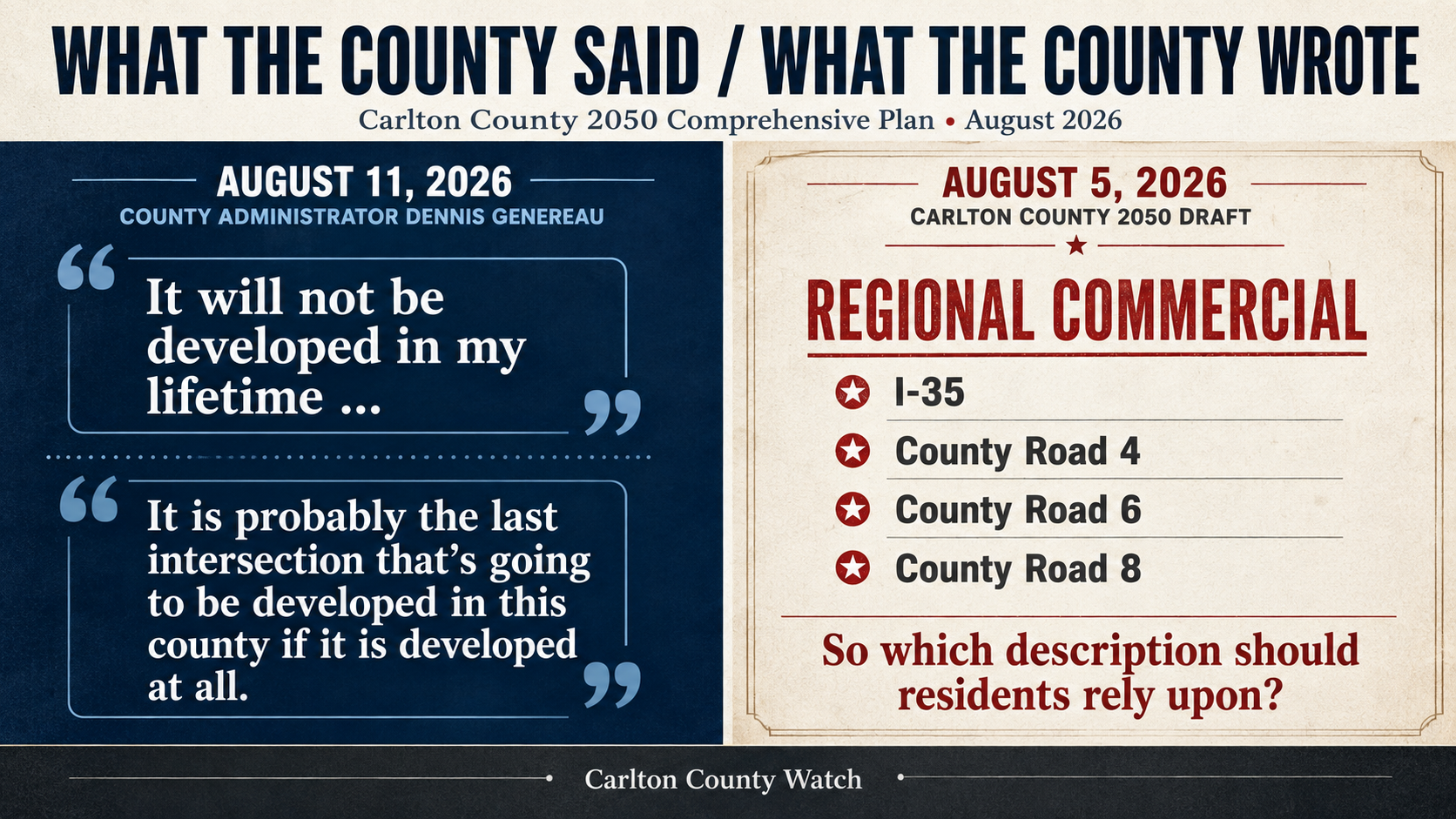
Addressing concerns regarding the I-35 and County Road 4 interchange near Mahtowa, Genereau offered an extraordinary prediction:
“It will not be developed in my lifetime ... even if I live to be 105 years old like my grandma.”
Genereau explained that the County's nearer-term development focus would instead involve existing Interstate access around Carlton, Cloquet and Moose Lake, followed by areas around the Esko and Barnum interchanges.
Then came an even stronger statement concerning County Road 4:
“It is probably the last intersection that's going to be developed in this county if it is developed at all.”
Those are significant statements.
If that is Carlton County's official planning position, residents near Mahtowa may understandably find some reassurance in them.
But those statements also raise a very simple question:
Where is that development priority written in the proposed 2050 Plan?
Because Carlton County's own August 5 planning materials say something considerably more complicated.
What Carlton County's Own Plan Actually Says
On August 5, the Board of Commissioners and Planning Commission met in special session specifically to review the draft Vision Statement, Goals and Preliminary Land Use Plan for the Carlton County 2050 Comprehensive Plan. County documents describe the Preliminary Land Use Plan as identifying high-level policies intended to guide future land uses and long-term investment. The County also makes clear that the document remains a draft that will continue to be refined.
That distinction matters.
The map is not a bulldozer schedule. It does not mean a shopping center will be built at County Road 4 next year — or even ten years from now.
But neither is the map meaningless.
The County's draft says its future land-use categories will form the basis for development review and approval and help guide future zoning amendments needed to implement the eventual plan.
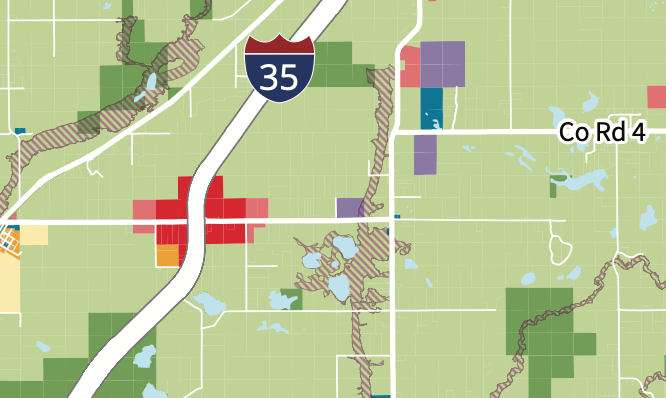
And under “Regional Commercial,” the draft specifically describes large-scale, automobile-oriented uses such as retailers, national restaurant chains, hotels and gas stations. It then identifies transportation corridors including I-35 and County Roads 4, 6 and 8 as locations where those uses should be concentrated.
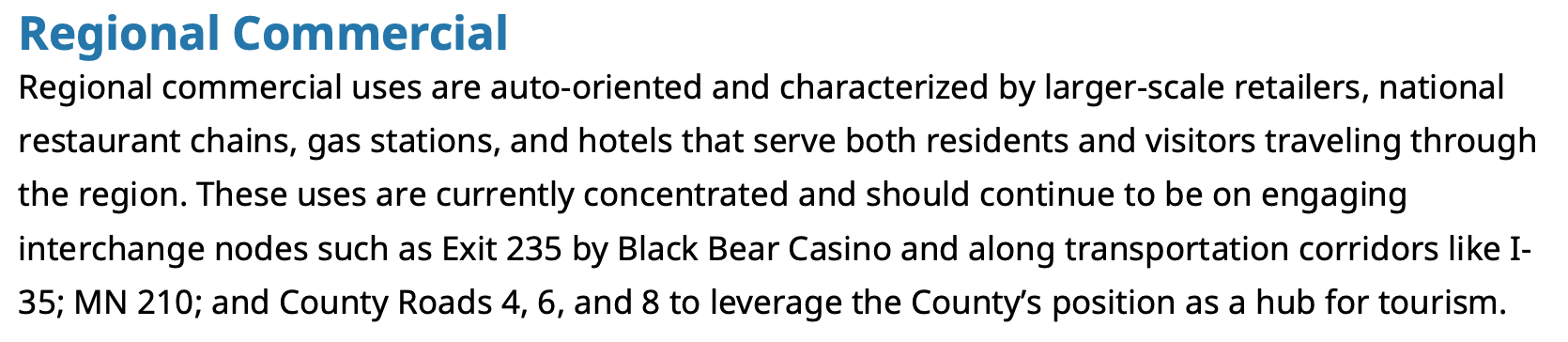
County Road 4 did not accidentally appear in a Facebook post or other social media platforms.
County Road 4 appears in the officially published Carlton County planning document.
The draft additionally identifies Mahtowa as one of the unincorporated rural centers targeted for mixed-use development.
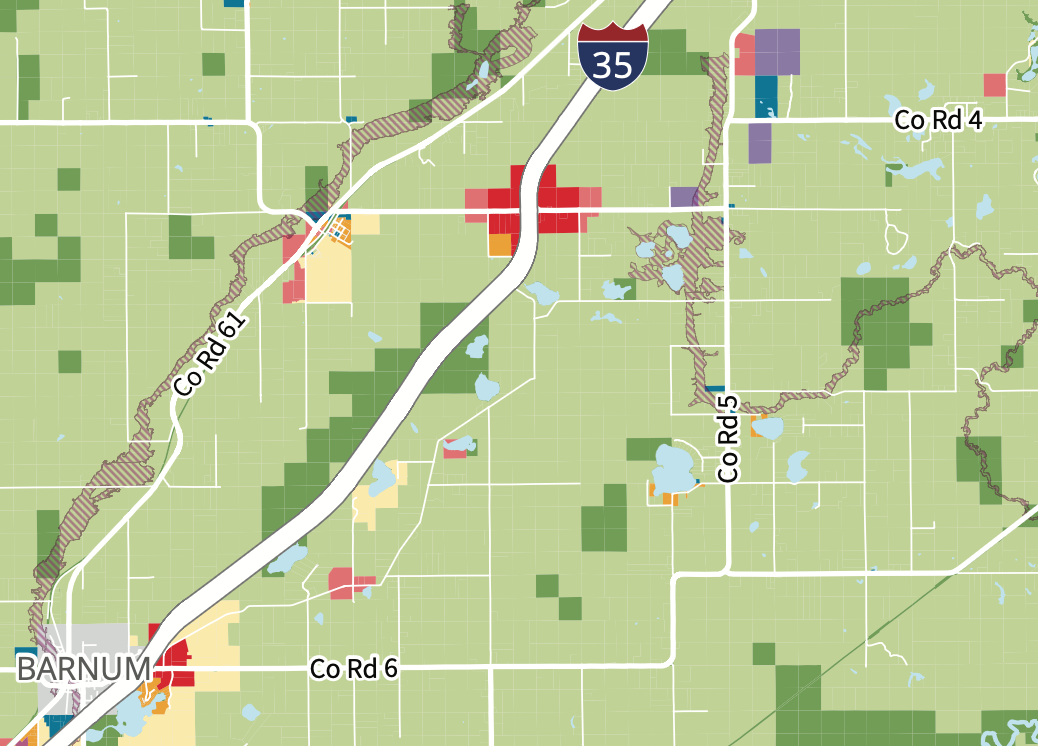
And the Preliminary Future Land Use Map itself depicts a conspicuous Regional Commercial area at the I-35/County Road 4 interchange. The legend identifies Regional Commercial in red, and that designation appears around the interchange.
Again: this does not mean development is imminent.
But it certainly gives residents a legitimate reason to ask questions.
The Plan Calls I-35 a “Magnet for Growth”
There is more.
The draft contains an entire section entitled “Interstate 35 Development Corridor.”
In that section, Carlton County's consultant describes I-35 as a “magnet for growth” that has attracted commercial and industrial development around high-traffic interchanges. The draft then discusses the challenge of strategically developing interstate nodes so travelers will stop and invest in Carlton County rather than simply pass through it.
That makes Genereau's August 11 explanation particularly important.
If Carlton, Cloquet and Moose Lake come first; Esko and Barnum come next; and County Road 4 is so remote in the County's development hierarchy that it may never be developed at all, then residents deserve to know:
Why isn't that sequencing clearly stated in the Plan?
If County Road 4 is merely a theoretical long-range possibility, say so.
If no significant Regional Commercial development is actually envisioned there through 2050, revise the map.
If the red Regional Commercial designation remains intentional, explain precisely what the designation means and what it does not mean.
That is what transparency looks like.
“Don't Rely on Social Media”
Genereau then turned from land-use planning to how residents should obtain information about their government.
His remarks were pointed:
“If people have questions do not rely on social media to get answers to those questions with respect to the work that we are doing as a county government.”
He continued:
“Social media in my experience just doesn't get a lot of things right.”
And then:
“Don't rely on social media. Call me instead. Contact your county commissioners.”
Carlton County Watch agrees with one portion of that message.
Residents should go to the source.
So that is exactly what we did.
We read Carlton County's agenda packet.
We examined Carlton County's Preliminary Future Land Use Map.
We watched Carlton County's public meetings.
And those government records — not rumor — are precisely what generated the questions.
There is also a larger problem with dismissing public concern as a product of “social media.”
Public discussion is not an obstacle to comprehensive planning.
Public discussion is supposed to be part of comprehensive planning.
When Carlton County began this process, the County's own materials described a planning effort involving substantial public engagement and a robust public-communication process.
Residents examining a government map, sharing it with their neighbors and questioning their elected officials is not a malfunction of democracy.
It is democracy.
An Unadvertised Response at the August 11 Meeting
There is another interesting aspect of Genereau's remarks.
The published August 11 agenda does not identify the 2050 Comprehensive Plan, Mahtowa, County Road 4 or public concerns about the plan as a separate agenda item.
The first page identifies the meeting as a regular session and lists approval of the agenda and a visitor regarding a different road-intersection issue. The remainder of the published agenda includes zoning applications, transportation business, administrative matters, budget presentations, commissioner comments and correspondence — but no identified 2050 Plan discussion. The uploaded County packet reflects the same agenda.
That is noteworthy from a transparency perspective.
Residents consulting the County's published agenda before the meeting would have had little reason to know that the County Administrator planned to make a substantial public statement addressing concerns about the 2050 Comprehensive Plan.
But Carlton County Watch is not presently alleging that this fact, standing alone, violated Minnesota's Open Meeting Law.
Minnesota law draws an important distinction between regular and special meetings. For regular meetings, the principal statutory notice requirement is that the public body maintain a schedule of its regular meetings. The Minnesota Data Practices Office specifically explains that the OML generally does not require an agenda for a regular meeting.
An official Minnesota advisory opinion has likewise explained that public bodies may add or remove subjects at a regular meeting, whereas special meetings are confined to the purposes identified in their notices.
So the stronger question here is not presently “Did Carlton County violate the Open Meeting Law?”
It is:
If Carlton County wanted the public to hear this response, why wasn't the subject identified on the agenda so interested residents would know it was coming?
Legal compliance is the floor.
Transparency should be the goal.
One Open Meeting Law Question Remains Worth Investigating
There is, however, another question that Carlton County Watch believes is worth examining.
Genereau stated that Commissioner Zmyslony asked him to make the presentation.
There is nothing inherently improper about one commissioner asking the County Administrator to address an issue.
But it would be useful to know
when the request was made;
how it was made;
who participated in the discussion;
whether talking points were circulated among commissioners; and
whether any agreement or collective discussion about the County's response occurred before the August 11 public meeting.
(Carlton County Watch invites Genereau or the County Board to voluntarily provide answers to these questions.)
Minnesota's Open Meeting Law applies when a quorum of a governing body gathers to discuss, decide or receive information regarding official business, and Minnesota authorities have cautioned against using serial communications involving less than a quorum at a time as a method of avoiding public deliberation.
Carlton County Watch presently has no evidence that happened here.
But the records can answer the question.
And Carlton County Watch intends to keep asking questions based upon records rather than speculation.
The County's Response Proves Why Public Scrutiny Matters
There is a larger lesson in what happened between August 5 and August 11.
On August 5, Carlton County officials publicly reviewed a long-range planning document.
Residents examined it.
Residents discussed it.
Residents raised concerns.
Six days later, the County Administrator devoted several minutes of a Board meeting to explaining the County's intentions.
That is not a reason to discourage public discussion.
It is evidence that public participation works.
Perhaps Genereau's August 11 explanation will ultimately result in a revised map or clearer language.
Perhaps the County Road 4 designation will remain.
Perhaps the County will explain why Regional Commercial is appropriate on the map even though County leadership believes development there is exceedingly unlikely.
Whatever the answer, Carlton County residents are entitled to hear it.
And the answer should not depend upon whether they know which administrator to telephone.
It should be written clearly enough in the public plan that every resident can understand it.
Carlton County Watch Will Continue Reading the Documents
Genereau encouraged residents to contact County officials rather than rely upon social media.
We encourage residents to do that too.
But we encourage something else:
Read the records.
Read the agendas.
Read the plans.
Look at the maps.
Watch the meetings.
Ask questions.
And when a government official's verbal explanation appears materially different from what residents reasonably understand from a government planning document, ask the government to reconcile the two.
That is not misinformation.
That is accountability.
And that is precisely what an engaged public is supposed to do.
“DON'T RELY ON SOCIAL MEDIA.”
WE DIDN'T! WE READ CARLTON COUNTY'S PLAN.
GOOD THING WE HAVE THE COUNTY'S OWN DOCUMENTS.