Open to the Public — If You Can Get Off Work
Carlton County Talks About Public Engagement. But Are Its Residents Given a Realistic Opportunity to Participate?
by Carlton County Watch
The reaction to Carlton County Watch's recent examination of the Carlton County 2050 Comprehensive Plan has been substantial.
Residents have expressed opinions about future commercial development, preservation of rural land, the proposed future land-use map, and the direction Carlton County may take over the next quarter-century.
But another concern has appeared repeatedly.
Why didn't we know about this?
It is a deceptively important question.
Carlton County may post agendas. Notices may be published. Meetings may technically be open to the public. Information may appear somewhere on a government website.
But there is an enormous difference between making information legally available and actually engaging the public.
And perhaps it is time Carlton County had that conversation.
Public Notice Is Not the Same Thing as Public Engagement
Nobody should suggest that Carlton County conducts its meetings in secret.
The County maintains an agenda center, publishes a Board calendar, makes agendas available before meetings and provides live (without community interaction functions) and recorded video of County Board proceedings.
Those are important services.
But consider how the average Carlton County resident actually lives.
People work.
They raise children.
They operate farms and businesses.
They commute.
Some residents live many miles from Carlton.
Some residents do not routinely visit the County government's website.
Others may not subscribe to a newspaper in which a government notice appears.
And rural Minnesota still faces a very real digital-access divide. As of December 2025, Minnesota's Office of Broadband Development reported that while 92.11 percent of households statewide had access to broadband meeting the state's 100/20 Mbps goal, the figure for non-metro Minnesota was only 80.97 percent.
Carlton County itself has been the subject of state-supported broadband expansion. One such project was designed to extend fiber service to 503 households and businesses in Barnum, Eagle Lake, Lakeview and Moose Lake townships.
In other words, treating a government website as the principal doorway to civic participation presents an obvious problem in a rural county.
Posting information somewhere is not necessarily the same as putting that information in front of the people whose property, taxes and communities may ultimately be affected by it.
Then There Is the Meeting Schedule
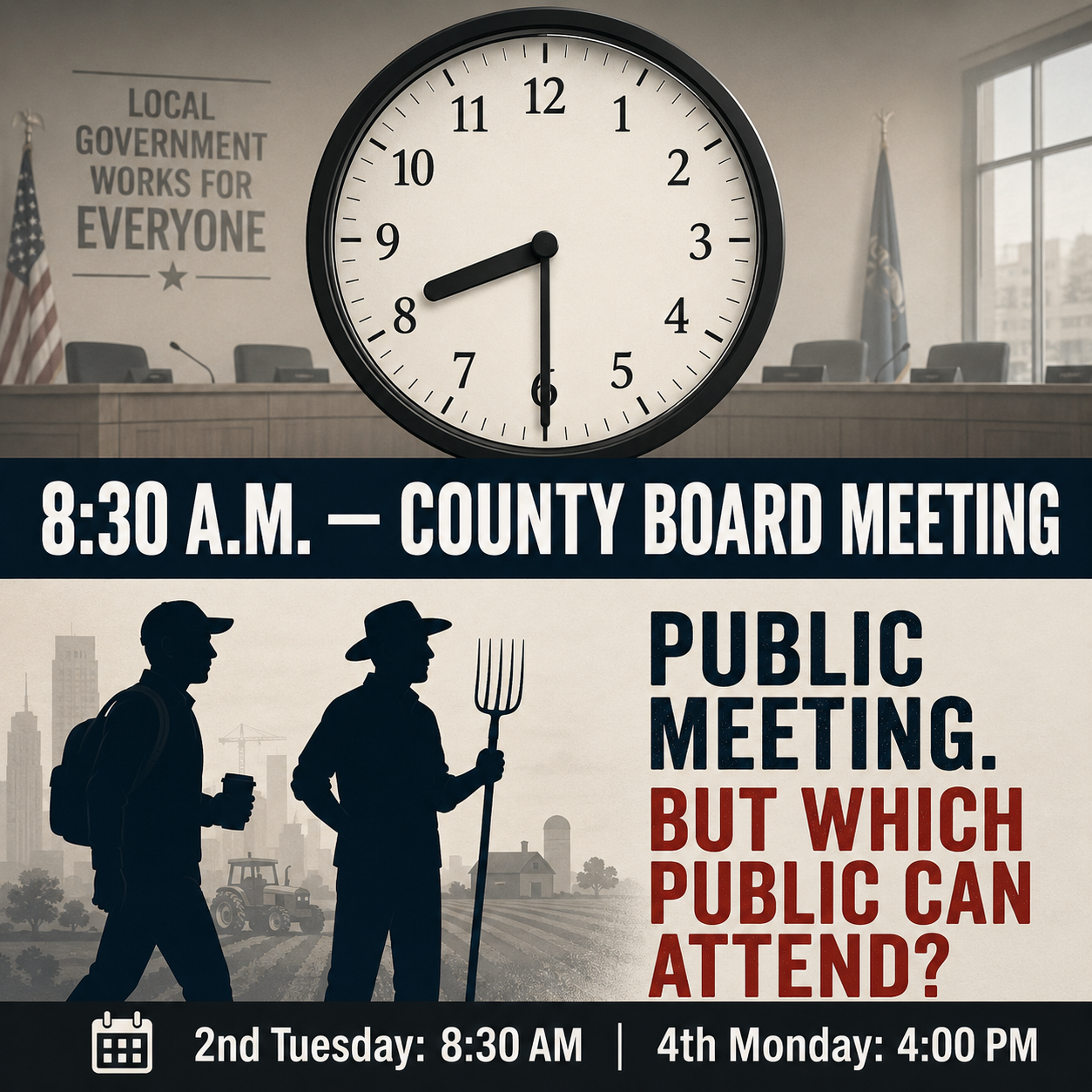
This may be the more troubling question.
Carlton County's published 2026 schedule establishes its regular County Board session for:
8:30 a.m. on the second Tuesday of every month.
Its regular adjourned session is scheduled for:
4:00 p.m. on the fourth Monday of every month.
And some meetings begin even earlier.
The July 27 meeting began at 3:00 p.m. The August 24 meeting is likewise scheduled for 3:00 p.m. The August 11 regular County Board meeting is scheduled for 8:30 a.m.
Ask a simple question:
Who exactly is available at 8:30 on a Tuesday morning?
Or 3:00 on a Monday afternoon?
For many working residents, attending such a meeting does not merely require civic interest.
It requires taking time off from work.
It may require losing wages.
It may require finding child care.
It may require driving across a large rural county in the middle of a workday.
That may be perfectly convenient for government.
But is it convenient for the governed?
“Open” Does Not Necessarily Mean Accessible
Minnesota's Open Meeting Law requires public bodies to conduct covered meetings openly and establishes notice requirements for regular and special meetings. For regular meetings, the public body must maintain its meeting schedule; special meetings carry additional notice requirements.
But meeting the minimum requirements of the law should not necessarily be the finish line for public engagement.
It should be the starting line.
There is an important distinction between asking:
“Did government satisfy the legal notice requirement?”
and asking:
“Did government make a genuine effort to ensure its citizens knew what was happening and could participate?”
Those are not the same question.
A meeting can be completely lawful and technically open to the public while still being extraordinarily difficult for much of the public to attend.
Carlton County Already Knows Evening Meetings Are Possible
Perhaps the most important evidence comes from the County itself.
The August 5 special joint meeting of the County Board and Planning Commission concerning the Carlton County 2050 Comprehensive Plan began at 5:00 p.m.
The County's 2026 Truth in Taxation meeting is scheduled for 6:00 p.m.
So this is not a question of whether Carlton County government can hold meetings later in the day.
It clearly can.
The question is why greater accessibility should be reserved for occasional meetings rather than built into the ordinary operation of County government.
Imagine something as simple as alternating meeting times.
One monthly County Board meeting could remain during the day.
The other could begin at 6:00 p.m.
Or the Board could conduct quarterly evening meetings specifically designed to accommodate residents who work traditional hours.
Major land-use proposals, zoning changes, tax decisions, large capital expenditures and long-range planning matters could automatically trigger an evening public-information session.
These are not revolutionary ideas.
They are basic accommodations designed to bring government closer to the people who pay for it.
The 2050 Plan Makes the Question Particularly Important
The criticism becomes especially relevant because Carlton County's own comprehensive-planning process was introduced with promises of substantial public involvement.
During an August 2025 presentation concerning development of the comprehensive land-use plan, the process was described as including significant public engagement, upfront public engagement and a robust public communication process.
That is exactly what a plan extending to 2050 should involve.
The decisions being discussed today may influence land use, development patterns, transportation, housing and the character of rural communities for decades.
The rough-draft minutes from the August 5, 2026 special session confirm that the County Board and Planning Commission reviewed the Draft Vision Statement, Goals and Preliminary Land Use Plan for Carlton County 2050.
These are not trivial housekeeping matters.
They concern what Carlton County may look like a generation from now.
Residents should not discover those ideas only after decisions have advanced far enough to appear on a map.
Government Should Not Wait for Residents to Find Government
There may once have been a time when publishing a notice in the local newspaper, placing something on a courthouse bulletin board and conducting a weekday meeting constituted effective public outreach.
The world has changed.
So has Carlton County.
The County should be asking how information reaches the resident who isn't looking for it yet.
That might mean direct-mail postcards for major land-use proposals.
It might mean notices at township halls, libraries, post offices, community centers and local businesses.
It might mean email and text-message subscription systems that clearly describe what is actually being considered rather than simply announcing another “Board Meeting.”
It could include coordinated notices through township and city governments.
And, yes, it should include social media and the County website.
But no single method should substitute for all the others.
Particularly not in rural Minnesota.
A Simple Test
There is an easy way to evaluate public engagement.
Don't ask whether the notice was posted.
Don't ask whether someone theoretically could have found the agenda.
Don't ask whether a meeting technically complied with the Open Meeting Law.
Instead, ask this:
Did the average Carlton County resident have a reasonable chance to learn about the issue, understand why it mattered, and participate before an important decision was made?
If the answer is no, government should not congratulate itself because a PDF happened to be sitting on a website.
It should improve the process.
Carlton County 2050 May Be Providing an Opportunity
The controversy surrounding the preliminary Carlton County 2050 land-use plan could ultimately produce something positive.
Residents are paying attention.
They are asking questions.
They are discussing development.
And many appear to want a greater voice in determining what their communities look like decades from now.
County officials should welcome that participation rather than merely satisfy the procedural requirements necessary to conduct government business.
Because public involvement should not depend upon whether someone happens to subscribe to the right newspaper, regularly searches a government website, or has the ability to leave work at 8:30 on a Tuesday morning.
Government meetings may be “open to the public.”
But meaningful representative government requires something more.
The public must have a realistic opportunity to be there.