“Don’t Rely on Social Media”? Carlton County’s Own History Tells a Different Story
County Administrator Dennis Genereau told residents not to rely on social media for answers about County government. But Carlton County once said those very platforms would improve communication and community engagement. The contradiction raises a larger question: Is public information merely available — or is Carlton County actually trying to make sure residents see it?
by Carlton County Watch
At the August 11, 2026 regular meeting of the Carlton County Board of Commissioners, County Administrator Dennis Genereau offered residents some advice.
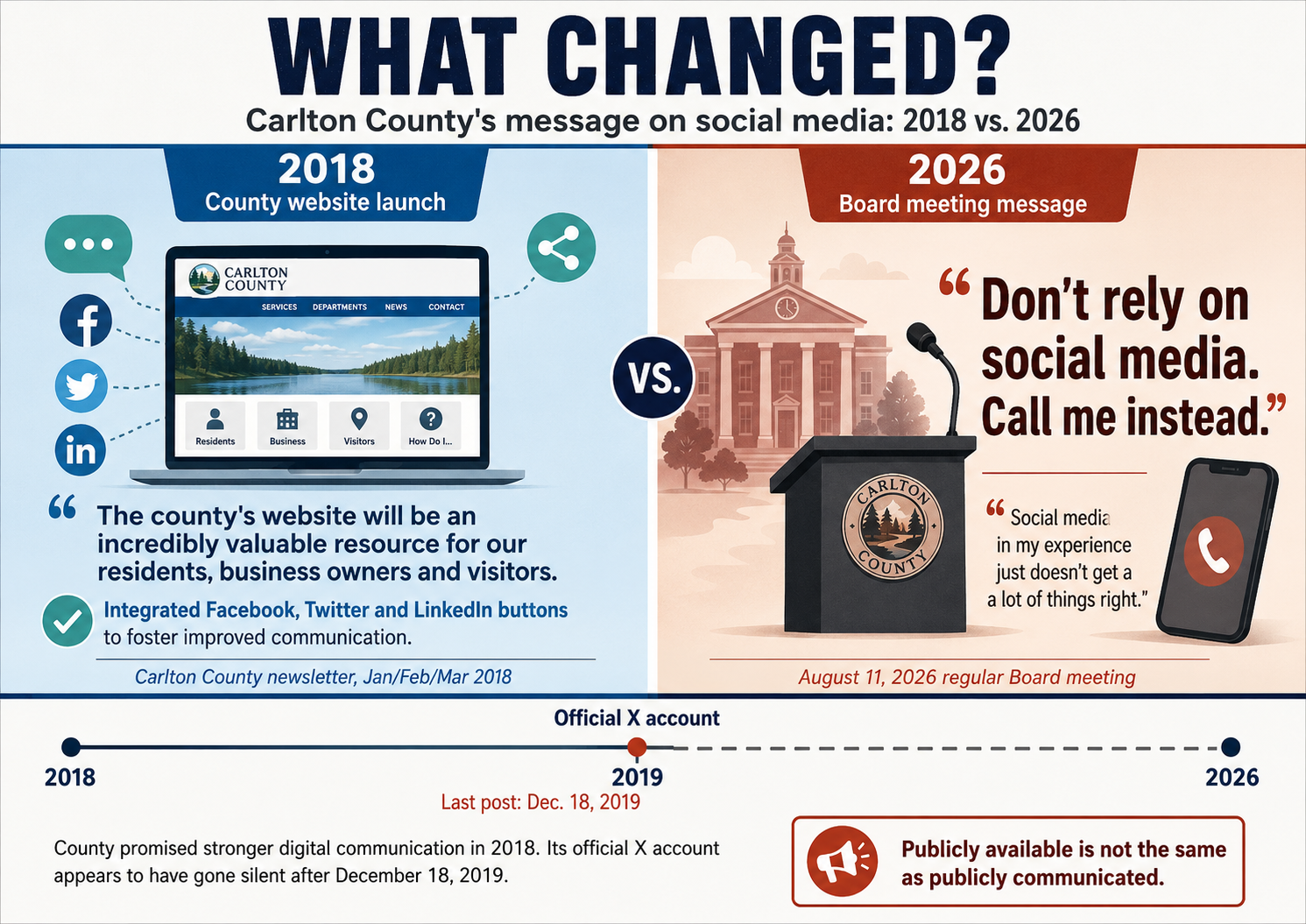
“If people have questions do not rely on social media to get answers to those questions with respect to the work that we are doing as a county government.”
Genereau continued:
“Social media in my experience just doesn't get a lot of things right.”
His proposed alternative was straightforward:
“Don't rely on social media. Call me instead. Contact your county commissioners.”
There is certainly truth in the observation that information circulating on social media can be incomplete, misleading or simply wrong. But, that is also true of newspapers and nightly TV news.
But Genereau's comments raise another — and perhaps much larger — question:
Why isn't Carlton County using its own official social-media platforms to make sure residents receive accurate information directly from their government?
If misinformation is the concern, the solution should not necessarily be less government communication.
It might be more government communication.
And Carlton County apparently understood that principle years ago.
In 2018, Carlton County Had a Very Different Message
In 2018, Carlton County proudly announced the launch of its newly redesigned website.
The announcement did not treat digital communication as something government should distrust or avoid.
Quite the opposite.
Carlton County went even further.
The County said its new digital infrastructure would help “increase its community engagement” and improve communication between residents and their local government.
That was 2018.
Fast-forward to 2026.
Carlton County's official X/Twitter account, @CarltonCountyMN, appears to have been essentially abandoned. Carlton County Watch's review found the last post dated December 18, 2019 — an advertisement seeking applicants for an Assistant Maintenance Superintendent. That post remains publicly indexed today.
More than six years later, the question seems obvious:
What happened to the County's promise to use these tools to improve communication?
Carlton County Knows How to Use Social Media
This is not a case where Carlton County lacks a social-media presence or doesn't know how to publish information online.
Its official Facebook page remains active.
Recent and indexed posts include public-health messaging, World Breastfeeding Week information, an Active Transportation Plan, County newsletters, property-tax reminders and numerous employment advertisements — including Deputy Sheriff and other County positions.
There is nothing wrong with any of that.
Those are legitimate uses of a County government Facebook page.
But they demonstrate something important:
Carlton County already knows how to use social media when it wants information distributed.
That leads to another question.
If Facebook is an appropriate place to tell thousands of people that Carlton County is hiring a deputy sheriff, why isn't it routinely used with the same enthusiasm to tell residents that their County government is considering:
major zoning changes;
a new comprehensive land-use plan;
commercial-development designations;
public hearings;
County budget proposals;
major spending decisions;
Planning Commission meetings;
ordinance changes;
or other decisions that could affect residents' property, taxes and communities for decades?
That is not an argument against job postings or public-health announcements.
It is an argument for adding government accountability and decision-making information to the communication already taking place.
“Call Me” Is Not a Public-Information Strategy
Perhaps the most troubling part of Genereau's August 11 comments is the suggestion that residents with questions should simply call him or contact their county commissioners.
Certainly residents should be able to do that.
But one-on-one telephone conversations are not a substitute for broad public communication.
A telephone call communicates information to one person.
A public government post can communicate the same information to thousands of people simultaneously.
A telephone conversation requires the citizen to know whom to call.
A social-media announcement can find the citizen.
A telephone conversation generally disappears when the call ends.
A public government post remains available for others to read, share, discuss and compare with official documents.
And perhaps most importantly:
A resident cannot call Carlton County to ask questions about something he or she does not know Carlton County is considering.
That is the fundamental problem.
Telling residents, “If you have questions, call us,” assumes residents already know enough about what their government is doing to formulate the question.
What happens when they don't?
What happens when a resident doesn't know that a future land-use map contains a designation affecting property near his home?
What happens when a resident doesn't know that a public hearing has been scheduled?
What happens when a resident doesn't know that a major budget increase is under consideration?
What happens when the first time residents learn about a government proposal is after Carlton County Watch, another news organization, or another citizen finds it buried inside an agenda packet?
You cannot ask a question about a government action you never knew existed.
Publicly Available Is Not the Same as Publicly Communicated
Carlton County does make substantial information available online.
Its website contains agendas, calendars, documents, notifications and a CivicMedia system containing dozens of County Board videos.
That deserves acknowledgement.
Residents can also subscribe to certain electronic notifications.
Those are valuable resources.
But there is a fundamental difference between making information available somewhere and actively communicating that information to the public.
A document sitting several clicks deep inside a government website may technically be public.
An agenda packet may technically be public.
A planning map contained inside that agenda packet may technically be public.
A meeting calendar may technically be public.
But meaningful public engagement requires something more than saying:
“The information was on our website.”
People have jobs.
People have families.
People do not ordinarily wake up every morning and search Carlton County's website to determine whether a Planning Commission agenda, zoning proposal, comprehensive-plan revision or public hearing appeared overnight.
Nor should citizens need to behave like investigative reporters simply to understand what their local government is considering.
Government knows when government is about to act.
Government therefore has the opportunity to tell people before it acts.
The August 11 Meeting Illustrates the Problem
Even the timing of County government meetings makes proactive digital communication more important.
Carlton County's adopted 2026 meeting schedule provides that its regular Board meetings generally begin at 8:30 a.m. on the second Tuesday of each month. The August 11 meeting at which Genereau made his social-media comments was specifically scheduled for 8:30 a.m.
For many residents, that is the middle of a workday.
If government meetings occur when substantial portions of the public are working, government should be doing more to distribute information before and after those meetings — not less.
Post the agenda.
Explain the major issues.
Link the supporting documents.
Post the maps.
Announce the public hearings.
Post the meeting video.
Tell residents how and when they can participate.
Those tasks require neither a television station nor a printing press.
Carlton County already possesses the technology.
Newspapers Still Matter. But Legal Notice Should Be the Floor, Not the Ceiling.
Minnesota law continues to require many formal public notices to be published through qualified newspapers. Minnesota Statutes Chapter 331A generally provides that legally required public notices are published in a qualified newspaper likely to provide notice within the affected area.
Carlton County's own 2026 resolutions awarded legal-publication work to the Moose Lake Star Gazette and Pine Knot News, including publication of Commissioner proceedings and other legal notices.
Carlton County Watch is not suggesting that the County ignore those requirements.
It should comply with them.
But legal compliance is the minimum standard. It does not have to be the County's entire communication strategy.
Nothing about publishing a legally required notice in a newspaper prevents Carlton County from also posting:
PUBLIC HEARING — AUGUST 24
Carlton County is considering the following ordinance.
Here is what it would do.
Read the proposal here.
Attend the hearing here.
Submit comments here.
A government Facebook post does not have to replace a legal notice.
It can amplify it.
And unlike placing another paid legal advertisement, cross-posting information through an existing government social-media account ordinarily carries no separate per-notice publication charge to the County.
Social Media Is Where People Already Are
Whatever anyone personally thinks of social media, its reach cannot reasonably be ignored.
Pew Research Center reported in 2025 that 71% of American adults use Facebook, while 84% use YouTube.
Pew separately found that 53% of American adults at least sometimes get news through social media, including 38% who regularly get news on Facebook.
That does not mean every Facebook post is trustworthy.
Of course it isn't.
But an official Carlton County government post is not supposed to be a rumor from a stranger.
It is supposed to be information directly from Carlton County government.
That distinction matters enormously.
Residents should not have to rely on social media speculation to understand what Carlton County is doing.
But they should absolutely be able to rely on the official Carlton County social media page’s to tell them what Carlton County is doing.
If Social Media Gets Things Wrong, Carlton County Should Get Things Right
This may ultimately be the biggest contradiction in Genereau's August 11 remarks.
If County officials believe inaccurate information about County government is circulating through social media, then abandoning or underusing official social-media channels effectively leaves the field open to everyone else.
The County possesses the primary documents.
The County knows when meetings are scheduled.
The County knows when ordinances are proposed.
The County knows when maps change.
The County knows what agendas contain.
The County knows what public hearings are coming.
The County knows what commissioners will be asked to vote upon.
Why should residents have to learn those things secondhand?
Carlton County could become one of the most authoritative sources of Carlton County government information on social media for one simple reason:
It is Carlton County government.
A Simple Public-Information Standard
Carlton County does not need a sophisticated public-relations department.
It does not need viral videos.
It does not need dancing commissioners, political messaging or expensive advertising campaigns.
It needs a basic commitment to routinely distribute consequential public information through the communication systems it already operates.
When Carlton County publishes a County Board agenda, post it.
When the Planning Commission considers a significant zoning matter, post it.
When a public hearing is scheduled, post it.
When a major comprehensive-plan map is released, post it.
When a major budget proposal comes forward, post it.
When an ordinance affecting residents is proposed, post it.
When the meeting video becomes available, post it.
Put the same information on the County website, Facebook page, X (formerly Twitter), or other appropriate social-media accounts and electronic notification systems.
Give every resident who wants to know a reasonable opportunity to know.
Public Participation Begins With Public Information
The controversy surrounding the Carlton County 2050 Comprehensive Plan has already demonstrated what happens when residents discover significant government planning decisions late in the process.
County officials may correctly respond that meetings were public, agendas were posted and documents existed somewhere online.
But that misses the larger question.
Did Carlton County actually try to reach the people who would be affected?
There is a difference between hiding government information and simply failing to distribute it effectively.
But from the perspective of the resident who never knew the information existed, the practical result can look remarkably similar:
They weren't there because they didn't know.
That is why Genereau's advice on August 11 deserves scrutiny.
“Call me” may be an invitation.
It is not a communications system.
“Contact your county commissioners” may be useful advice.
It is not public outreach.
And “don't rely on social media” may be perfectly sensible advice when discussing rumors, speculation and anonymous commentary.
But when discussing official government information, Carlton County should be asking an entirely different question:
Why shouldn't residents be able to rely on Carlton County's own social media?
Eight years ago, Carlton County said digital technology could foster improved communication and increase community engagement.
That was the right idea then.
It is an even more important idea today.
Public information should not merely be technically available.
It should be communicated.
And if Carlton County truly wants an informed and participating public, it should not wait for residents to discover something, wonder what it means, locate a telephone number and call County government one person at a time.
Tell them.
Post the agenda.
Post the map.
Post the proposal.
Post the hearing.
Post the video.
Post the explanation.
Put the information where people already are.
And then let the public decide what questions it wants to ask.
Because meaningful public participation cannot begin until the public first knows there is something to participate in.