Carlton County Watch Asked for the Public Records. More Than a Month Later, the County Says It May Need Another 30 Days.
by Carlton County Watch
“Sunlight is said to be the best of disinfectants; electric light the most efficient policeman.”
— Louis D. Brandeis (1914)
How much does it actually cost Carlton County taxpayers each year to compensate their five elected County Commissioners?
It sounds like a relatively straightforward question.
There is the commissioners’ annual salary. But that may not tell the whole story.
There may also be per-diem payments, mileage reimbursements, travel expenses, employer-paid benefits, retirement contributions, conference expenses, payments associated with service on boards or committees, and other forms of public compensation or reimbursement.
Carlton County Watch wants to know what each commissioner actually receives from taxpayers.
More importantly, we believe the public has a right to see the government records and determine the answer for itself.
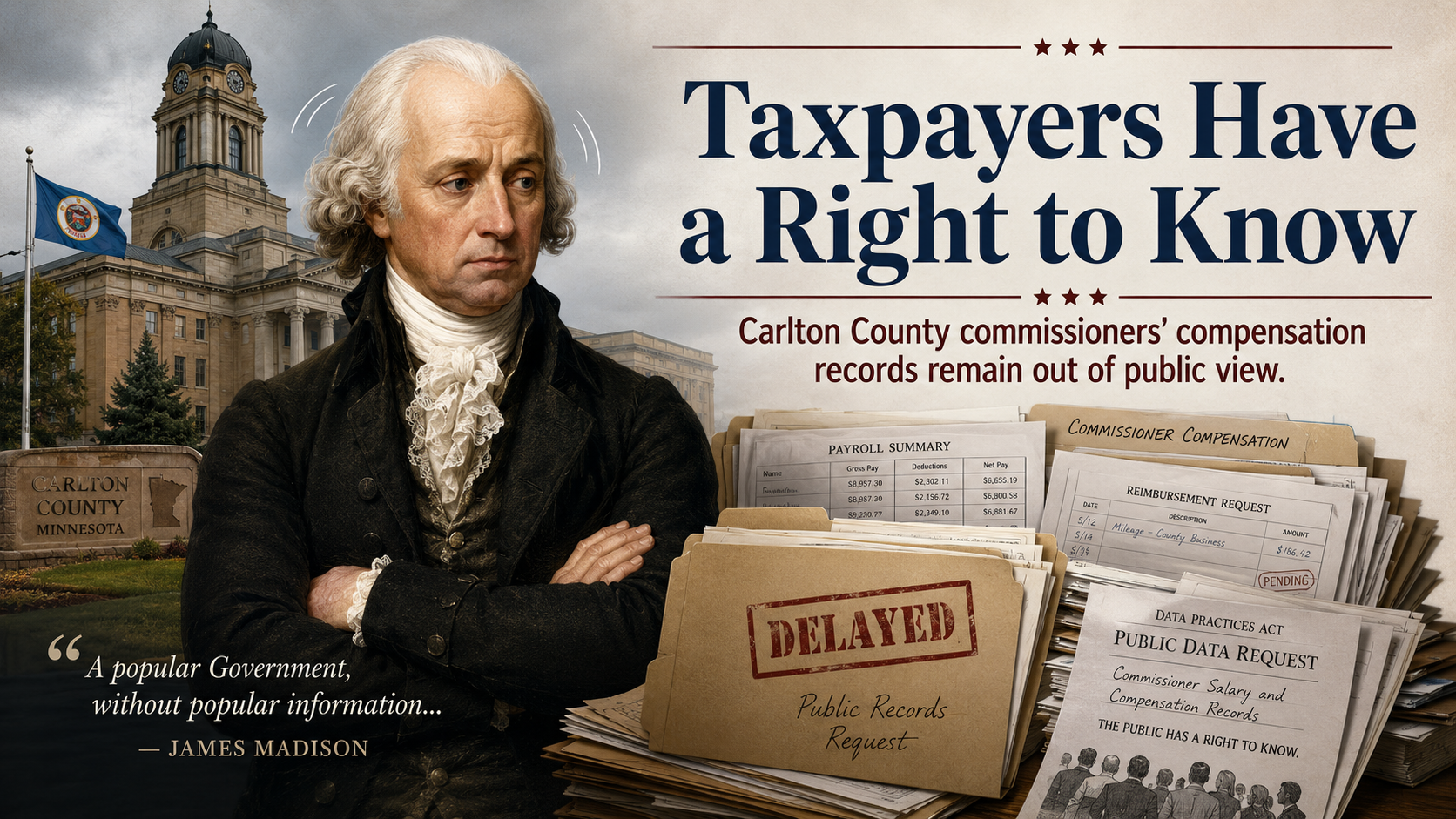
So, on July 29, 2026, Carlton County Watch submitted a Minnesota Government Data Practices Act request seeking inspection and copy access to the existing public records documenting compensation and payments associated with each member of the Carlton County Board of Commissioners from January 1, 2024, through the date of the County's search.
More than one month later, not a single responsive record had been provided for inspection.
Now Carlton County says it may need another 30 days.
What We Asked For
The July 29 request was intentionally designed to answer a broader question than simply identifying the commissioners' stated annual salaries.
Carlton County Watch requested existing records showing salary and payroll compensation; per-diem payments; expense and mileage reimbursements; employer-paid benefits and retirement contributions; County-paid expenses; payments associated with outside boards and governmental organizations; and transaction-level payroll, accounts-payable and general-ledger information.
The request applies separately to Commissioners Sarah Plante Buhs, Marv Bodie, Thomas R. Proulx, Susan Zmyslony and Dan Reed.
Importantly, Carlton County Watch did not ask the County to conduct a financial analysis for us.
We did not ask County employees to calculate totals that do not already exist.
And we did not ask the County to create a new report.
The request expressly states:
“I am requesting existing data and reports. I am not asking the County to create a new report or perform calculations that it does not ordinarily perform.”
It also expressly permits Carlton County to provide the records in the manner in which the County already maintains them.
In other words, we asked to see the books.
The County Acknowledged the Request
On July 30, the Carlton County Administrator's Office formally acknowledged receiving the request.
County Administrator Dennis Genereau stated that the request would be forwarded to the Carlton County Auditor/Treasurer's Office “for review for available data pertaining to your request.”
The County further stated:
“Carlton County will work to compile all of the requested data in a timely fashion.”
The acknowledgment also said the County would inform Carlton County Watch whether the requested data existed, in what format it existed, and how many pages it consisted of.
Then we waited.
No records were provided.
No partial production was provided.
No categories of responsive records were identified.
No inspection date was offered.
On August 31 — more than a month after the original request — Carlton County Watch contacted the County and asked for a status update.
That evening, Genereau responded.
County: Another 30 Days
Genereau wrote:
“We are working on your data request, and anticipate having the data ready within the next 30 days, given the volume of data that has been requested.”
That is the County's explanation, and Carlton County Watch presents it here in fairness and in context.
If Carlton County takes the entire additional 30-day period contemplated in Genereau's August 31 email, taxpayers could be waiting until approximately the end of September — roughly two months after the original request — to begin inspecting records showing how public money is paid to elected County Commissioners.
Minnesota Law Says Government Data Must Be Accessible
The Minnesota Government Data Practices Act begins with an important presumption: government data are public unless a law specifically classifies them otherwise.
But Minnesota law goes further.
Minn. Stat. §13.03, subd. 1 states that the responsible authority in every government entity must maintain records containing government data:
“in such an arrangement and condition as to make them easily accessible for convenient use.”
The same statute requires government entities to establish procedures ensuring requests for government data are received and complied with in an “appropriate and prompt manner.”
Those words matter.
Easily accessible.
Convenient use.
Appropriate and prompt.
The Legislature did not design the Data Practices Act merely to declare records public in theory. Public records have little practical value if citizens cannot actually obtain access to them.
These Are Ordinary Government Financial Records
County commissioner compensation is not an obscure category of County activity.
Minnesota law specifically provides that county commissioners receive annual salaries and may additionally receive per-diem payments and reimbursement for necessary expenses. The county board establishes those amounts by resolution. Minnesota law also recognizes mileage, expense allowances, reimbursement and participation in certain group insurance programs.
Carlton County therefore necessarily has systems for paying its commissioners and accounting for those payments.
Someone calculates payroll.
Someone issues the payments.
Someone processes reimbursements.
Someone records expenditures.
Someone accounts for the money.
And those transactions ultimately involve public funds.
That makes the question particularly difficult to ignore:
If Carlton County can regularly pay its commissioners, why should taxpayers have to wait approximately two months to inspect the existing records documenting those payments?
There may be a reasonable explanation for why certain portions of the request take longer to locate — particularly older supporting documents, outside-board records, receipts or records maintained across several County departments.
But that does not explain why readily retrievable payroll and accounting data cannot be provided while the more complicated portions of the request are processed.
Minnesota Has Confronted Long Data Delays Before
This is not an entirely new issue under Minnesota's Data Practices Act.
In Advisory Opinion 18-006, the Minnesota Commissioner of Administration examined a request for public personnel data concerning three University of Minnesota employees.
The Commissioner reiterated that a government entity must respond in an appropriate and prompt manner and within a reasonable time, while also emphasizing the statutory requirement that government records be maintained so they are easily accessible for convenient use.
Considering the type and amount of information requested, the Commissioner concluded that the University's response was not timely.
The circumstances involving Carlton County are not identical, and no court or Commissioner has determined that Carlton County has violated the MGDPA concerning this request.
But the underlying principle is worth remembering:
Calling government information “public” means very little
if the public cannot reasonably get to it.
Carlton County Watch Has Asked for Access
Following Genereau's August 31 response, Carlton County Watch asked the County not to hold every responsive record until the entire request is completed.
Instead, we requested inspection and production.
We asked the County to begin with records that should ordinarily be readily retrievable, including payroll compensation records, existing annual or year-to-date reports, and resolutions and policies governing commissioner compensation.
The more complicated portions of the request can then follow as the County locates them.
The original July 29 request has not been narrowed or withdrawn.
We still intend to inspect the complete responsive public record.
What Does Each Commissioner Actually Receive?
This investigation ultimately is not about processing times.
It is about public money.
Carlton County has five elected commissioners.
Taxpayers deserve to know not merely the salary established on paper, but what taxpayers actually spend compensating each commissioner over the course of a year.
What was each commissioner's gross compensation?
How much was paid in per diems?
How much was reimbursed for mileage and expenses?
What benefits or retirement contributions were paid by the County?
What other taxpayer-funded expenses were attributable to each commissioner?
Those are not accusations.
They are questions.
And there is nothing inherently improper about a commissioner receiving compensation, benefits, mileage, per diems or reimbursement authorized by law.
But there is something fundamental about allowing the people who pay those expenses to see the records.
Government transparency does not mean government telling citizens what government believes they need to know.
Transparency means giving citizens access to the public records so they can determine the facts for themselves.
James Madison captured that principle more than two centuries ago:
“A popular Government, without popular information, or the means of acquiring it, is but a Prologue to a Farce or a Tragedy.”
The technology has changed since Madison wrote those words in 1822.
The principle has not.
We Will Publish What the Records Show
Carlton County Watch will update this article if Carlton County provides additional information concerning the delay or responds to our request for rolling access.
And when Carlton County finally provides the requested public records, we intend to examine the data and report what they show.
If the compensation is exactly what taxpayers expect, the records will demonstrate that.
If there are additional per diems, reimbursements, benefits or other payments, taxpayers will be able to see those as well.
That is the purpose of public data.
Not speculation.
Not rumor.
Not a government-prepared summary.
The records themselves.
Carlton County taxpayers pay the bills.
They have every right to see the receipts.