Carlton County Sheriff's Office promised a data requester a “timely” response. Twenty-eight days later, no records have been produced — and the Sheriff's Office has provided no meaningful explanation of when they will be.
by Carlton County Watch
On July 29, 2026, a member of the public submitted a detailed Minnesota Government Data Practices Act request to the Carlton County Sheriff's Office.
The request sought inspection and copy access to public government data concerning employee complaints, misconduct investigations, disciplinary actions, final disciplinary dispositions, grievances, arbitration proceedings, employment-related settlements, and related records involving current and former Sheriff's Office employees dating back to January 1, 2020.
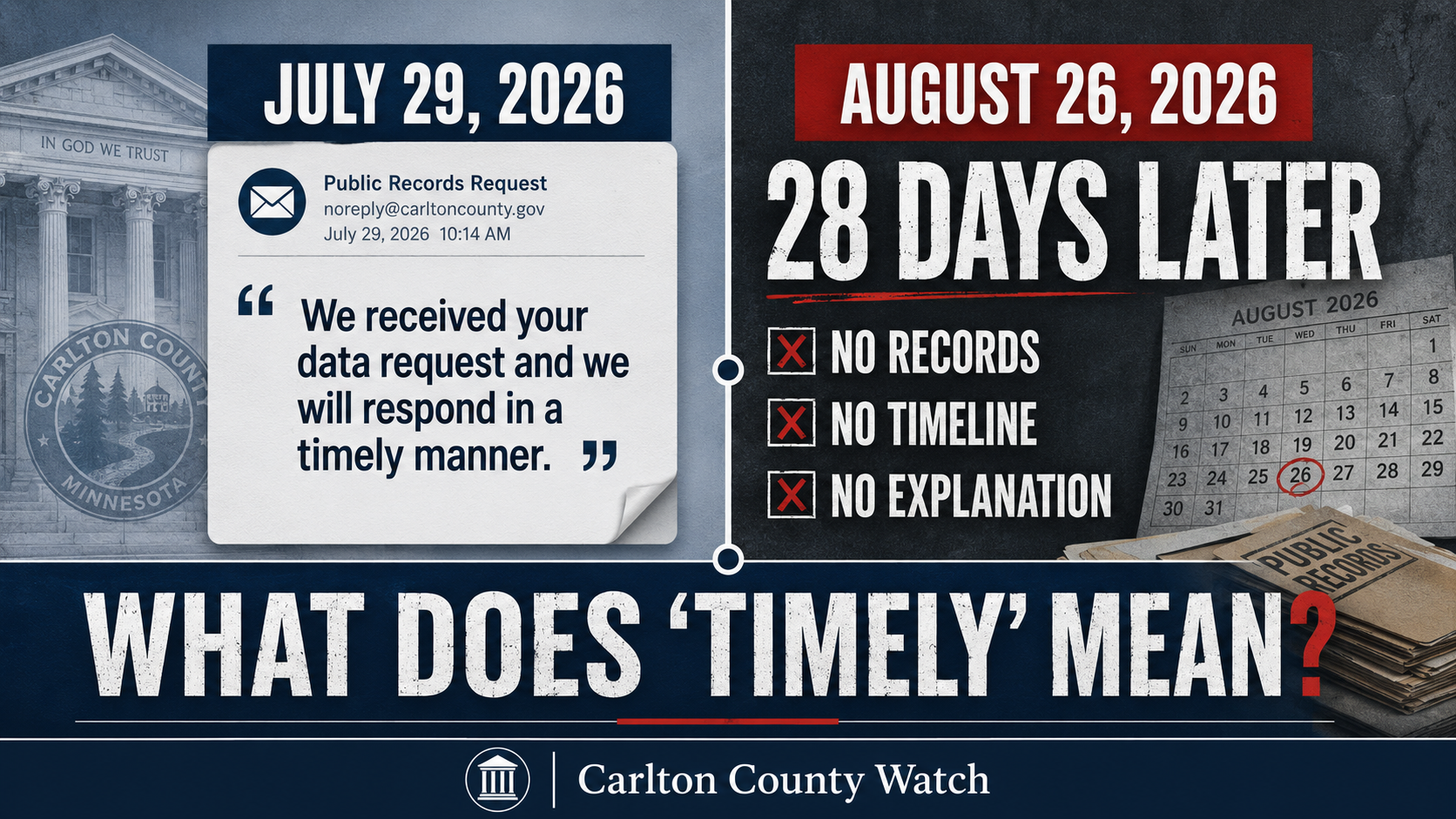
Thirty-three minutes after receiving the request, Carlton County Sheriff's Office Lead Records Clerk responded:
“We received your data request and we will respond in a timely manner. Thank you.”
That was July 29.
Today is August 26.
Twenty-eight days have passed.
No responsive records have been produced.
No inspection date has been provided.
No approximate completion date has been provided.
No clarification has been requested.
And according to correspondence reviewed by Carlton County Watch, there has been no substantive response from the Sheriff's Office since its July 29 acknowledgment.

What Does “Timely” Mean?
Minnesota law does not establish a universal number of days in which every public-data request must be completed.
A request involving a single readily available record obviously differs from one involving thousands of documents requiring review and lawful redaction.
But Minnesota law does establish a standard.
Minnesota Statutes § 13.03, subdivision 2(a), states:
“The responsible authority in every government entity shall establish procedures, consistent with this chapter, to insure that requests for government data are received and complied with in an appropriate and prompt manner.”
The statute therefore speaks not merely of eventually responding.
It requires government entities to establish procedures designed to produce an appropriate and prompt response.
And Minnesota's Commissioner of Administration has repeatedly explained that what constitutes a prompt and reasonable response depends upon the nature, volume, and complexity of the particular request.
That gives the Carlton County Sheriff's Office an entirely legitimate point:
This is a substantial request.
The records potentially span approximately six years and could involve administrative files, personnel records, complaint records, disciplinary proceedings, grievances, arbitration matters, electronic records, Human Resources files, settlement agreements and other sources.
Reviewing those materials and separating public from not-public data may reasonably take time.
But acknowledging that reality produces a second and much more difficult question:
Does the complexity of a request justify silence?
The Requester Asked for a Timeline — Not Overnight Production
The requester did not demand that six years of records be collected, reviewed and produced immediately.
The July 29 request expressly anticipated that processing could take time.
It asked the Sheriff's Office to provide:
the date the request was received;
the name and contact information of the person assigned to process it;
the categories of responsive data located or being searched;
an approximate schedule for inspection; and
notice of any portion of the request requiring clarification.
The requester also asked the Sheriff's Office to state clearly if no responsive data existed within a requested category rather than simply omitting that category from its response.
Nearly a month later, the available correspondence shows that none of that information has been provided beyond the original acknowledgment that the request was received.
There is an important difference between:
“This is a large request. We are working on it and expect to begin making records available by approximately ______.”
and:
Silence.
Four Follow-Up Requests — and No Substantive Answer
The requester did not simply submit the request and disappear.
The correspondence reviewed by Carlton County Watch documents repeated attempts to obtain a status update.
On August 14:
“Please provide an update on the status of the data request.”
On August 22:
“Please provide an update on the data request.”
Additional follow-up messages were sent on August 25 and again on August 26.
Yet the email chain reviewed by Carlton County Watch contains no subsequent substantive response from Sheriff Kelly Lake or the Carlton County Sheriff's Office.
The central question remains unanswered:
When will the requested public government data be available for inspection?
Minnesota Has Seen This Question Before
The issue of a substantial government-data request — and whether complexity excuses a lack of communication — is not new.
In Advisory Opinion 97-055, a member of the public requested personnel information concerning 209 University of Minnesota employees, including complaint, disciplinary and settlement data.
The University argued that gathering information concerning 209 employees required time.
The Commissioner did not reject that reality.
Instead, the Commissioner said that because of the request's size, it would have been appropriate for the University to tell the requester that compiling the data would take time and provide an approximation of when access could be expected.
The University had provided no response for at least four weeks and no access after more than seven weeks.
The Commissioner concluded that its response was neither prompt nor reasonable.
That distinction is important.
A substantial request may justify additional processing time.
It does not necessarily justify leaving the requester wondering whether the request is being processed at all.
But Minnesota Law Goes Even Further
There is another provision of the Minnesota Government Data Practices Act that deserves attention.
Minnesota Statutes § 13.03, subdivision 1, imposes an affirmative obligation concerning how government records are maintained in the first place.
The statute provides:
“The responsible authority in every government entity shall keep records containing government data in such an arrangement and condition as to make them easily accessible for convenient use.”
Those words matter.
The Legislature did not simply require government agencies to preserve records somewhere.
It required those records to be maintained so that the government data contained within them are “easily accessible for convenient use.”
That statutory requirement changes the conversation surrounding large or difficult data requests.
If a government entity says locating responsive public records is difficult because the records are scattered among numerous files, locations, storage systems or formats, that difficulty does not necessarily end the inquiry.
It may begin another one.
Government Filing Systems Are Supposed to Assist Public Access — Not Hinder It
Minnesota's Commissioner of Administration addressed this issue directly in Advisory Opinion 96-032.
Interpreting the same “easily accessible for convenient use” language, the Commissioner described § 13.03, subdivision 1, as imposing an affirmative duty upon government agencies when designing their recordkeeping systems.
The Commissioner explained that government data-storage, retrieval and filing systems should be designed so those systems assist rather than hinder the public in obtaining access to government data.
That principle is especially significant here.
The July 29 request did not ask Carlton County to invent records that do not exist.
In fact, the request expressly stated:
“This request does not require the County to create a new record or compilation that does not already exist.”
Instead, the requester sought existing government data maintained in existing indexes, registers, spreadsheets, databases, logs, case-management systems, internal-affairs systems, personnel-tracking systems and other existing records.
The request further anticipated that responsive records might reside in multiple places — including Sheriff's Office administrative files, internal-affairs files, electronic systems, Human Resources records, labor-relations files, grievance records, County Attorney files, arbitration files and archived storage — and expressly asked the Sheriff's Office to coordinate with other Carlton County custodians where necessary.
Which raises an important question.
If locating employee complaint and disciplinary records is what is causing the delay, are those records being maintained in the arrangement and condition Minnesota law requires?
Carlton County Watch does not presently know whether difficulty locating records is responsible for the delay.
The Sheriff's Office has not said.
But if disorganized, fragmented or inaccessible recordkeeping is offered as an eventual explanation, Minnesota law makes that explanation relevant to a separate statutory obligation.
A Police Department Tried That Explanation Before
There is an especially relevant Minnesota advisory opinion involving almost exactly the type of records requested here.
In Advisory Opinion 07-023, a member of the public requested access to complaint data involving six police officers in the City of Newport.
The police chief explained that complaint information might have been stored in numerous locations and on different media — including paper files, floppy disks, CDs and computer files — and that older files were difficult to locate because of their filing method and location.
The Commissioner acknowledged those circumstances but pointed directly to § 13.03, subdivision 1's requirement that government records be maintained so the data are easily accessible for convenient use.
The Commissioner concluded that difficulty locating records documenting complaints against police officers did not eliminate the City's obligation to respond appropriately and promptly within a reasonable time.
The City's response was found not timely.
The comparison is difficult to ignore.
The Carlton County request likewise seeks public data concerning complaints against law-enforcement employees.
And it raises the same fundamental principle:
The public's statutory right to government data cannot depend entirely upon whether the government happened to create an efficient filing system.
The Law Does Not Contain a “Too Much Data” Exception
A much more recent Minnesota advisory opinion reinforces the same principle.
In Advisory Opinion 25-006, issued June 30, 2025, the Commissioner considered a school district's response to a substantial request involving more than two years of electronic communications.
Technical staff expressed concerns regarding the volume of responsive records. The district ultimately searched and produced only a narrower subset of what the requester had actually requested.
The Commissioner again cited § 13.03, subdivision 1 and emphasized that the Data Practices Act contains no exception permitting government to deny access simply because a request generates a large quantity of information requiring compilation and review.
The Commissioner concluded that a government entity cannot limit what public data are accessible merely because responding may be burdensome or technically difficult.
The opinion reiterated:
Government data must be maintained so they are easily accessible for convenient use.
Taken together, these opinions reveal a consistent interpretation of the statute:
Government is expected to organize itself so the public's right of access can actually function.
The Sheriff's Office Cannot Have It Both Ways
This presents a straightforward accountability question.
If Carlton County Sheriff's Office complaint and disciplinary records are readily accessible, then the public may reasonably ask:
Why has nearly a month passed without a substantive response, estimated timeline, inspection appointment or partial production?
If, on the other hand, the Sheriff's Office needs weeks or perhaps months merely because responsive complaints and disciplinary records cannot readily be located across its own files and systems, another question emerges:
How does that condition comport with Minnesota's requirement that government records be kept in an arrangement and condition making the data “easily accessible for convenient use”?
There may be a perfectly reasonable explanation.
Perhaps hundreds or thousands of responsive documents have already been located and attorneys are reviewing them for legally required redactions.
Perhaps responsive records have been gathered and are nearly ready for inspection.
Perhaps Human Resources or another Carlton County department is assisting.
Perhaps some records can be produced immediately while others require additional review.
But that brings us back to the original problem:
The Sheriff's Office has not said.
What Information Is the Public Asking to See?
The subject matter of this request makes the delay particularly significant.
The records concern how the Carlton County Sheriff's Office responds when its own employees are accused of misconduct.
Minnesota Statutes § 13.43 makes certain government personnel data expressly public.
Among those public data are the existence and status of complaints or charges against an employee, regardless of whether the complaint ultimately results in disciplinary action.
When there has been a final disposition of disciplinary action, additional information becomes public under the statute, including the final disposition, specific reasons for the disciplinary action and data documenting the basis for it, subject to applicable statutory classifications.
Certain terms of agreements settling disputes arising out of the employment relationship are also public.
The July 29 request accordingly seeks public information concerning complaints, complaint status, final disciplinary actions, grievance and arbitration outcomes, employment-related settlements and supporting public records.
These are not abstract bureaucratic records.
They answer basic questions about public accountability:
How many complaints have been made against Sheriff's Office employees?
What happened to those complaints?
How many remain pending?
How many were determined not to warrant discipline?
Which matters resulted in discipline?
What misconduct formed the basis for final disciplinary actions?
Were disciplinary decisions appealed or grieved?
Were they upheld, reduced or reversed?
Were employment disputes resolved through settlement agreements?
Those questions concern the operation of a public law-enforcement agency funded by Carlton County taxpayers.
Complexity Can Explain Time. It Cannot Automatically Explain Inaccessibility.
Carlton County Watch recognizes an important distinction.
Twenty-eight days without production does not, by itself, establish that the Carlton County Sheriff's Office has violated the Minnesota Government Data Practices Act.
Locating responsive materials, determining their classifications, reviewing potentially private personnel information and performing lawful redactions can legitimately require time.
But the Minnesota Government Data Practices Act addresses both sides of that equation.
Government must respond to requests in an appropriate and prompt manner.
And government must maintain records containing government data in an arrangement and condition making them easily accessible for convenient use.
The statute therefore provides little comfort in an explanation that amounts simply to:
“There are too many records.”
And it provides little comfort in another explanation:
“We cannot readily find them.”
Volume may affect how long review takes.
It does not eliminate the public's right to access public government data.
And poor record organization, if that is part of the problem, raises its own statutory concern.
An Accountability Request Has Become an Accountability Story
There is an unavoidable irony here.
The requester is seeking records showing how the Carlton County Sheriff's Office holds its own employees accountable when complaints or allegations of misconduct arise.
Nearly one month later, the Sheriff's Office's handling of that transparency request has itself become a public-accountability question.
On July 29, its Records Office promised:
“We will respond in a timely manner.”
As of August 26, the correspondence reviewed by Carlton County Watch shows:
No records.
No inspection appointment.
No approximate completion date.
No request for clarification.
No substantive explanation for the delay.
Carlton County Watch does not know why.
Silence alone does not establish wrongdoing.
But the public should not have to guess whether its government is processing a lawful request for public records.
Sheriff Lake Can Answer These Questions
Carlton County Watch welcomes an explanation from Carlton County Sheriff Kelly Lake and the Carlton County Sheriff's Office.
The questions are straightforward:
Has the Sheriff's Office located records responsive to the July 29 request?
Approximately how much responsive data has been identified?
Is the request presently being processed?
Is any portion of the request unclear?
Are Carlton County Human Resources, the County Attorney's Office or other County departments assisting in locating or reviewing responsive records?
Can any responsive public data be made available for inspection now while other records continue to be reviewed?
What accounts for the 28-day delay without a substantive status response?
And ultimately:
When will the public be permitted to inspect the requested public government data?
Nearly one month after the Sheriff's Office promised a “timely” response, those are reasonable questions deserving straightforward answers.
The Clock Is Still Running
Carlton County Watch will continue following this request.
If the Sheriff's Office produces the records, we will report that.
If the Sheriff's Office explains the delay, we will report that explanation fairly.
If particular records are withheld, we will examine the statutory basis cited for withholding them.
If the responsive records reveal information concerning employee complaints, disciplinary actions, settlements or other matters Minnesota law makes public, we will examine that information.
And if the Sheriff's Office continues to remain silent, we will report that too.
Because Minnesota's Government Data Practices Act is not simply a law governing pieces of paper stored in filing cabinets or bits of information stored on computer servers.
It embodies a broader principle:
Public government data must not only exist. The public must be able to get to it.
Minnesota law requires government to organize its records for convenient access.
It requires procedures for appropriate and prompt responses.
And it gives members of the public the right to inspect and copy public government data.
On July 29, the Carlton County Sheriff's Office promised a “timely” response.
Twenty-eight days later, the public is still waiting.
And now there are two questions:
Where are the records?
And why is it taking so long to see them?
