Moose Lake says it saved approximately $150,000 after eliminating its municipal police department and contracting with the Carlton County Sheriff's Office. But the publicly available records raise another question that has yet to be answered: What, exactly, are taxpayers receiving for the money?
by Carlton County Watch
In February 2024, the Moose Lake City Council made one of the most consequential decisions a local government can make.
The primary argument was financial.
Moose Lake's municipal police department had become increasingly expensive. At the time of the Council's decision, the City's police budget was approximately $687,850. The proposed Carlton County arrangement was initially presented at approximately $544,720 annually and would provide four Sheriff's deputies and part-time administrative support.
The argument appeared straightforward:
More coverage. Less money.
More than two years later, enough public information now exists to begin asking whether that promise has been realized.
Carlton County Watch has begun examining the financial and operational records surrounding the Moose Lake policing contract.
And what we have found so far raises questions worth answering.
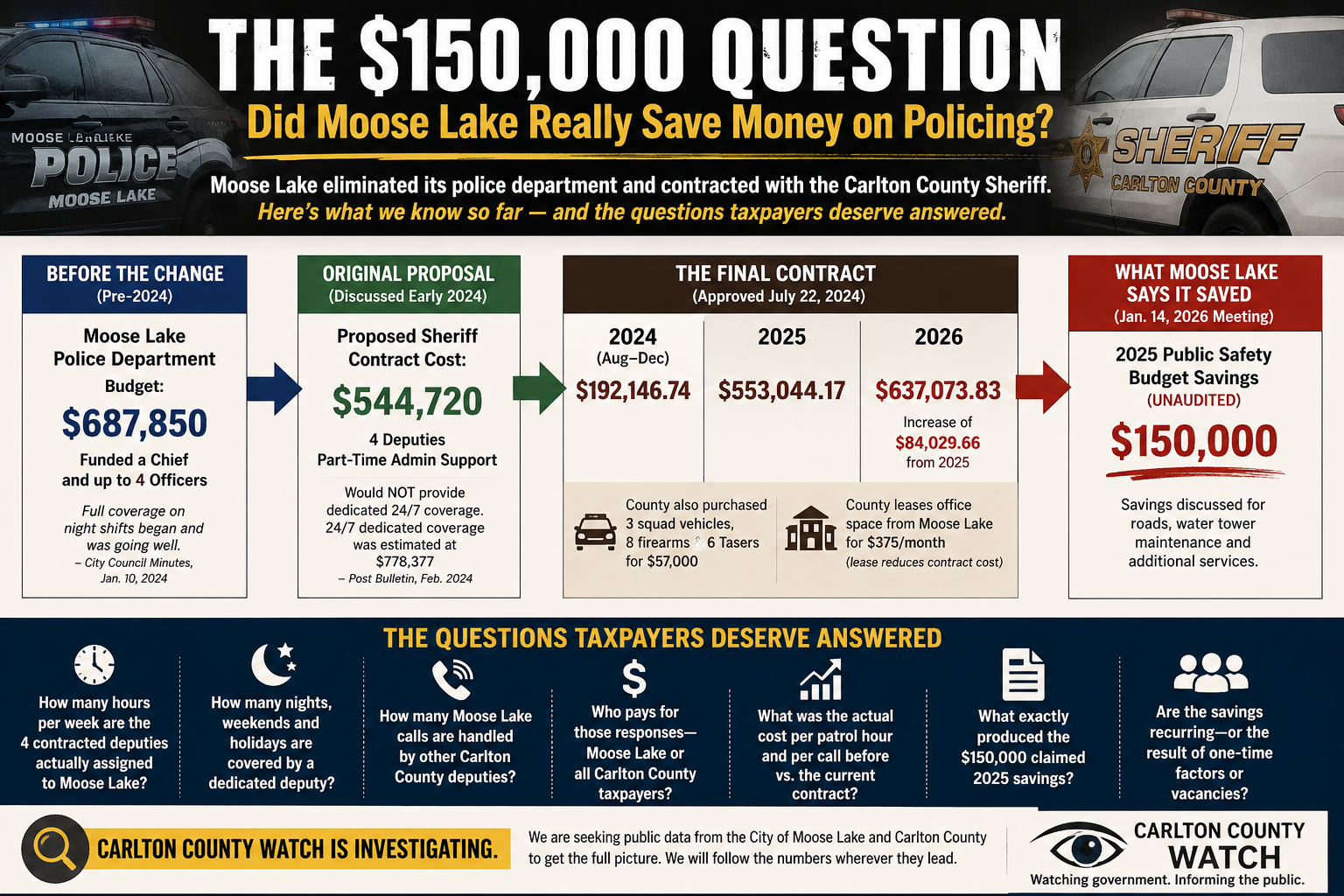
The Contract Became More Expensive
The final agreement approved by the Carlton County Board of Commissioners was more expensive than the approximately $544,720 figure discussed when the Moose Lake City Council voted to eliminate its police department.
Under the agreement, Moose Lake agreed to reimburse Carlton County:
$192,146.74 for August through December 2024
$553,044.17 for 2025
$637,073.83 for 2026
The County also agreed to purchase three Moose Lake police vehicles, eight firearms and six Tasers for $57,000.
Additionally, Carlton County leases office space from Moose Lake for $375 per month, with the lease amount reducing the base expenses of the law-enforcement agreement.
The difference between the 2025 and 2026 contract amounts alone is $84,029.66.
In other words, whatever savings existed in the first full year of the agreement should not automatically be assumed to continue indefinitely.
Moose Lake Says It Saved Approximately $150,000
There is evidence that the City did experience financial savings during the first full year of the contract.
At its January 14, 2026 meeting, the Moose Lake City Council discussed what its own meeting minutes describe as:
“2025 Public Safety Budget Savings Discussion - $150,000 (unaudited)”
Council members discussed using those savings for roads, water-tower maintenance and additional law-enforcement services for City events.
That is significant.
It means Moose Lake itself has publicly identified approximately $150,000 in 2025 public-safety budget savings.
But it also raises an important accounting question:
Saved compared to what?
Was the $150,000 calculated against the City's adopted 2025 public-safety budget?
Was it compared to what Moose Lake anticipated spending had the municipal police department remained in operation?
Was it the difference between budgeted and actual Sheriff-contract expenditures?
Did vacancies, transition expenses, equipment transactions or one-time circumstances contribute to the figure?
And most importantly:
Is the $150,000 a recurring annual savings — or a one-year accounting result?
The City's January minutes expressly described the figure as unaudited. The same meeting minutes state that work on the City's 2025 audit had begun and that an onsite audit visit was scheduled for May.
Until the underlying calculation is examined, the $150,000 figure tells us that the City believes money was saved.
It does not yet tell us exactly how it was saved.
What Did Moose Lake Receive in Exchange?
Financial savings are only half of the equation.
To fairly evaluate the decision, taxpayers also need to know what level of law-enforcement service Moose Lake received before and after eliminating its police department.
Before its staffing crisis, the Moose Lake Police Department had been fully staffed with a police chief and four officers.
By early 2024, resignations had dramatically reduced the department. The City's approximately $687,850 police budget at that point was designed to support a chief and two officers rather than the five sworn personnel funded previously. Contemporary reporting described a department that had been destabilized by resignations and escalating employee-benefit expenses.
That distinction matters.
A fair long-term comparison should not simply compare four Carlton County deputies against the single Moose Lake officer who remained immediately before the department closed.
The proper comparison is between a normally staffed municipal police department and a normally staffed contracted Sheriff operation.
And that comparison requires more information than government websites currently provide.
Four Full-Time Deputies — But What Are Their Actual Hours?
Carlton County's own budget documents identify:
Four 1.0-FTE Deputy Sheriff — Moose Lake positions
and
one 0.5-FTE Records Clerk — Moose Lake position.
All five positions are identified as being reimbursed by the City of Moose Lake.
That tells taxpayers what positions were budgeted.
It does not tell taxpayers exactly when those deputies are working in Moose Lake.
The Carlton County Sheriff's Office maintains a separate webpage for its Moose Lake office.
The hours currently advertised to the public are:
Monday: 8:30 a.m. – 1:30 p.m.
Tuesday: 8:30 a.m. – 1:30 p.m.
Wednesday: Closed
Thursday: 8:30 a.m. – 1:30 p.m.
Friday: 8:30 a.m. – 1:30 p.m.
Weekends: No office hours listed
Holidays: Closed
That equals 20 public office hours per week.
Those posted hours should not be confused with patrol availability.
The Sheriff's webpage provides an emergency number of 911, and the available information does not establish that Sheriff's deputies provide law enforcement only during those 20 hours.
Indeed, the 20-hour schedule may correspond primarily to the half-time Moose Lake records position rather than the schedules of the four deputies.
But that distinction itself reveals something important:
Carlton County publicly tells Moose Lake residents when its local office is open. It does not publicly tell taxpayers when the four full-time deputies they are paying for are actually assigned to Moose Lake.
That is information taxpayers deserve to know.
Twenty-Four-Hour Dedicated Coverage Was Never Part of the Affordable Proposal
There is another important fact from the original 2024 debate.
Contemporary reporting stated that the proposed four-deputy Sheriff arrangement would not provide Moose Lake with dedicated 24-hour, seven-day-a-week coverage.
According to reporting at the time, the Sheriff's Office determined that continuous dedicated coverage would require four deputies plus a sergeant and would cost approximately $778,377.
The City chose the less expensive four-deputy option.
That fact deserves attention today because the current contract price has climbed to $637,073.83 for 2026.
It remains below the 2024 estimate for continuous dedicated coverage.
But it is also substantially above the approximately $544,720 figure discussed when the City Council originally decided to eliminate the police department.
What Did the Former Police Department Provide?
The historical records provide another useful comparison.
In January 2024, while the Moose Lake Police Department was still operating, Interim Police Chief Chad Pattison reported to the City Council that the department had handled 135 calls for service during December 2023.
The minutes contain another notable statement:
“Full coverage on night shifts began and is going well.”
That does not establish that Moose Lake maintained its own officer on duty every minute of every day.
Carlton County Watch is not making that claim without the underlying duty rosters.
But it does establish that night-shift coverage was part of the municipal department's operation immediately before the decision to abolish it.
And it strengthens the case for comparing actual schedules — not merely annual budgets.
The Question Isn't Simply Whether Moose Lake Saved Money
Suppose Moose Lake really did save $150,000 in 2025.
That would be important.
If taxpayers received the same or better law-enforcement service while spending $150,000 less, the decision deserves recognition as a successful example of governmental consolidation.
But suppose something different happened.
Suppose the contract provides fewer dedicated patrol hours.
Suppose ordinary Carlton County deputies routinely handle Moose Lake calls when the four contracted deputies are unavailable.
Suppose some of those costs are absorbed within the general Carlton County Sheriff's budget rather than charged directly to Moose Lake.
Or suppose the apparent first-year savings diminish as the contract price increases.
Those possibilities would lead to an entirely different assessment.
At this point, we do not know.
And that is precisely why Carlton County Watch believes the underlying public data should be examined.
The County Taxpayer Question
There is another issue that extends beyond the Moose Lake city limits.
When a dedicated Moose Lake contract deputy is unavailable and an ordinary Carlton County patrol deputy responds to a call within Moose Lake, who pays for that service?
Is the cost already built into Moose Lake's fixed contract?
Is Moose Lake charged separately?
Or is the cost simply absorbed by the broader Carlton County Sheriff's budget?
That distinction matters because Moose Lake's decision did not make the need for police protection disappear.
It changed who provides it and how it is financed.
If general County patrol resources are routinely supplementing the four contracted Moose Lake deputies, then determining the true cost of the arrangement requires examining not merely Moose Lake's checkbook, but Carlton County's as well.
Carlton County Watch Will Seek the Records
Carlton County Watch intends to seek public government data from both the City of Moose Lake and Carlton County under the Minnesota Government Data Practices Act.
Among the records we intend to examine are:
actual Moose Lake Police Department expenditures before dissolution;
actual Sheriff-contract expenditures;
the calculation supporting the City's approximately $150,000 claimed 2025 savings;
duty rosters and schedules for the former Moose Lake Police Department;
duty rosters and schedules for the four Moose Lake contract deputies;
vacancies in the four contracted positions;
overtime and employee-benefit costs;
calls for service handled by Moose Lake-designated deputies;
Moose Lake calls handled by other Carlton County deputies;
the County's methodology for allocating those costs;
records supporting the substantial increase in the contract price between 2025 and 2026; and
records identifying exactly how many hours of dedicated law-enforcement coverage Moose Lake receives under the contract.
From those records, a meaningful comparison should be possible.
Not simply:
How much did Moose Lake spend?
But:
How much did Moose Lake spend per hour of dedicated law-enforcement coverage?
How much did it spend per call for service?
How many nights and weekends were covered under each model?
How many Moose Lake calls required general Carlton County patrol resources?
And ultimately:
How much money did Moose Lake actually save for each unit of law-enforcement service it received?
An Investigation — Not a Conclusion
Carlton County Watch has not concluded that eliminating the Moose Lake Police Department was a financial mistake.
Nor have we concluded that the Sheriff's contract was a financial success.
The existing public record does not yet support either conclusion.
What the record does support is asking the question.
Moose Lake eliminated a police department that, when fully staffed, consisted of a chief and four officers. It replaced that department with a contract providing four Carlton County deputy positions and part-time records support. The contract cost $553,044.17 in 2025 and increased to $637,073.83 for 2026. The City subsequently reported approximately $150,000 in unaudited 2025 public-safety savings.
Those facts deserve to be placed beside one another.
Now we need the rest of the equation:
What level of dedicated law-enforcement service did taxpayers receive before — and what are they receiving now?
Carlton County Watch welcomes the City of Moose Lake, the Carlton County Sheriff's Office and Carlton County officials to provide information, records or explanation that may assist the public in understanding the financial and operational results of this arrangement.
We will follow the numbers wherever they lead.
The $150,000 question is not whether Moose Lake says it saved money.
The question is how much it actually saved — and exactly what taxpayers received in return.
This investigation will continue.