Carlton County enacted a one-year moratorium on data-center development while officials study potential impacts involving electricity, water, land use and the environment. Those questions deserve serious answers. But there is an enormous difference between protecting Carlton County through intelligent regulation and effectively hanging a “closed for business” sign on one of the most important infrastructure industries of the twenty-first century.
by Carlton County Watch
On Monday, August 24, Carlton County held a public hearing concerning proposed Interim Ordinance No. 42 — a measure that could impose a one-year pause on the construction, creation or expansion of data centers within the County.
The discussion comes at an important moment.
Artificial intelligence is expanding. Cloud computing continues growing. Businesses increasingly depend upon remote computing. Medical records are digital. Banking is digital. Government records are digital. Video entertainment is increasingly streamed. Social media connects billions of people through enormous networks of computers.
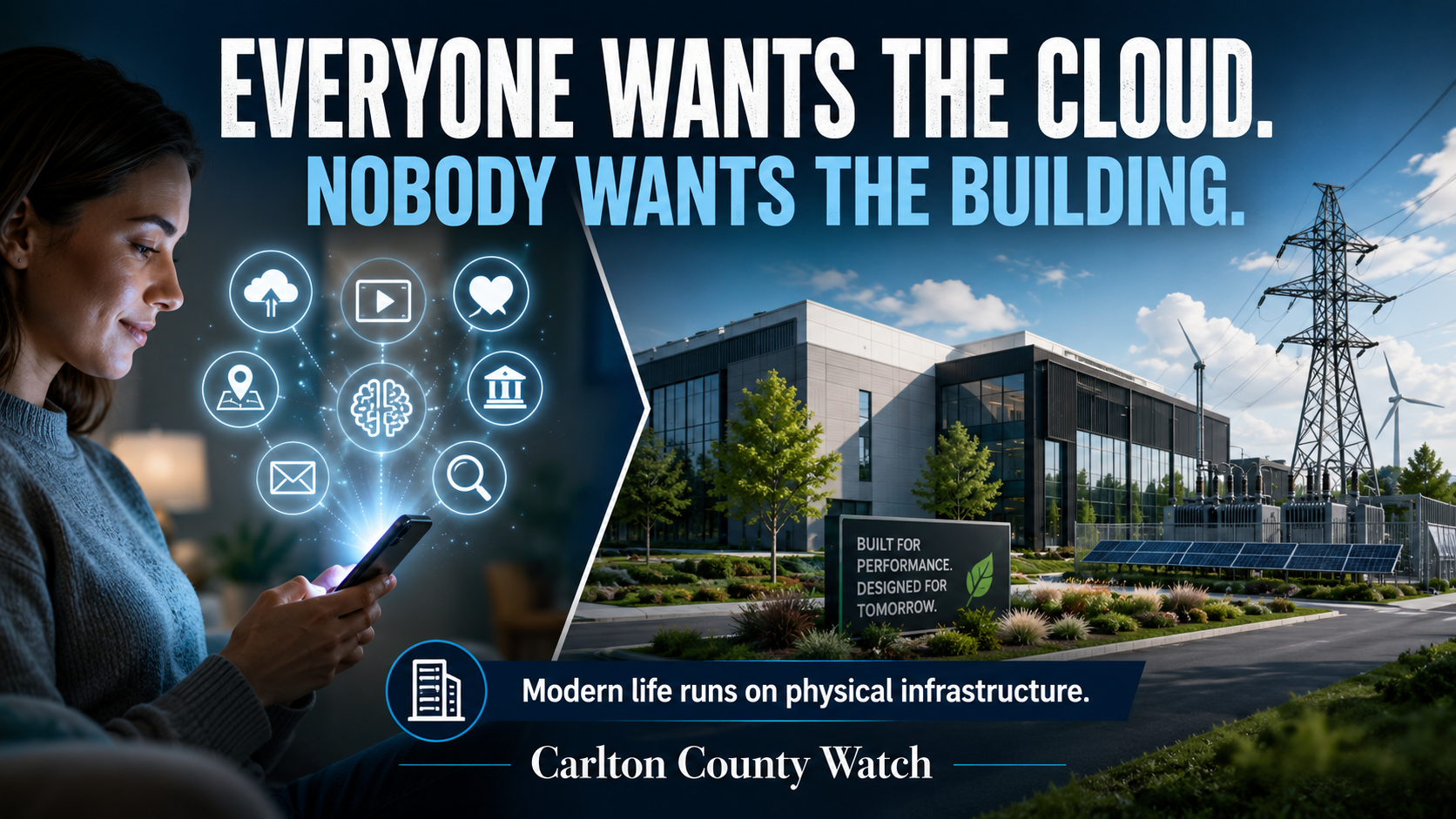
And all of that supposedly invisible technology has to physically exist somewhere.
Behind “the cloud” are buildings.
Behind an internet search are servers.
Behind Facebook, YouTube, online banking, cloud storage, artificial intelligence and countless other digital services are processors, storage devices, fiber-optic connections, electrical systems and cooling infrastructure.
The cloud is not actually in the clouds.
It lives in data centers.
The Digital-Infrastructure Paradox
There is an increasingly curious contradiction surrounding America's debate over data centers.
People understandably expect their smartphones to work instantly.
They expect streaming video without interruption.
They expect photographs stored in the cloud to appear immediately.
They expect online banking, email, social media, search engines, artificial intelligence, medical information, government databases and countless other services to operate around the clock.
Modern automobile navigation increasingly incorporates live traffic information, constantly updated maps, business information and connected routing services.
Yet when the physical infrastructure supporting this digital world is proposed somewhere nearby, the conversation frequently becomes:
Not here.
Put the servers somewhere else.
Put the electrical infrastructure somewhere else.
Put the building somewhere else.
Let another community accommodate it.
But make sure our internet keeps working.
That is the digital equivalent of demanding electricity while opposing every power plant and transmission line, or demanding groceries while objecting to farms, warehouses and trucks.
Infrastructure has a physical footprint.
The responsible question is not whether that footprint exists.
The responsible question is how we manage it.
Carlton County's Proposed Moratorium
The County's proposed Interim Ordinance No. 42 acknowledges that Carlton County's existing Zoning Ordinance No. 27 does not expressly regulate or establish specific permitting standards for data centers.
That is a legitimate problem.
Technology has moved faster than many local zoning codes.
Carlton County should absolutely determine how data centers fit within its land-use framework.
But Ordinance No. 42 goes considerably beyond beginning that discussion.
The proposed ordinance would establish a one-year pause on the creation or expansion of data centers within Carlton County.
The restriction would apply not merely to some theoretical future mega-project. The ordinance states that its temporary restrictions apply to pending and future zoning applications.
During that period, proposals involving conditional-use permits, interim-use permits, variances, subdivisions or rezonings associated with data-center development would not be accepted or processed.
The Carlton County Planning Commission would then study potential regulations, consult residents, staff, experts and other interested parties, and eventually recommend permanent controls to the County Board.
If no earlier report is made, a progress report would come before Commissioners in February 2027.
Those provisions deserve considerably more scrutiny than the seemingly innocuous phrase “let's study data centers” might suggest.
A study is one thing.
Closing the permitting door while studying is another.
Monday Night's Public Hearing
The concerns expressed by residents should not simply be dismissed.
Approximately 50 people attended Monday night's hearing and more than a dozen spoke. Most speakers reportedly opposed new data centers.
Concerns included water supplies, pollution and the long-term consequences of allowing large facilities into the region.
Those are legitimate subjects for public discussion.
Carlton County Watch does not believe environmental concerns should be ignored simply because economic development may be possible.
But neither should environmental protection become shorthand for opposing development before anyone has submitted an actual proposal demonstrating what would be constructed, where it would be constructed, how much water it would consume, where its electricity would originate, what cooling technology would be employed, what environmental safeguards would be incorporated, or what economic benefits would be offered in return.
There is no single thing called “a data center.”
Facilities differ enormously.
A hyperscale artificial-intelligence facility is different from a smaller enterprise data center.
A facility employing evaporative cooling is different from one utilizing closed-loop technologies.
A facility drawing enormous groundwater quantities is different from one designed around water conservation or reclaimed water.
A poorly located facility is different from one constructed in an industrial area near appropriate electrical and transportation infrastructure.
Good zoning recognizes those distinctions.
A blanket moratorium largely does not.
The Environmental Concerns Are Real
Supporters of data-center development should acknowledge reality rather than minimize it.
Data centers can consume substantial quantities of electricity.
Some cooling technologies consume significant amounts of water.
Backup generators can create noise and emissions.
Large developments can affect roads, transmission infrastructure, neighboring properties and local land-use patterns.
Those numbers deserve attention.
But acknowledging a problem is not the same thing as concluding that the technology creating the problem must therefore be rejected.
Automobiles create environmental impacts.
We regulate automobiles.
Factories create environmental impacts.
We regulate factories.
Power plants create environmental impacts.
We regulate power plants.
Homes, highways, hospitals and farms all affect land, water and energy resources.
We establish standards.
Why should data centers be treated differently?
Technology Can Address Technology
Perhaps the most important element missing from much of the public debate is that data-center technology itself continues evolving.
The Department of Energy publishes extensive guidance concerning energy-efficient data-center design, including improved IT efficiency, air management, electrical-system efficiency, cooling technology and heat recovery.
Water consumption is similarly not fixed.
Different cooling systems produce dramatically different water demands.
Closed-loop systems can recirculate water rather than continually consuming fresh supplies. Air-side economization can take advantage of cooler outdoor temperatures — a particularly interesting possibility in northern climates — to reduce mechanical cooling requirements.
Minnesota has already begun addressing these questions at the state level.
For particularly large water appropriations involving data centers, Minnesota law requires consideration of measures promoting water conservation, efficient water use and watershed health. Those measures can include recycling water before discharge, using reclaimed water and installing closed-loop systems.
Minnesota law also requires qualifying large-scale data centers receiving certain state tax benefits to achieve recognized sustainable-design or green-building standards, including standards such as LEED, Energy Star, ISO 50001, BREEAM and others.
That does not mean Minnesota has solved every environmental question surrounding data centers.
It means something more important:
These issues are capable of being regulated.
Carlton County Could Demand Better
Instead of asking whether Carlton County should simply allow or prohibit data centers, Commissioners should consider a considerably more sophisticated question:
What would an exceptionally well-regulated Carlton County data center look like?
Imagine an ordinance requiring any proposed facility to disclose its projected maximum electrical demand before approval.
Require identification of planned power sources.
Require detailed water-consumption projections.
Establish water-use thresholds triggering additional review.
Require analysis of closed-loop or water-conserving cooling technologies.
Establish noise limits measured at property boundaries.
Regulate backup generators and emissions.
Require setbacks and appropriate landscaping.
Protect wetlands and sensitive natural resources.
Require stormwater-management plans.
Evaluate road and transportation impacts.
Require developers to disclose expected construction employment and permanent employment rather than merely promising “jobs.”
Examine effects upon local electrical infrastructure and require appropriate improvements.
Require decommissioning plans so Carlton County taxpayers are not someday left responsible for an obsolete industrial facility.
Establish financial assurances where appropriate.
Create expedited permitting for projects exceeding environmental standards and additional scrutiny for projects that do not.
The County could even establish reporting requirements for water and electricity consumption so Commissioners and residents could compare promises made during permitting with actual operations afterward.
That is regulation.
That is environmental stewardship.
And that is economic development with accountability.
Don't Give Away Carlton County's Negotiating Power
There is another reason not to begin from a position of hostility toward data centers.
Carlton County possesses something valuable:
land and location.
If a serious developer someday approaches Carlton County, the County should negotiate from strength.
What infrastructure improvements will the developer fund?
What electrical upgrades?
What road improvements?
What protections for neighboring properties?
What construction standards?
What environmental monitoring?
What local tax revenue?
What jobs?
What community benefits?
What guarantees?
The answer should not automatically be “yes.”
But it should not automatically be “no,” either.
The answer should be:
Show us what you propose, show us what Carlton County receives, show us how you will protect our environment — and then we'll decide.
That is a far stronger negotiating position than refusing even to process an application.
Minnesota Apparently Sees an Economic Opportunity
The State of Minnesota itself has established a statutory framework encouraging qualifying data-center investment.
State law recognizes qualified data centers involving tens of millions of dollars in investment and separately defines large-scale facilities involving at least $250 million in qualifying investment.
Minnesota provides qualifying facilities with certain sales-tax treatment for information-technology equipment and software, while simultaneously attaching labor and sustainability requirements to large-scale projects.
Notably, electricity ceased qualifying for the data-center sales-tax exemption beginning July 1, 2025.
In other words, even Minnesota's approach reflects the balance Carlton County should pursue:
economic development accompanied by conditions and accountability.
The State does not treat every data center as environmentally harmless.
It also does not treat digital infrastructure as something Minnesota should categorically reject.
Neither should Carlton County.
A Moratorium Should Be the Last Resort, Not the First Instinct
There may occasionally be circumstances where a short interim moratorium is justified.
A community facing an imminent proposal while possessing absolutely no applicable zoning standards may reasonably need time to prevent regulatory chaos.
But Carlton County should ask whether one full year is actually necessary.
Why not 90 days?
Why not 120 days?
Why not six months with mandatory milestones?
Why not direct County staff and the Planning Commission to develop interim performance standards immediately while continuing to accept applications subject to those requirements?
Modern government should be capable of researching a rapidly developing land-use issue without suspending economic activity for twelve months.
Carlton County's proposed ordinance even allows consultants and subject-matter experts to assist in developing permanent standards.
Good.
Use them.
Bring in engineers.
Bring in hydrologists.
Bring in electrical-grid experts.
Bring in environmental scientists.
Bring in planners.
Bring in data-center operators.
Bring in people who oppose data centers.
Bring in people who support them.
And then develop regulations based upon evidence rather than fear.
One Voice Inside County Government Already Raised This Concern
During the County's earlier July discussion, Carlton County Economic Development Director cautioned against closing future development opportunities when there was not even a current data-center proposal before Commissioners.
His warning was essentially that the County should be careful about slamming the door on projects capable of bringing investment into communities, townships and school districts.
That perspective deserves at least as much consideration as calls for prohibition.
Economic development does not require abandoning environmental stewardship.
And environmental stewardship does not require economic stagnation.
Carlton County can do both.
The Internet Has a Backyard
There is an uncomfortable reality beneath this debate.
Our increasingly digital society requires increasingly physical infrastructure.
Every cloud file resides on actual storage equipment.
Every artificial-intelligence query runs on processors consuming actual electricity.
Every streamed movie passes through networks connected to physical machines.
Every social-media platform operates through enormous computing infrastructure.
Every business migrating its operations into “the cloud” is not eliminating infrastructure.
It is relocating infrastructure.
Somewhere there is a building.
Somewhere there are servers.
Somewhere electricity is being consumed.
Somewhere heat is being removed.
Somewhere a community hosts the physical infrastructure supporting everyone else's digital life.
We cannot rationally demand an increasingly digital world while insisting that the infrastructure supporting it must perpetually be located in somebody else's backyard.
The better philosophy is:
If it comes to our backyard, build it responsibly.
Protect our water.
Protect our environment.
Protect neighboring property owners.
Protect taxpayers.
Make developers pay their fair share of infrastructure costs.
Require measurable standards.
Demand accountability.
But remain open to investment, innovation and opportunity.
Carlton County Should Lead Rather Than Retreat
Carlton County has an opportunity here.
Instead of becoming another community frightened by a technology it has not yet regulated, Carlton County could develop one of Minnesota's strongest local frameworks for responsible data-center development.
A framework that welcomes investment while protecting groundwater.
That accommodates technological growth while protecting neighboring properties.
That permits development while requiring infrastructure commitments.
That embraces innovation while demanding environmental responsibility.
That approach would recognize something increasingly difficult to avoid:
Data centers are no longer exotic facilities on the edge of the technology industry. They are basic infrastructure supporting modern life.
Carlton County should absolutely study them.
Carlton County should absolutely regulate them.
Carlton County should absolutely protect its natural resources.
But study should lead to knowledge.
Regulation should lead to responsible development.
And environmental protection should not automatically become prohibition.
Monday night's County Board did not ultimately vote on the proposed moratorium.
That means Carlton County still has an opportunity to ask the larger question before making its decision.
Not:
“How do we keep data centers out?”
But:
“How do we make sure that if data centers come to Carlton County, they are built the right way?”
Those are profoundly different questions.
For a county planning toward 2050, only one of them looks toward the future.