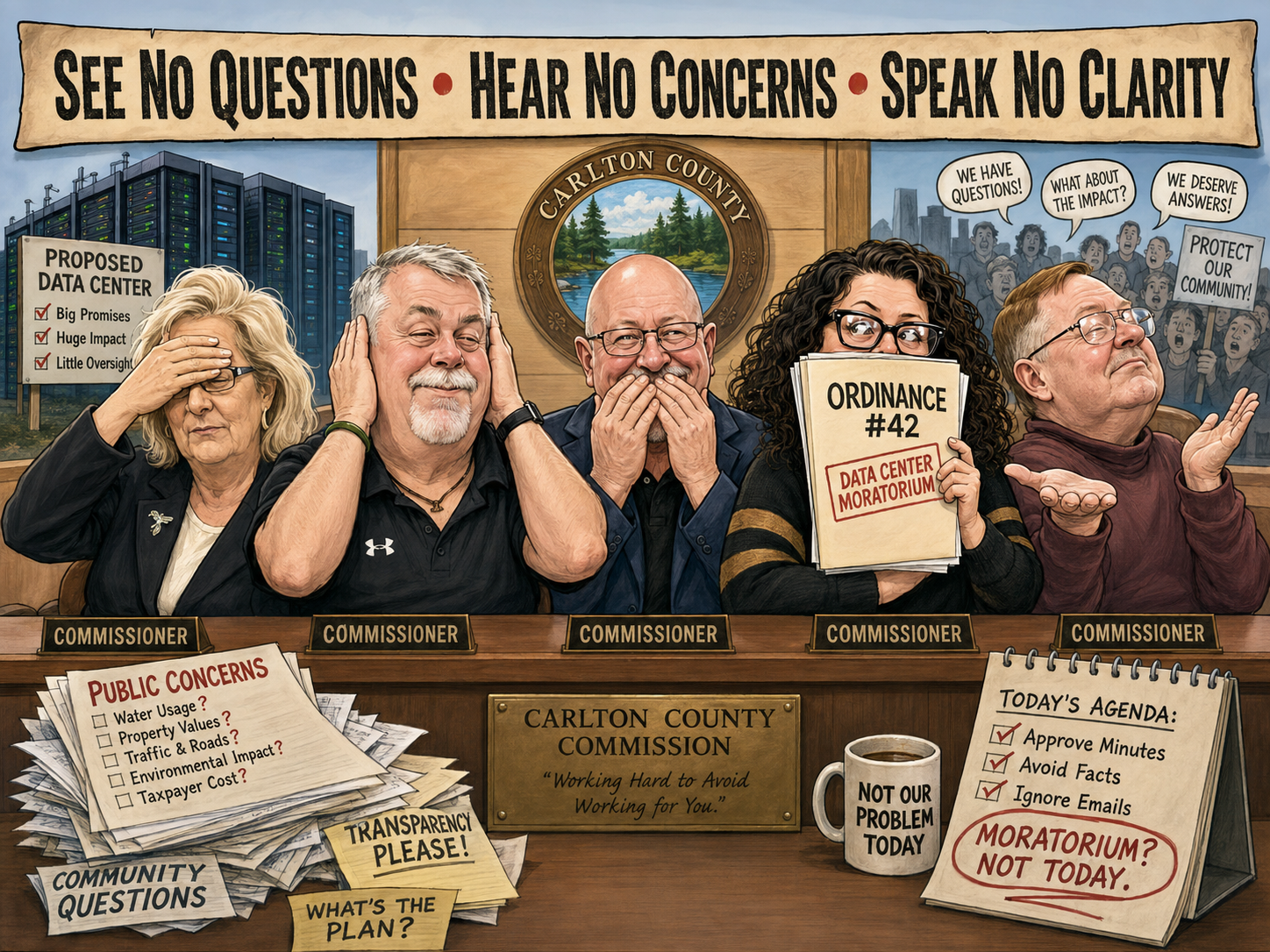
A one-year moratorium may provide Carlton County an opportunity to develop thoughtful protections for residents and the environment. But the language of Interim Ordinance #42 raises an important question: how broadly did the County define a “data center”?
By Carlton County Watch
Carlton County does not need to choose between technological and economic development on one hand and environmental stewardship on the other.
We can — and should — pursue both.
Data centers have the potential to bring substantial investment, construction activity, tax-base growth and new infrastructure into communities willing to host them. At the same time, large data-center developments can raise legitimate questions concerning electrical demand, water usage, noise, cooling systems, backup generators, transmission infrastructure, stormwater, neighboring land uses and eventual decommissioning.
Those concerns deserve thoughtful study.
That is precisely what Carlton County says it intends to do. But will we?
After reviewing the actual language presented to the public, Carlton County Watch believes another question deserves attention: What, exactly, has Carlton County defined as a “data center”?
The answer may be considerably broader than many people expect.
The Definition Matters
The August 24 public-hearing version of Ordinance #42 defines a data center as:
“any facility, building, complex, or campus used for housing computers, servers, storage, or networking equipment used principally to process, transfer, manage, or store digital information.”
The definition goes on to expressly encompass cryptocurrency mining, artificial-intelligence generation and associated infrastructure such as generators, cooling or water-storage systems, utilities, security facilities and other support structures.
Certainly, a massive hyperscale facility containing thousands of servers would fit that definition.
An industrial cryptocurrency-mining operation almost certainly would.
So would the enormous AI-computing campuses increasingly being proposed around the country.
But the ordinance never says large data center.
It never establishes a minimum square footage.
It contains no minimum electrical-demand threshold.
It contains no minimum number of servers.
It contains no minimum acreage.
It contains no rack-density requirement.
And it does not appear to require that operation of a data center be the principal use of the property.
That omission produces some surprisingly difficult questions.
What About the Ordinary Server Room?
Consider a new commercial building constructed by a local business. A hospital. A law office. Your home office.
Inside the building is a dedicated information-technology room containing servers, network switches, storage equipment, backup power supplies and cooling equipment. The servers store company records, run business applications and process digital information.
Is that a “data center”?
Most people probably would say no.
But compare that facility against the words Carlton County actually used.
It is arguably a facility or portion of a building housing computers, servers, storage or networking equipment used principally to process, transfer, manage or store digital information.
That sounds remarkably similar to the ordinance's definition.
The distinction becomes even less obvious if the business constructs a separate small building specifically for its computing infrastructure.
What about a medical clinic operating its own servers?
A bank?
A manufacturing company?
A telecommunications provider?
A research laboratory?
A school?
A township?
A local governmental agency maintaining a dedicated computer or records facility?
We are not saying Carlton County necessarily intends to prohibit those facilities.
Quite the opposite.
We suspect the County's concern is primarily the development of large-scale industrial data centers of the kind described in the ordinance's background section, which specifically discusses artificial intelligence, cloud services, cryptocurrency mining and rapidly increasing demand for new physical data centers.
But that illustrates the problem.
Words matter. See, e.g., Minn. Stat. 645.01, 645.08, or 645.16.
The purpose described by the County and the definition actually written into the ordinance do not appear to have identical boundaries.
If the County intends to regulate only industrial-scale or hyperscale data centers, the ordinance could say that.
One Word Creates Another Interesting Problem: “Principally”
At first glance, the word “principally” might appear to solve the problem.
But look carefully at where it appears.
The ordinance does not clearly define a data center as a building principally used as a data center.
Instead, it describes equipment:
computers, servers, storage, or networking equipment “used principally to process, transfer, manage, or store digital information.”
But that is what servers and networking equipment ordinarily do.
A server in a small business and a server inside a billion-dollar AI facility both process, transfer, manage or store digital information.
If the County intended the principal use of the building or property to be the important distinction, much clearer language could accomplish that.
For example, a permanent ordinance could differentiate ordinary accessory IT infrastructure from facilities in which large-scale computing constitutes the primary land use.
That distinction does not appear clearly in the August 24 language.
“Expanded in Any Way”
There is another phrase worthy of examination.
Section 2.3 provides that no existing data center within Carlton County on the effective date of the ordinance shall be:
“expanded in any way.”
Again, what does that mean?
Suppose an existing business has a facility qualifying under the ordinance's broad definition and replaces six aging servers with twelve new servers.
Has its data center been “expanded”?
What if no additional building is constructed?
What if no zoning permit is required?
What if the physical footprint remains exactly the same but computing capacity doubles?
Does “expanded in any way” refer only to land-use development, or does it encompass expansion of computing equipment inside an existing building?
The surrounding ordinance strongly suggests that Carlton County is primarily addressing zoning and land-use development. Section 2.3 separately states that proposals for conditional uses, interim uses, variances, subdivisions or rezonings related to data-center development will not be accepted or processed during the moratorium.
That context could support a narrower interpretation.
But government regulations should not require businesses and property owners to guess what their regulators meant.
They should say what they mean. Again, words matter!
Does the Moratorium Apply Everywhere Geographically Located in Carlton County?
There is another important issue.
Section 2.3 uses broad language prohibiting creation or operation of a data center “within Carlton County.”
Read by itself, that phrase might lead someone to believe the moratorium applies equally in Moose Lake, Barnum, Kettle River, Wrenshall, Cloquet and every other municipality geographically located inside Carlton County.
But another provision of the same ordinance is considerably more specific.
Section 2.1 states that the interim zoning restrictions are imposed pursuant to Minn. Stat. § 394.34 “and the jurisdictional authority of the Carlton County Zoning Ordinance #27.”
That distinction matters.
Carlton County's own Zoning and Environmental Services Department currently states that the County is the zoning authority throughout Carlton County except the cities of Barnum, Carlton, Cloquet, Cromwell, Kettle River, Moose Lake, Scanlon, Wrenshall and Wright, as well as Thomson Township, subject to certain identified shoreland exceptions.
Minnesota law likewise provides a mechanism through which a municipality may request county planning and zoning services and county official controls may be adopted within municipal boundaries. That statutory structure would make little sense if county zoning ordinances automatically controlled every incorporated city simply because the city sits geographically within a county.
Thus, based upon the language presently available, Carlton County Watch does not read the words “within Carlton County” as automatically extending Ordinance #42 into municipalities where Carlton County itself says it is not the zoning authority.
But this is exactly the kind of issue the County should clarify publicly.
What About Government-Owned Facilities?
There is an equally interesting question concerning public facilities.
Section 2.3 does not prohibit only private corporations from creating data centers. Its prohibition applies broadly to any “person, firm, entity, or corporation.”
Minnesota's county-zoning statutes also provide that, where county official controls are effective, those controls apply to land used for both private and public purposes, while specifically excluding land owned or leased by the federal or state government from county official controls.
That raises another perfectly legitimate question:
If Carlton County, a township or another local public entity wished to construct a new dedicated server facility in an area subject to Carlton County zoning during the moratorium, would Ordinance #42 prohibit it?
Again, perhaps that was never the County's intent.
But the language deserves an answer.
Even the Draft Contains an Apparent Cross-Reference Problem
There is also what appears to be a drafting error.
Near the conclusion of the data-center definition, the ordinance states that:
“The temporary restrictions set forth in Section 1.1 shall apply to any pending or future zoning applications.”
But Section 1.1 is titled “Purpose.”
The actual moratorium and prohibitions appear principally in Article II — Sections 2.1 through 2.3.
This may ultimately amount to nothing more than an incorrect internal cross-reference.
But when an ordinance can affect property rights, development decisions and potentially millions of dollars in investment, careful drafting matters.
A Moratorium Can Be a Useful Tool
None of these questions means that Carlton County was wrong to pause and study the issue.
Minnesota law expressly gives counties authority, under certain circumstances, to adopt temporary interim zoning measures while studying comprehensive plans or official controls. Minn. Stat. § 394.34 authorizes such temporary regulation for purposes relating to public health, safety and general welfare.
A one-year study period could be put to very good use.
Carlton County can examine water consumption.
Electrical infrastructure.
Noise.
Setbacks.
Backup generation.
Emergency response.
Stormwater.
Tax implications.
Road impacts.
Decommissioning requirements.
Environmental safeguards.
And perhaps most importantly, the County can determine what size and type of computing facility actually requires special land-use regulation.
That is how reasonable regulation should work.
Carlton County Does Not Have to Choose
The debate over data centers should not be reduced to two camps.
One side does not have to argue that every proposed development should be approved without restriction.
The other does not have to argue that technological development represents an environmental threat that should simply be prohibited.
There is a substantial middle ground.
Carlton County can welcome responsible technological investment while establishing reasonable protections for water, energy infrastructure, neighboring property owners and the environment.
Those goals are not mutually exclusive.
Indeed, good planning should accomplish both.
But good planning also requires clear definitions.
A multinational corporation considering a billion-dollar development should know the rules.
A local business building a server room should know whether those rules apply to it.
A municipality should know whether County Ordinance #42 applies within its boundaries.
A township should know whether its computer infrastructure could qualify.
And Carlton County residents should know precisely what their elected government has temporarily prohibited.
Questions Carlton County Watch Believes Deserve Answers
Carlton County Watch intends to seek clarification from County officials concerning several straightforward questions:
Is there a minimum size, electrical load, acreage, computing capacity or other threshold before a facility becomes a “data center” under Ordinance #42?
Can a dedicated server or network room within an otherwise ordinary commercial building qualify as a data center?
What does the prohibition against expanding an existing data center “in any way” encompass? Does it include merely adding servers or computing capacity inside an existing building?
Does Carlton County interpret Ordinance #42 as applying within incorporated municipalities such as Moose Lake, Barnum, Kettle River or Wrenshall where Carlton County says it is not ordinarily the zoning authority?
Does the ordinance apply to data or server facilities developed by Carlton County, townships or other local governmental entities within County zoning jurisdiction?
Was the reference to temporary restrictions in “Section 1.1” intentional, or should that provision reference Article II or another section of the ordinance?
Will the permanent ordinance distinguish large industrial or hyperscale data centers from ordinary accessory computer and server infrastructure?
These questions are not arguments against environmental protection.
They are not arguments against the moratorium.
And they are certainly not arguments against data centers.
They are questions about clarity.
The Opportunity Ahead
Carlton County now has an opportunity.
If this one-year period is used thoughtfully, the County can produce regulations that protect its natural resources and communities while providing enough certainty for responsible companies to invest here.
That should be the goal.
Economic development and environmental stewardship can coexist.
Carlton County should not have to sacrifice one to achieve the other.
But before permanent regulations are written, the County should begin with one fundamental question:
What exactly is a “data center”?
Because under the language presently before the public, the answer may be much broader than anyone intended.
Editor's Note:Carlton County Watch's analysis is based upon the August 24, 2026 public-hearing version of Interim Ordinance #42. As of September 1, Carlton County's ordinances webpage continues to identify the posted document as “DRAFT Interim Ordinance on Data Centers.” Carlton County Watch will review the final signed ordinance when it becomes publicly available and will correct or update this analysis if the final enacted language differs.