The Man Who Was Punched In The Face — and Then Prosecuted
Carlton County Watch Investigative Series | Part One
An October 17, 2024 assault, a dismissed prosecution, disputed 911 calls, and questions about the Carlton County Attorney's Office. With a jury trial scheduled for November 2, 2026, the public deserves to understand how this case developed.
When the alleged victim becomes the defendant
On October 17, 2024, a confrontation involving Leonard L. Simich (former public employee and former manager of Southwest Transit) and a Carlton County resident whom we will identify as "M" resulted in an extraordinary sequence of events.
Simich violently assaulted M, punching M in the face and causing significant injuries. Law enforcement responded, and Simich was arrested and subsequently charged.

But the criminal prosecution against Simich was later dismissed. And, without explanation. But we know some of the reasons why: as a favor to Simich, as a hatred of M by the County Attorney and County Sheriff, and corruption of Amy Voss and Lauri Ketola.
M, meanwhile, now faces misdemeanor charges involving disorderly conduct and his use of the 911 emergency telephone system during the aftermath of the confrontation.
The central question is difficult to ignore:
How did the individual who was struck in the face end up facing criminal prosecution while the individual accused of striking him had his case dismissed?
This is not merely M's description of what occurred.
At a July 17, 2026 hearing before Carlton County District Court Judge Amy Lukasavitz, defense attorney Michael Holland emphasized that M had been punched, that Simich had initially been arrested and charged, and that the prosecution against Simich was subsequently dismissed.
Assistant County Attorney Demonte Noble acknowledged that M had been punched in the face.
The dismissal that raises unanswered questions
The Simich prosecution, Court File No. 09-CR-24-1731, was handled by the Carlton County Attorney's Office.
Assistant County Attorney Amy Voss was associated with the decision to dismiss the case.
An important circumstance surrounds that decision.
Before entering public service, Voss worked as an associate attorney at Halberg Criminal Defense. Attorney Marsh Halberg, associated with that same firm, represented Leonard Simich.
Carlton County Attorney Jeffrey Boucher maintains that Voss ended her employment with the firm in August 2022. Apparently this is not true.
A preserved version of the firm's website nevertheless continued to identify Voss as an attorney in June 2026.
The relevant questions concern whether a conflict review occurred, whether appropriate safeguards were considered, and how the decision to dismiss the Simich prosecution was reached.
Carlton County Watch previously examined this issue in its reporting, When the Prosecutor Came from the Defense Firm.
M also points to multiple harassment restraining orders (HRO), a domestic assault no contact order (DANCO) and two orders for protection (OFP) involving Simich, which M remain in effect following a July 2026 renewal by the Court.
A 911 call following a reported assault
Another central question concerns M's calls to 911.
M maintains that the calls were legitimate requests for emergency law-enforcement assistance arising from the confrontation and his concerns about the response at the scene.
There is no doubt that M was violently assaulted. The Sheriff’s Deputies acknowledged that M was assaulted. The paramedics evaluated and treated M for injuries sustained from the assault. The County Attorney agrees that M was assaulted.
If it quacks like a duck then it is most likely a duck.
The State argues that the emergency had ended and that M improperly continued contacting 911, including requesting assistance from the Minnesota State Patrol.
Minnesota Statutes §609.78 prohibits certain emergency calls made with knowledge that no qualifying emergency exists.
That knowledge requirement is important.
A person who genuinely believes emergency assistance remains necessary presents a substantially different factual question from someone who knowingly calls 911 when no emergency exists.
M has maintained that an emergency existed.
Carlton County Sheriff's Office Tells Residents to Call 911 — Even When There Is No Emergency
The public also has an interest in ensuring that individuals who have experienced violence are not discouraged from seeking emergency assistance.
Perhaps one of the most surprising aspects of this prosecution involves the Carlton County Sheriff's Office's own published instructions to the public.
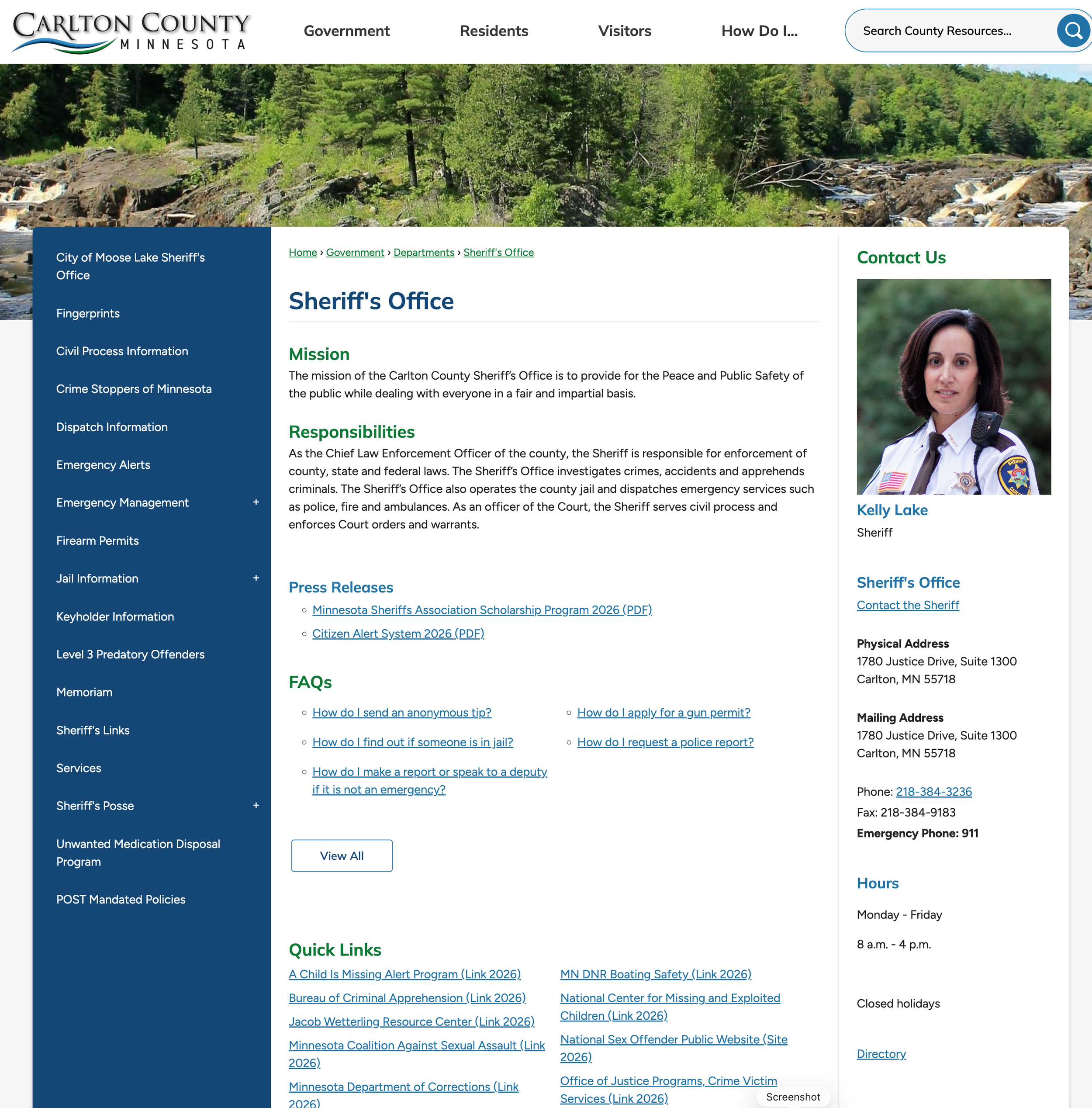
On its official website, the Sheriff's Office provides guidance for residents who wish to contact a deputy or report an incident that does not constitute an emergency.
Its instructions expressly direct residents to call 911, “whether or not it is an emergency situation.”
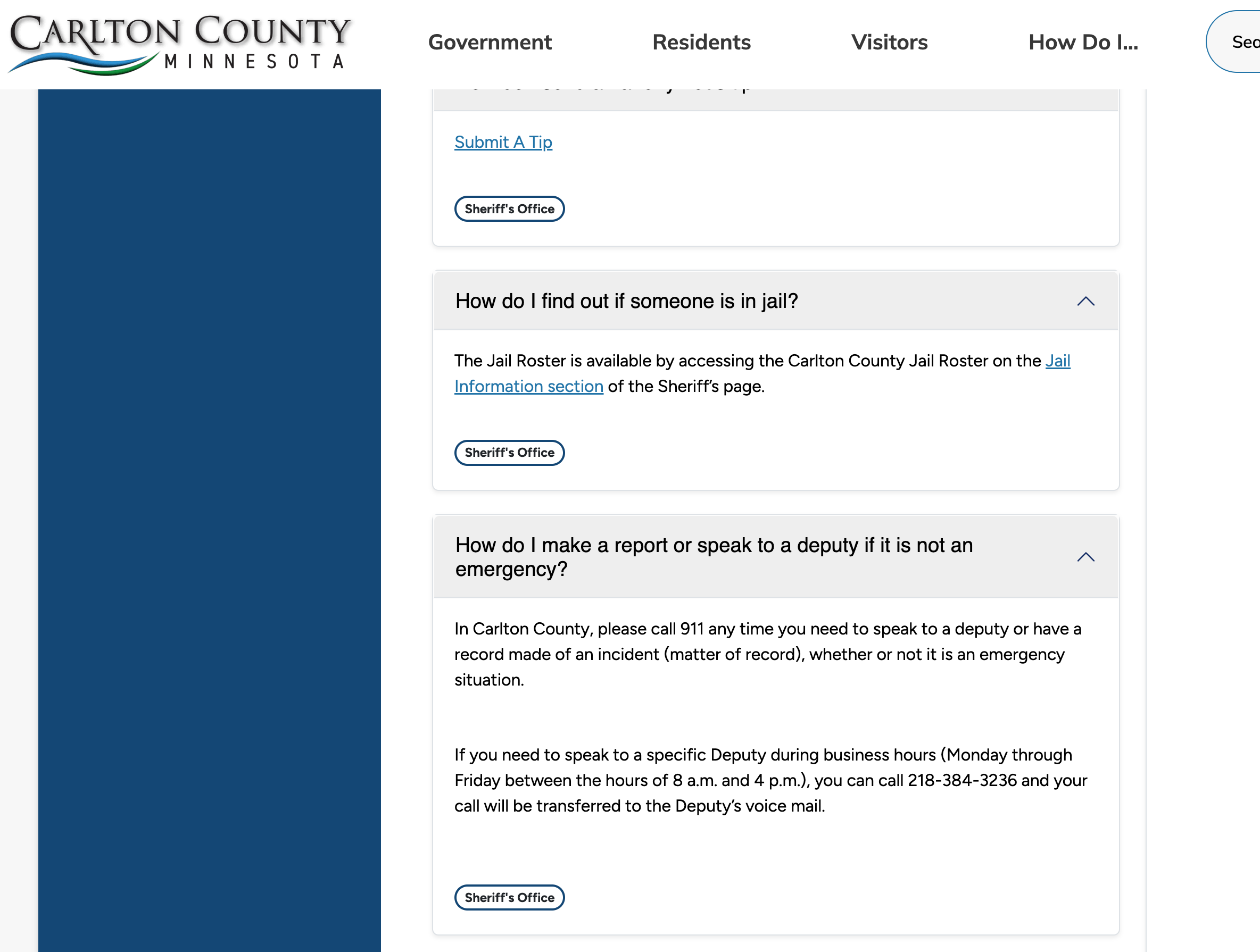
That guidance remains publicly available on the County's website as of October 19, 2026.
Read the Sheriff's Office's official instructions.
Yet Carlton County is prosecuting M for his use of 911 following an actual physical confrontation in which he was punched in the face.
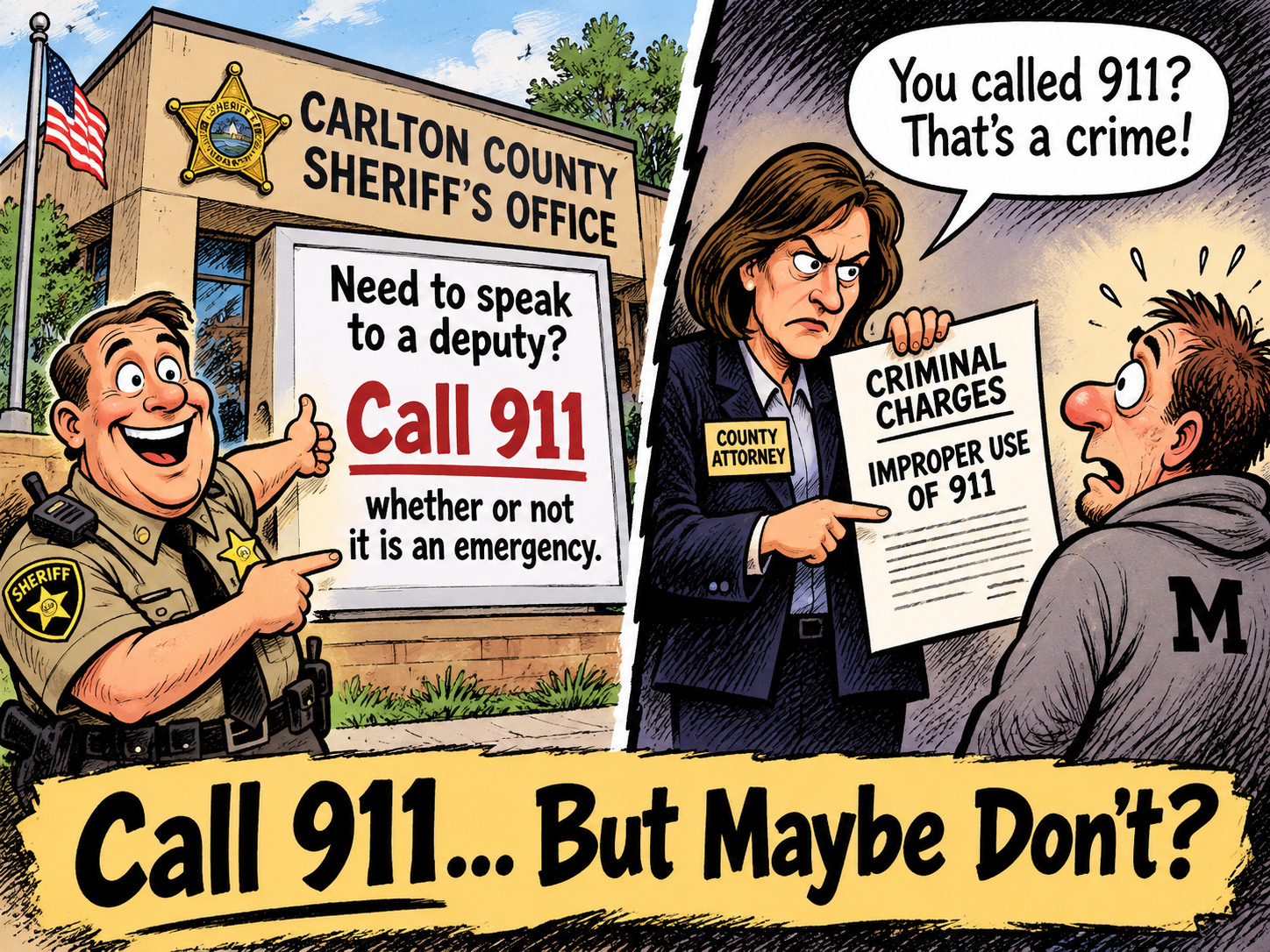
During the July 17, 2026 hearing, Assistant County Attorney Demonte Noble argued that M's subsequent calls were improper because the emergency had ended. The defense maintains that M had legitimate reasons to request additional law-enforcement assistance.
We disagree with Noble. We have reviewed the publicly available body camera footage and the 911 calls and there was CLEARLY and emergency situation.
This raises an obvious question:
If Carlton County Sheriff's Office publicly instructs residents to call 911 even for nonemergency police assistance, how does the County distinguish an authorized request for assistance from a criminal misuse of the same telephone system?
Citizens should not have to guess whether following their Sheriff's published instructions could expose them to criminal prosecution.
Citizines should not fear a criminal charge because they call 911 to report an emergency; whether or not it is an emergency; we support the Sheriff’s official position:
CALL 911!
Carlton County Watch believes the public deserves a clear explanation of how the Sheriff's guidance is reconciled with the County Attorney's interpretation of Minnesota law.
Is criticism of law enforcement a crime?
M's remaining charge concerns disorderly conduct.
The defense maintains that M's statements to responding deputies, including heated criticism and language, were constitutionally protected.
We agree with M.
The First Amendment generally protects criticism of government officials, including speech that those officials consider insulting or upsetting.
Both the Minnesota Supreme Court and the United States Supreme Court AGREE with M.
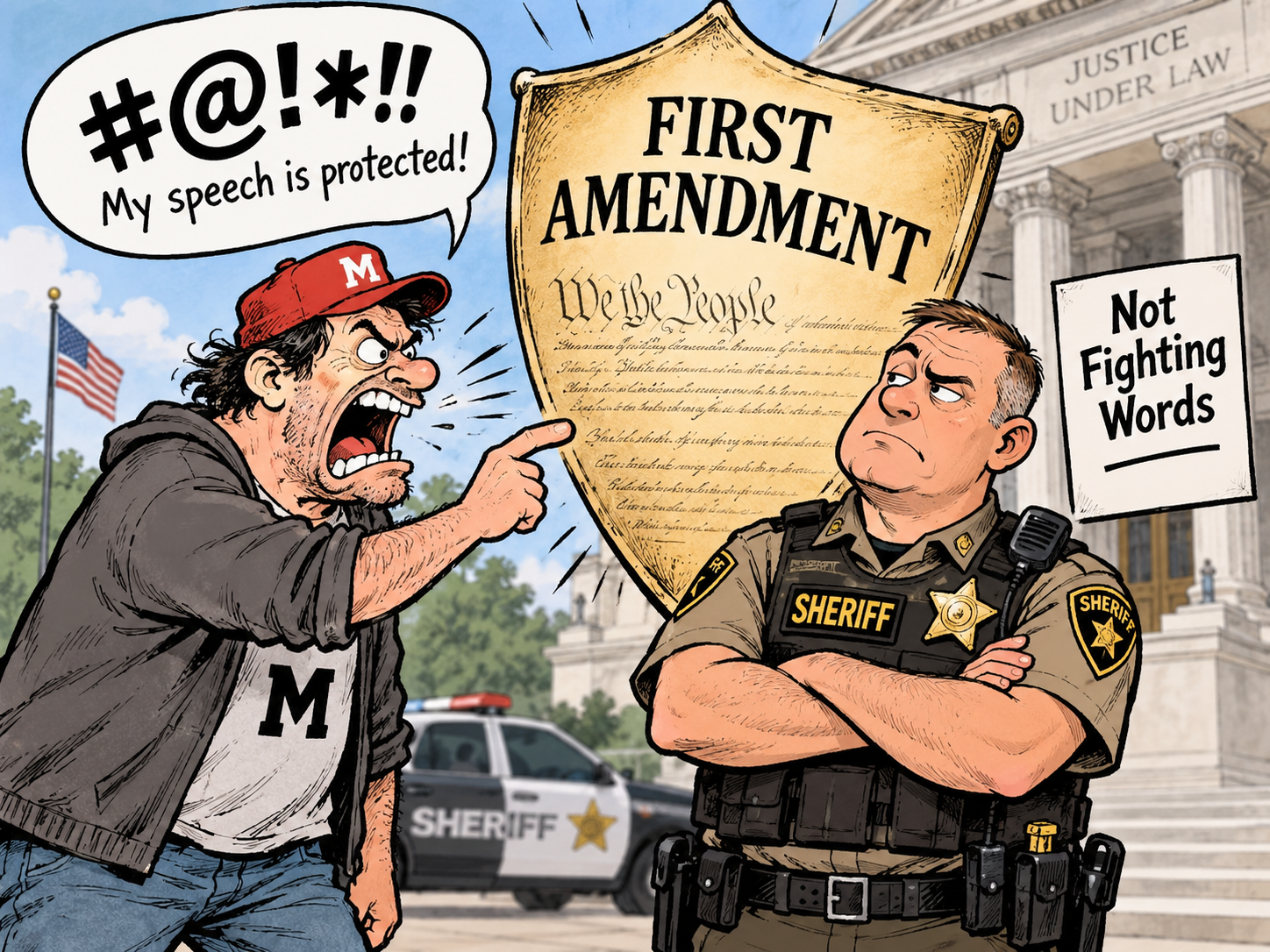
Minnesota courts have repeatedly recognized constitutional limits on prosecuting offensive language as disorderly conduct.
There are limits to that protection, particularly where separate threatening, fighting, or disruptive conduct is established. The prosecution has argued that M's alleged behavior extended beyond speech alone.
We DISAGREE with the County. M’s language is protected by the Constitution.
From review of public data, at no time did M threaten law enforcement or use “fighting words” to anyone.
A citizen does not surrender First Amendment protections merely because that citizen is angry with the government.
One First Amendment — for Every American
The First Amendment does not distinguish between Republicans and Democrats, conservatives and liberals, or supporters and critics of government.
It protects a Republican publicly expressing support for President Donald Trump. It protects a Democrat participating in a peaceful No Kings demonstration opposing President Trump. And it protects a citizen criticizing the actions of a Carlton County sheriff's deputy.
The Constitution does not require citizens to be polite, agreeable, or complimentary toward government officials before their speech receives protection.
Consider the implications if offensive language, raised voices, or expressions of anger toward government were sufficient, by themselves, to establish disorderly conduct.
Political demonstrators could face punishment merely for expressing unpopular opinions. Citizens attending county board meetings could risk prosecution for heated criticism of elected officials. Individuals confronting what they perceive as official misconduct could find themselves facing criminal charges for their words rather than having their grievances heard.
The United States Supreme Court addressed this concern in City of Houston v. Hill, 482 U.S. 451 (1987), recognizing substantial First Amendment protection for verbal criticism and challenges directed toward police officers.
Minnesota courts have similarly held that offensive and profane remarks directed at law enforcement do not automatically constitute criminal fighting words.
Offending a government official is not, by itself, a crime.
M maintains that, following an assault, he expressed his anger and frustration at deputies whose handling of the investigation he believed was improper.
The First Amendment protects the right to challenge government precisely because government officials do not always welcome being challenged.
If we want those protections for people whose political views we share, we must recognize that the same protections extend to people whose views, words, and manner of expression we find objectionable.
Constitutional rights do not depend on which political party controls the government — or whether a sheriff's deputy appreciates the criticism.
County Attorney Boucher's unusual reliance on Google searches
The case took another turn on May 28, 2026.
In a four-page letter to M's defense counsel the was shared with the Carlton County Watch, County Attorney Jeffrey Boucher challenged numerous factual allegations contained in a defense motion seeking dismissal for vindictive prosecution.
M has been a long time public data advocate and has sought advisory opinions against the County and has also filed lawsuits against the County.
Among Boucher's assertions was that M's public-data advocacy, litigation, and alleged media coverage had not produced the public attention claimed by the defense.
To challenge that account, Boucher reported conducting a series of Google searches and examining their news results.
Seriously … our County Attorney rests a criminal charge on Google searches. What a clown!
There is a fundamental problem with treating a Google News search as an exhaustive test of historical media coverage.
Google is a search engine, not a complete archive of every article, public record, lawsuit, news report, or government controversy.
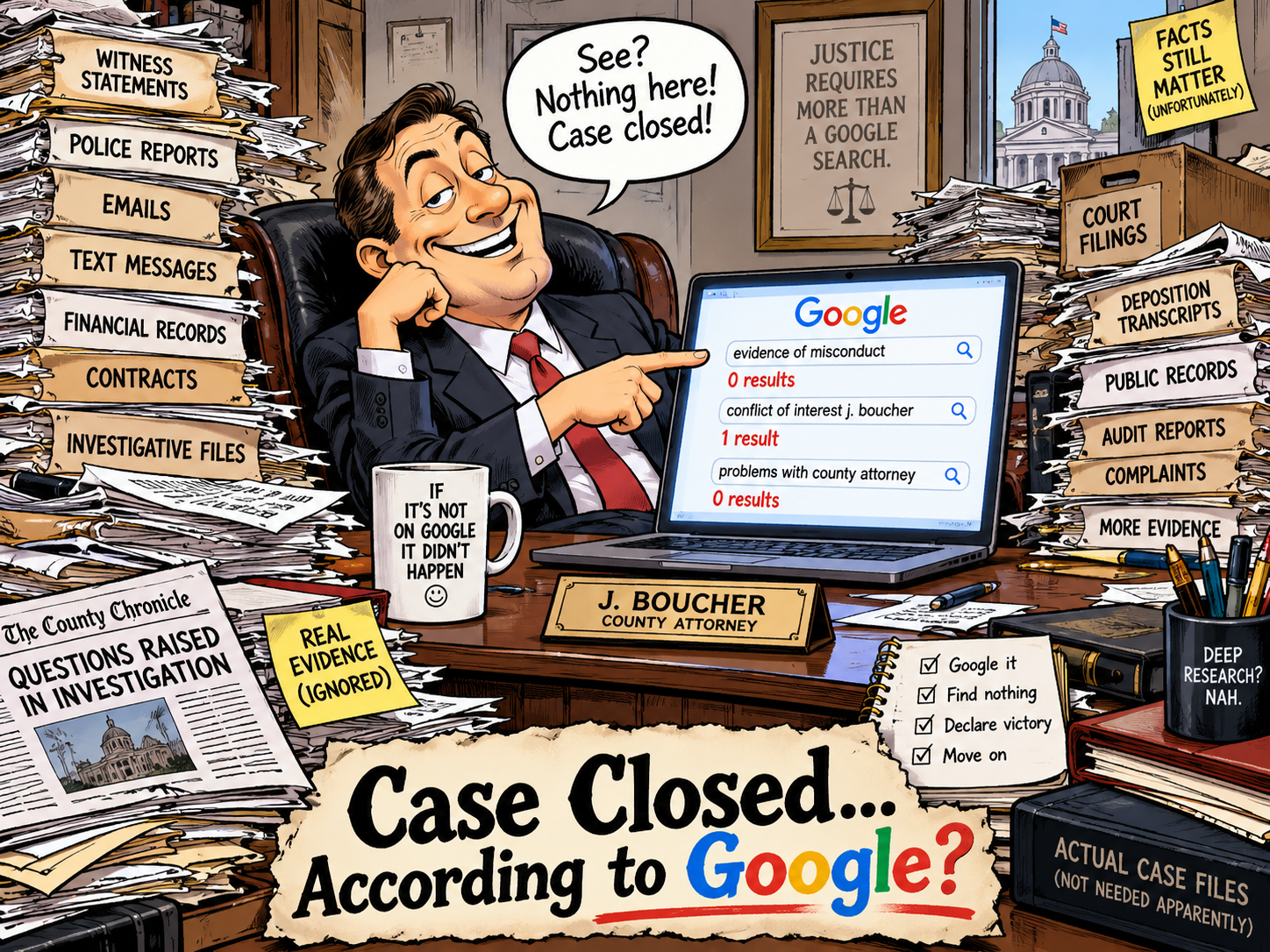
Google itself explains that search results can vary with location, language, settings, and other factors.
A search returning zero results establishes only what that particular search returned under those particular conditions. It does not prove that no relevant reporting ever existed.
Nor can a limited Google News search determine the extent of a person's government-data requests, public advocacy, or participation in public controversies.
The existence of particular lawsuits is a separate, verifiable question that should be resolved using court records, docket numbers, and actual filings.
M disputes Boucher's characterization of his litigation and public advocacy. The defense testified to public-data requests, litigation, and encounters with Carlton County officials.
Carlton County Watch intends to examine the documentary evidence behind these competing claims in subsequent installments.
Public officials should welcome that scrutiny.
The allegation of retaliatory prosecution
M has long maintained that his prosecution reflects hostility connected to his government-transparency activities and disputes with Carlton County officials.
His defense raised the issue through a motion alleging vindictive prosecution.
The underlying questions about governmental discretion and the evidence supporting the charges remain subjects of legitimate public interest.
A jury trial approaches
As of this publication, M is scheduled to face a jury trial in Carlton County District Court on November 2, 2026, just one day before Minnesota's general election.
M disputes the charges and maintains that the 911 calls were justified and that his speech was constitutionally protected.
The State contends that his conduct violated Minnesota law.
M is presumed innocent unless and until the State proves guilt beyond a reasonable doubt.
The public should not prejudge the case. Neither should the public be discouraged from asking legitimate questions about the government's decisions.
Why were the charges against Simich dismissed? How were the two cases evaluated? What was the factual basis for determining that M's calls were not legitimate emergencies? And what evidence supports the State's distinction between protected speech and criminal disorderly conduct?
These questions deserve documented answers.
This investigation is just beginning
In the coming installments, Carlton County Watch will examine the May 28 letter, the July 17 hearing transcript, the reported history of public-data litigation and media coverage, the 911 records, and the legal and factual issues presented by the charges.
The purpose is not to decide a criminal case through newspaper commentary.
It is to ensure that official statements, prosecutorial decisions, and government conduct are subject to meaningful public scrutiny.
The First Amendment was not written to protect only pleasant conversations and popular opinions. Its protections matter most when citizens challenge government authority. Whether someone supports President Trump, protests his administration, or criticizes a Carlton County sheriff's deputy, the same Constitution applies. The question is whether our government honors those protections when it is the target of the criticism.
Justice requires accountability. And accountability begins with the record.
Editor's note: This article distinguishes documented court proceedings, allegations made by the defense, and positions taken by the prosecution. The prosecution and defense are entitled to have their evidence considered under the applicable rules of law. This series will publish corrections or material responses when warranted.