Carlton County Sheriff's Office Complaint Records: What the First Production Reveals — and What Remains Unanswered
Records identify complaints involving multiple deputies and investigators. But questions remain about the underlying complaint records, oversight procedures, and the completeness of the Sheriff's response.
An ongoing Carlton County Watch investigation | October 2026
By Carlton County Watch
When a citizen files a complaint against a Carlton County Sheriff's deputy, what happens next?
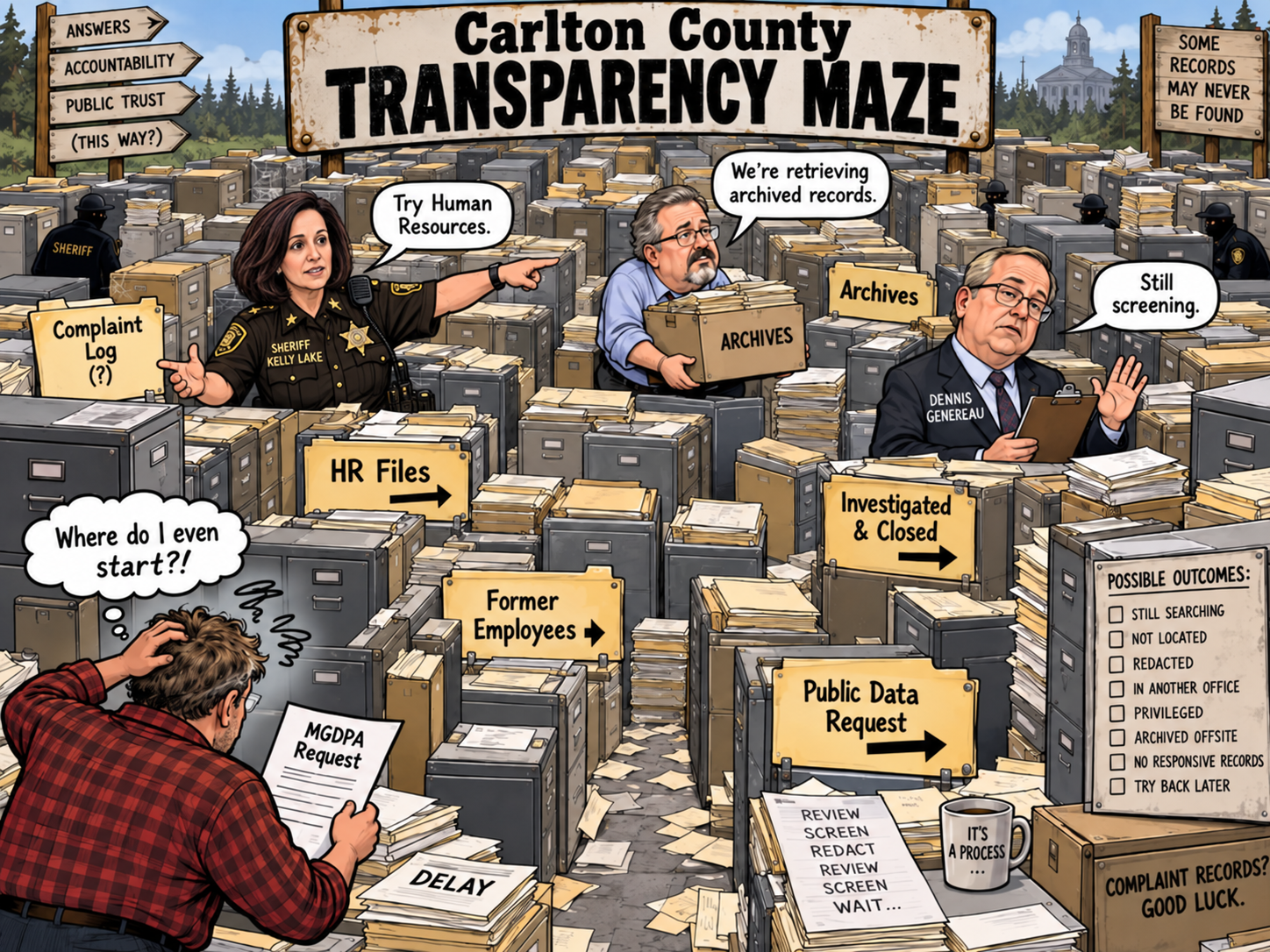
Is the complaint formally documented? Who investigates it? What findings are made? What corrective action, if any, follows? And how can the public determine whether the Sheriff's Office is holding its own personnel accountable?
These questions formed the basis of an earlier Carlton County Watch investigation into the Sheriff's personnel-complaint procedures.
Now, following a private citizen’s Minnesota Government Data Practices Act (MGDPA) request submitted July 29, 2026, additional records have become available.
Those records identify complaints involving multiple deputies and law-enforcement investigators during Sheriff Kelly Lake's administration.
But they also leave important questions unanswered.
What were the outcomes of these complaints? What underlying public records exist? And why has obtaining a complete picture of the Sheriff's complaint system required additional requests to Carlton County Human Resources?
These are questions about public accountability, government transparency, and the supervision of employees entrusted with law-enforcement authority.
The Sheriff's Office Identifies Nine Complaints Involving Eight Law-Enforcement Personnel
Among the materials made available during a September 28, 2026 inspection were unsigned summary sheets identifying employees who had been the subjects of complaints.
One summary, covering January 1, 2024, through March 24, 2026, identifies 17 complaint matters involving 11 Sheriff's Office employees across multiple job functions.
For this installment, Carlton County Watch is focusing on the eight identified deputies or law-enforcement investigators whose entries account for nine of those complaint matters.
The Sheriff's Office provided the following information:
Employee Complaints Reported Status
Justin Frykman 1 Investigated and closed
Georgia Gates 1 Investigated and closed
Nils Hansen. 2 Investigated and closed
Justin Jokinen 1 Investigated and closed
Tyler Ojibway 1 Investigated and closed
Ryan Rennquist 1 Investigated and closed
James Stracek 1 Investigated and closed
Jason Warnygora 1 Investigated and closed
Total 9
Source: Sheriff's Office complaint summary made available for inspection September 28, 2026. Job classifications have been checked against publicly available employment information.
An important distinction: The existence of a complaint does not establish that the employee engaged in misconduct. A complaint may be unfounded, the employee may be exonerated, or an investigation may be unable to substantiate an allegation.
The summary identifies the existence of complaints and reports their status as investigated and closed. It does not describe the allegations or provide a separate finding for each complaint.
The Sheriff's Office also supplied disciplinary correspondence involving other employees, which is not individually detailed in this installment.
Our focus here is on sworn law-enforcement personnel and the procedures used to document, investigate, review, and disclose information about complaints.
An Earlier Summary Identifies Additional Complaints
A separate Sheriff's Office document covers February 4, 2021, through 2023.
It identifies complaints involving several of the same law-enforcement personnel, including
Georgia Gates,
Nils Hansen; and
Justin Jokinen.
It also identifies complaints concerning former Deputy Robert Lucas and Deputy David Radzak.
These matters are described as complaints received and closed, without individual complaint dates, descriptions, or detailed investigative outcomes.
The document also advises the requester to contact Carlton County Human Resources regarding former employees because the Sheriff's Office does not maintain all former-employee data.
That raises an important administrative question.
If public complaint information concerning Sheriff's Office personnel is maintained in different County departments, what procedures ensure that a request to the Sheriff results in a coordinated and complete search?
The existence of records in Human Resources does not necessarily mean those records are missing or improperly maintained.
But a fragmented response can make it difficult for the public to understand the complete history of complaints within a law-enforcement agency.
Sixty-One Days Between the Original Request and Inspection
The original public-data request was submitted to Sheriff Kelly Lake on July 29, 2026.
It sought existing public information concerning employee complaints, disciplinary actions, and final dispositions from January 1, 2020, forward.
The Sheriff's Office acknowledged the request that same day.
Over the following weeks, the requester submitted multiple inquiries seeking information about the status of production.
On September 4, Sheriff Lake explained that the request covered more than six years and that she did not consider the time required to compile the records unreasonable.
The requester ultimately inspected the materials on September 28 — 61 days after submission of the initial request.
According to the requester, Sheriff Lake was not present during the inspection, and Chief Deputy Dan Danielson was designated to assist but could not (or would not) answer several substantive questions concerning the records.
Minnesota law allows a responsible authority to designate employees to handle public-data requests. It also provides that a person requesting public data may ask to be informed of its meaning.
The relevant requirement is found in Minn. Stat. § 13.03, which requires government entities to establish procedures for responding to public-data requests appropriately and promptly.
Nevertheless, the processing timeline raises a legitimate question about the Sheriff's Office's ability to locate and explain records concerning its own personnel-complaint system.
What About the Missing Time Periods?
A second issue emerges when comparing the request with the documents supplied.
The July 29 request sought information beginning January 1, 2020, and continuing through completion of the request.
Yet the summaries provided to the data requestor and reviewed by Carlton County Watch begin February 4, 2021, and end March 24, 2026.
This leaves two periods not addressed by those summaries:
January 1, 2020, through February 3, 2021.
March 25, 2026, through the September 28 inspection.
These gaps do not, by themselves, establish that additional complaints existed.
But the public has not yet been provided an explanation establishing whether responsive records were located for those periods, whether no complaints were recorded, or whether relevant information resides elsewhere in County government.
A complete response should make clear what was searched and what public information, if any, remains available for these periods.
What Happened to the Complaint Log and Annual Audits?
This question takes the investigation back to the Sheriff's Office's own written policy.
The currently published Carlton County Sheriff's Office Personnel Complaints Policy, section 1007.5, addresses documentation and tracking.
It directs supervisors to ensure formal and informal complaints are documented on complaint forms.
It also states that complaints and inquiries should be documented in a tracking log, with the nature of the complaint and actions taken recorded.
The policy further contemplates an annual audit of that log and an audit report provided to the Sheriff or authorized designee.
These provisions are significant.
A complaint-tracking system should allow an agency to identify complaints, follow their progress, and examine whether procedures are operating consistently.
The current policy describes such a system. Historical policy versions must still be examined before determining which requirements governed complaints in earlier years.
But the abbreviated complaint summaries reviewed by Carlton County Watch do not, standing alone, establish whether the underlying log and audit procedures were followed.
The public has not yet been shown the complete picture.
Were complaints assigned tracking numbers? Were annual audits performed? Did those audits identify repeated complaints or administrative deficiencies? Were any corrective actions recommended?
Those questions deserve answers supported by records.
Minnesota Law Requires Public Access to Important Complaint Information
Minnesota law does not require disclosure of every allegation, witness interview, or confidential personnel-investigation document.
However, Minn. Stat. § 13.43, subdivision 2(a)(4), generally makes public the existence and status of complaints or charges against government employees, even when no discipline results.
Subdivision 2(a)(5) additionally makes public the final disposition of qualifying disciplinary actions, specific reasons for the action, and public data documenting its basis, subject to applicable restrictions.
These distinctions matter.
A statement that a complaint was investigated and closed conveys information, but it does not necessarily establish whether the complaint was substantiated, whether disciplinary proceedings occurred, or whether additional information has become public following a final disciplinary disposition.
Not every underlying investigative record is publicly accessible merely because a complaint is closed.
The question is whether the Sheriff's Office has provided all information that Minnesota law classifies as public — not whether every private personnel record should be disclosed.
Government Records Must Also Be Properly Maintained
Public-data access is only one part of the accountability equation.
Minnesota law also establishes requirements concerning the creation, preservation, management, and lawful disposition of official government records.
Minn. Stat. § 15.17 generally requires government agencies to make and preserve records necessary to provide an accurate account of their official activities.
Minn. Stat. § 138.17 governs government-records management, retention schedules, and authorized disposition.
Carlton County also maintains records-retention schedules addressing personnel and other government records.
These requirements do not mean every complaint record must be retained permanently. Applicable retention periods depend on the record category and governing schedule.
But they create legitimate questions whenever requested records cannot be located:
Were the records created? Where were they maintained? Have they been transferred to another County department or archive? If destroyed, was that destruction authorized under the applicable retention schedule?
These are not accusations of unlawful destruction.
They are questions designed to determine whether the County's recordkeeping practices can be documented and independently evaluated.
Carlton County Human Resources Is Now Searching for Additional Records
Following the September inspection, a second MGDPA request was submitted on October 1, 2026, to County Administrator Dennis Genereau and County Human Resources.
That request specifically sought public personnel data maintained outside the Sheriff's Office, including information concerning former employees, complaint dispositions, disciplinary matters, grievance proceedings, and records-retention documentation.
On October 8, County Human Resources Director Gary Jackson acknowledged the request.
Jackson explained that the County was screening records and retrieving archived materials and would contact the requester when the information was ready for inspection.
As of October 15, the additional production remains outstanding according to the correspondence reviewed by Carlton County Watch.
Jackson's response indicates that additional records are being searched for and retrieved. It does not establish that the County has refused to produce them.
But the process raises a broader question:
Why was a separate request to County Administration and Human Resources necessary to pursue records concerning Sheriff's Office personnel after the original request had expressly identified other County record custodians?
That is a question for the Sheriff's Office and County Administration to clarify.
The Responsibility for Oversight Rests With the Sheriff's Administration
Individual deputies are responsible for their own conduct.
But the Sheriff is responsible for administering a law-enforcement organization with systems for receiving complaints, investigating allegations, supervising employees, maintaining records, and complying with applicable public-disclosure laws.
Sheriff Kelly Lake has overseen the Carlton County Sheriff's Office during the periods examined in these records.
An effective complaint-accountability system serves multiple purposes.
It protects citizens when allegations of misconduct are substantiated. It protects employees from unsupported accusations. It allows supervisors to identify recurring problems. And it creates a documented record of how government authority has been exercised.
The limited complaint information disclosed so far does not establish that the Sheriff's Office failed to investigate the identified matters.
Indeed, the summary expressly describes the more recent complaints as investigated and closed.
What remains unclear is how those reported outcomes correspond to the underlying complaint-tracking records and what additional information is legally available to the public.
That uncertainty should be resolved through records and explanations, not speculation.
Questions That Remain Unanswered
Carlton County Watch will continue examining the available evidence and seeking clarification concerning the following:
What existing public data document the status of the complaints identified in the Sheriff's summaries?
Were complaint numbers or tracking identifiers assigned to each matter?
Does the Sheriff's Office maintain the complaint-tracking logs described in its published policy, and do the publicly disclosable portions reconcile with the summaries provided?
What annual complaint-log audits and audit reports were completed during the requested periods?
What explains the absence of summary information for January 2020 through early February 2021 and for the period after March 24, 2026?
Which complaint and disciplinary records are maintained by Human Resources rather than the Sheriff's Office?
Were any responsive records lawfully destroyed, transferred, or archived under approved records-retention schedules?
What procedures ensure that a requester can obtain an explanation of public data supplied for inspection?
These questions are directed toward identifying the actual record, not prejudging what that record will establish.
Public Accountability Requires More Than a Written Policy
The central question raised by this investigation is not whether Sheriff's Office employees have ever been the subjects of complaints.
The records establish that complaints have occurred.
Nor should anyone assume that a complaint, standing alone, proves wrongdoing.
The more important question is whether Carlton County maintains a complaint-accountability system that can be meaningfully examined through the public records Minnesota law makes available.
Sheriff Lake's administration has produced information identifying complaints involving law-enforcement personnel.
That is a starting point.
But the underlying recordkeeping questions remain unresolved, and the County's additional records search is ongoing.
Carlton County Watch will report further findings as additional documents become available.
The public deserves an accurate account of how complaints are handled, employees deserve fair treatment, and the Sheriff's Office deserves to have its practices evaluated against the actual record.
The next step is straightforward:
Produce the public records. Explain the remaining gaps. Let the documentation establish what happened.
Carlton County Watch welcomes factual corrections, responsive public documents, and additional information concerning Sheriff’s Office complaint-handling procedures. Readers with relevant records may contact the publication at carltoncountywatch@gmail.com.
This article is based on records made available during the September 28, 2026 inspection, subsequent MGDPA correspondence, and publicly available Minnesota statutes and Sheriff's Office policies. Reporting will be updated as additional information becomes available.