Democratic Party victories do not establish the Democratic Party a moral superiority, just as Republican Party victories do not establish Republican Party a moral superiority. A closer examination of political history and Minnesota's government fraud scandals raises important questions about accountability, consistency, and the meaning of decency.
by Carlton County Watch
On November 6, 2026, the Pine Knot News published an editorial titled Our View: A referendum on basic decency, celebrating Democratic victories in the November 3 midterm elections.
The editorial presents these victories not merely as a change in political direction, but as a moral reckoning — a triumph of decency over cruelty, compassion over abuse, and enlightened voters over those who supported President Donald Trump and Republican candidates.
That interpretation deserves scrutiny.
An election determines who holds public office. It does not determine who possesses moral virtue.
The Pine Knot is entitled to celebrate its preferred candidates and criticize Republican policies. But there is an important difference between criticizing government decisions and suggesting that an electoral victory demonstrates the moral superiority of one political constituency over another.
The editorial concludes by encouraging Americans to recognize common values, respect differences, and come together.
Those are worthwhile aspirations. Yet its preceding rhetoric raises a question: Can a newspaper effectively advocate political reconciliation while describing the election as a rejection of cruelty and abuse associated with one side of the political divide?
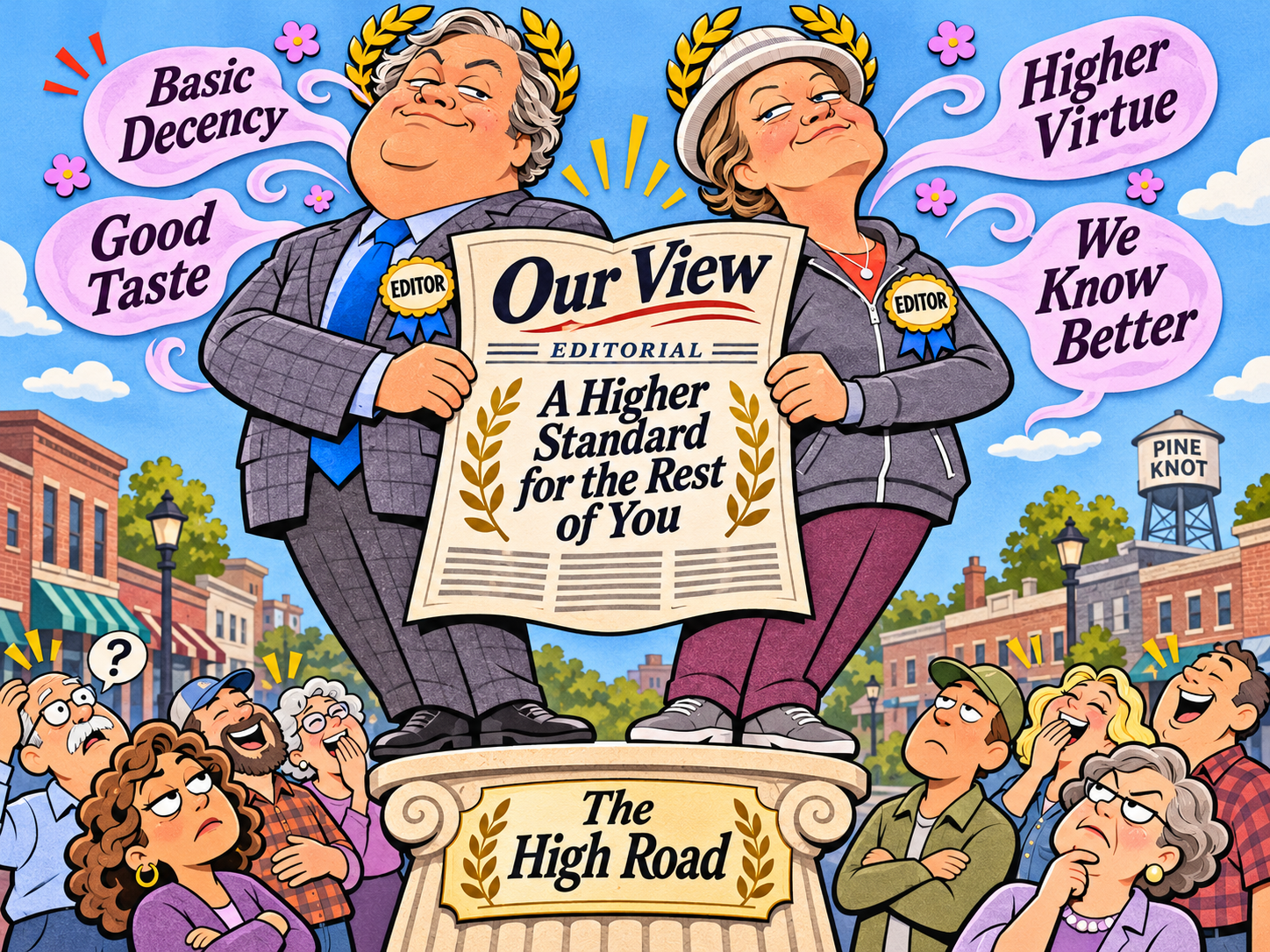
1. When Did Political Affiliation Become a Measure of Human Decency?
If Democratic victories in 2026 represent a return to decency, what does that imply about the millions of Americans who voted Republican?
Are they less compassionate? Less intelligent? Less concerned about their neighbors? Less committed to fairness?
And what about Carlton County residents who supported President Trump in 2024 but voted for Democratic candidates in 2026?
Did their fundamental moral character change in two years?
Or is the more reasonable explanation that voters make decisions based on economic circumstances, candidate preferences, political dissatisfaction, and personal priorities?
A Republican who volunteers at a food shelf is not less compassionate because of a ballot choice. A Democrat who mistreats a neighbor is not automatically virtuous because of party affiliation.
Neither party has exclusive ownership of morality.
2. Bill Clinton and the Problem With Partisan Moral Standards
The Pine Knot's emphasis on political decency raises an interesting historical question.
How should Americans evaluate serious ethical controversies involving Democratic presidents?
Consider former President Bill Clinton.
During Clinton's presidency, his relationship with White House intern Monica Lewinsky became the subject of a national controversy involving allegations of misconduct, misleading public statements, and false sworn testimony.
The record is well established.
In December 1998, the U.S. House of Representatives impeached Clinton on charges of perjury and obstruction of justice arising from the investigation. The Senate subsequently acquitted him in February 1999.
In January 2001, Clinton acknowledged that certain statements in his sworn testimony concerning Lewinsky had been false. He also accepted a five-year suspension of his Arkansas law license and a $25,000 payment associated with disciplinary proceedings.
These are documented historical events, not allegations invented by political opponents.
Clinton's conduct generated profound disagreement. Some Americans believed his actions demonstrated serious failures of personal integrity and public responsibility. Others believed the impeachment proceedings were excessive or politically motivated.
Those disagreements were legitimate subjects of debate.
But consider the underlying principle.
If personal integrity, honesty, and respect for others are legitimate standards for evaluating President Trump, should those identical standards apply to Bill Clinton?
And should they apply to every president, governor, attorney general, legislator, and local elected official, regardless of political affiliation?
The historical record simply demonstrates why morality cannot reasonably be defined by political party membership.
When public figures make false statements, abuse their authority, or fail to meet their responsibilities, those actions deserve examination regardless of whether the individual is a Democrat or Republican.
The same standards should apply to everyone.
3. Minnesota's Fraud Scandals: What About Accountability at Home?
Perhaps the most troubling portion of the Pine Knot's editorial concerns government fraud.
The editorial suggests that Minnesota has become a politically convenient target and directs readers toward President Trump's pardons of individuals convicted of defrauding the government.
Those pardons are legitimate subjects for criticism.
But pointing to wrongdoing elsewhere does not answer questions about Minnesota's own oversight failures.
And those failures deserve particularly close examination because substantial fraud occurred while Minnesota's executive branch was led by Democratic officials.
The Feeding Our Future scandal
The Feeding Our Future case involved an alleged $250 million fraud scheme in federally funded child nutrition programs administered in Minnesota.
The federal government brought criminal charges against dozens of individuals, and prosecutions resulted in convictions.
But the scandal was not limited to the conduct of those who stole or allegedly stole public funds.
It also exposed significant failures in Minnesota's government oversight system.
On June 13, 2024, the Minnesota Office of the Legislative Auditor released its investigation into the Minnesota Department of Education's oversight of Feeding Our Future.
Its principal finding was unequivocal:
MDE's inadequate oversight of Feeding Our Future created opportunities for fraud.
The report documented troubling deficiencies, including:
Failure to conduct a follow-up review after serious findings in a 2018 administrative review.
Failure to adequately investigate complaints about Feeding Our Future.
Inappropriately asking Feeding Our Future to investigate complaints concerning itself.
Approval of program applications despite unresolved concerns.
Failure to reasonably verify that corrective actions had been implemented.
The auditors reported that the department received at least 30 complaints involving Feeding Our Future or its sites between June 2018 and December 2021.
These findings are not speculative political attacks.
They come from Minnesota's own Office of the Legislative Auditor.
Who was responsible for overseeing Minnesota government?
Consider the political leadership during the years surrounding the scandal.
Governor Tim Walz, a Democrat, assumed office in January 2019.
Attorney General Keith Ellison, also a Democrat, assumed office that same month.
During the principal period of the alleged fraud, the Minnesota House was controlled by Democrats while the Minnesota Senate was controlled by Republicans.
In 2023 and 2024, Democrats controlled both chambers of the Legislature and the governor's office, giving them unified control of state government during an important period for investigating the scandal and addressing the identified weaknesses.
In 2025 and 2026, legislative control was again divided.
These distinctions matter. No single political party controlled the entire Legislature throughout the scandal.
But the documented oversight failures occurred in an executive agency that was part of Minnesota's government before (Mark Dayton, Democrat) and during the Walz administration.
The political affiliation of those officials should neither establish their personal guilt nor shield their administrations from scrutiny.
The political double standard question
The Pine Knot suggests that Minnesota's fraud problems have been politically exploited.
That may be a legitimate concern in particular circumstances.
But the possibility of political exploitation does not diminish the seriousness of documented fraud or the need to investigate failures in public administration.
Fraud does not become less serious because the governor is a Democrat. Nor does fraud become more serious because a Republican president draws attention to it.
The victims are ultimately taxpayers and the people whose intended public services were undermined.
A consistent standard requires examining failures under Democratic and Republican administrations alike.
One cannot credibly demand accountability from Washington while overlooking comparable questions closer to home.
4. The Blue Wave Was Real. The Moral Interpretation Is Opinion.
The November 3 election produced significant Democratic victories.
In Minnesota, Democrats regained control of the House for the upcoming legislative session and retained control of the Senate.
Those are electoral results.
But describing them as proof of a public return to decency is a political interpretation.
Voters may have been motivated by concerns about immigration enforcement, health-care policy, the economy, individual candidates, or frustration with national political leadership.
Some may have viewed their ballots as moral statements. Others may have voted for reasons unrelated to the rhetoric of national politics.
An election produces vote totals. It does not measure the moral character of individual voters.
The distinction matters because political leaders in both parties have faced ethical controversies, and public officials from both parties have presided over institutional failures.
The historical record does not support an assumption that electoral success establishes moral superiority.
5. Immigration Enforcement: Serious Questions Deserve Serious Analysis
The Pine Knot condemns the Trump administration's immigration enforcement operations in the Twin Cities.
Federal enforcement tactics, the treatment of immigrants, and the constitutional rights of individuals affected by enforcement operations are legitimate subjects of public scrutiny.
Government agents must obey the law, and allegations of excessive force or unlawful conduct deserve investigation.
But Americans may support immigration enforcement while opposing abusive enforcement tactics.
Others may favor substantial changes to immigration law or the enforcement system itself.
These positions can be debated on their merits.
Neither support for enforcement nor opposition to a particular policy, standing alone, establishes a person's racial attitudes or moral character.
The relevant questions are what government officials did, whether their actions were lawful, and whether public policy appropriately balances enforcement responsibilities with constitutional protections.
Strong moral language may communicate the depth of an editorial board's concern, but it cannot substitute for a careful examination of evidence.
6. Inflation, Health Care, and Social Security Require Factual Distinctions
The editorial also attributes Americans' financial difficulties to President Trump's economic decisions.
That is an appropriate subject for political debate.
Tariffs can increase costs for consumers and businesses. Changes in federal health-care funding can affect insurance coverage and access to care. Federal budget decisions can have substantial consequences.
But affordability problems developed before President Trump's current administration.
A factual analysis should distinguish the effects of specific decisions from broader economic trends.
The same principle applies to health care and Social Security.
Enacted reductions in federal health-care spending, projected changes in insurance coverage, administrative changes to Social Security, and potential future benefit reductions are different policy questions.
They should not be treated as interchangeable.
The public benefits when the actual costs, expected consequences, and legal provisions of proposed or enacted policies are identified.
Americans deserve more than competing political slogans when their financial security is at stake.
7. A Call for Unity Should Begin With Mutual Respect
The Pine Knot concludes its editorial with a call for Americans to recognize their common values.
That aspiration deserves consideration.
Yet there is a tension between encouraging reconciliation and presenting an election victory as a moral triumph over political opponents.
A genuine appeal for unity requires recognizing that people may disagree sincerely and that disagreement does not automatically establish a failure of character.
Republicans should not presume that Democrats lack patriotism because they oppose particular immigration policies.
Democrats should not presume that Republicans lack compassion because they support stricter immigration enforcement.
And neither side should assume that every electoral victory validates the conduct of the politicians associated with it.
Decency requires treating people with respect even when they disagree with us.
That principle should apply equally to Democrats, Republicans, independents, elected officials, newspaper editors, and ordinary citizens.
8. What Should We Expect From a Community Newspaper?
The Pine Knot has every right to publish strongly worded editorial opinions.
The First Amendment protects that right.
But a community newspaper also occupies an influential position in shaping local conversations.
Carlton County is home to residents with diverse political views. These residents share schools, roads, businesses, public services, and local institutions.
A constructive public conversation requires more than agreement among people who already share the same political beliefs.
It requires a willingness to examine contrary evidence, acknowledge the limitations of one's arguments, and apply consistent standards.
For example, a newspaper can criticize President Trump's conduct while acknowledging that Democratic presidents have also faced significant ethical controversies.
It can condemn fraud-related presidential pardons while also demanding answers about government oversight failures in Minnesota.
And it can celebrate Democratic election victories without assuming that Republican voters are morally deficient.
None of these positions requires a newspaper to abandon its editorial perspective.
They require only that readers be given a clear distinction between verifiable facts, reasonable inferences, and political opinions.
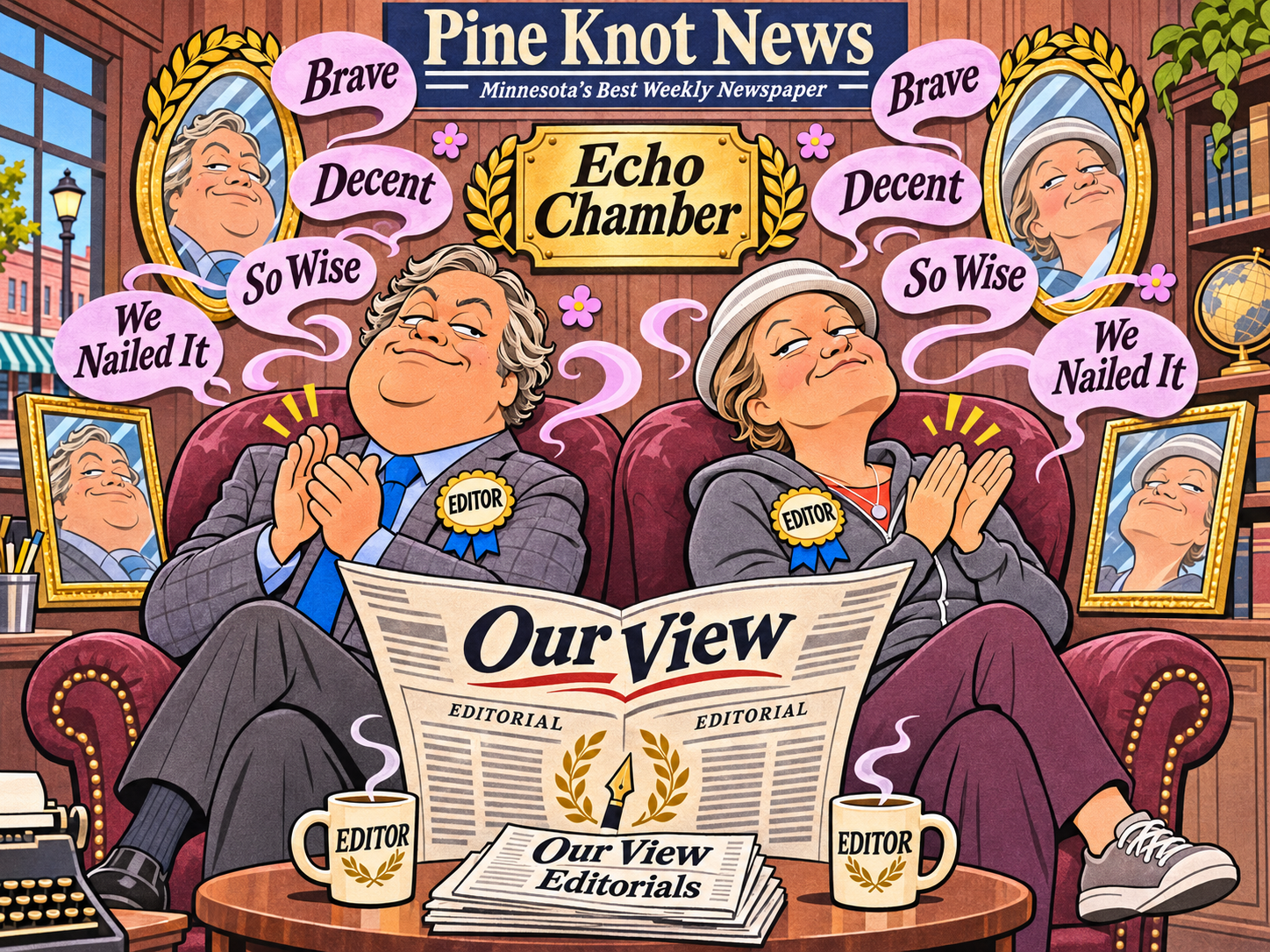
Conclusion: Decency Is Not Red or Blue
The Pine Knot is correct that Americans should seek common ground.
But common ground does not require agreement on every issue, and it cannot be achieved merely by declaring one side morally superior.
Bill Clinton's documented ethical controversies did not establish that every Democratic voter lacked decency.
Donald Trump's controversial statements and policies do not establish that every Republican voter lacks decency.
And Minnesota's government fraud scandals do not establish that every Democratic officeholder is corrupt.
They do establish the importance of evaluating public conduct individually and holding government institutions accountable on the evidence.
At Carlton County Watch, our editorial position is that public officials should be judged by their actions, their adherence to the law, their stewardship of taxpayer resources, and their accountability to the people they serve.
The standard should not change depending on whether the officeholder has a D or an R after their name.
There are decent Republicans, decent Democrats, decent independents, and Americans who have lost confidence in both major political parties.
There are also public officials across the political spectrum whose decisions merit serious criticism and investigation.
An election can change political leadership.
It cannot redefine the constitutional rights, human dignity, or fundamental worth of the people who voted for the losing candidates.
Decency is not a Democratic value or a Republican value. It is a human value.
Perhaps genuine reconciliation begins when we stop treating political differences as proof of personal moral failure and start examining public conduct under standards that apply equally to everyone.