When an assault suspect asked deputies to prevent his victim from recording the arrest, one deputy acknowledged the victim's right to film. What happened next raises troubling questions about police transparency, public accountability, and the First Amendment.
by Carlton County Watch
An Arrest, a Camera, and a Conversation the Public Was Never Supposed to Hear.
On the evening of October 17, 2024, Carlton County Sheriff's Office Sgt. Justin Frykman and Deputy James Stracek responded to a violent assault in Moose Lake, Minnesota, involving Leonard Simich and a man identified in this article as "M."
Simich acknowledged punching M. Simich’s son and wife admitted to Simich punching M. Other witnesses observed Simich violently punch M. According to the deputies' recorded statements, M had suffered an observable injury, and the deputies informed Simich that he would be arrested.
But another issue emerged as the deputies prepared to take Simich into custody: Simich did not want his arrest recorded by the man he had violently assaulted.
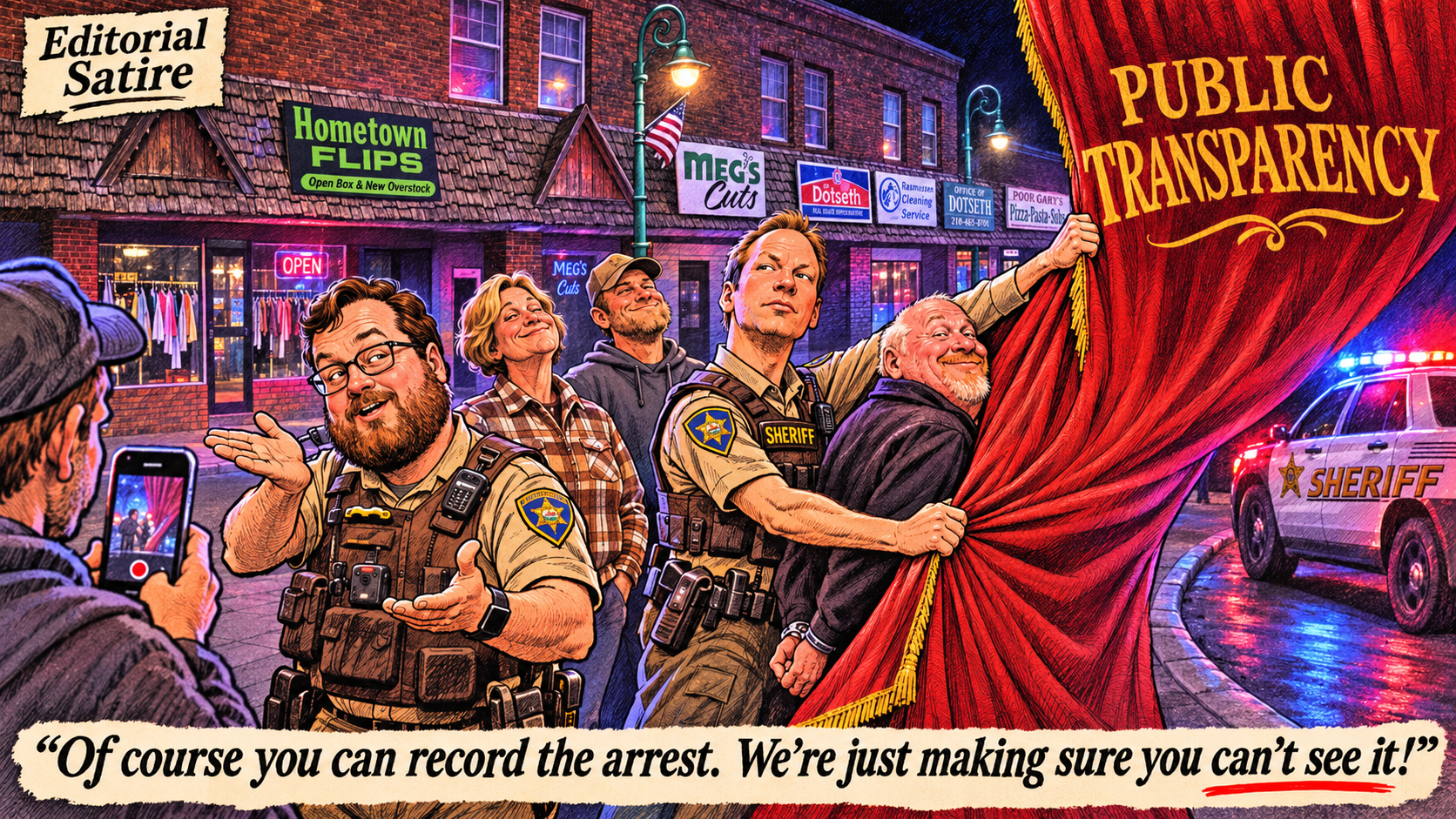
A newly published police body-camera recording, captured by Deputy Stracek, documents a conversation among Simich, Frykman, and Stracek about the impending arrest and the victim's efforts to record police activity.
The working transcript of that recording raises an extraordinary question: Did the deputies coordinate a plan to distract the victim so that Simich could be arrested outside his view?
Yes!
Carlton County Watch believes that question warrants public scrutiny.
Watch YouTube Video here
https://www.youtube.com/watch?v=wx9JhUdy0PA&t=12s
The Suspect Makes a Request: Stop Him From Recording
As the deputies explained the arrest process, Simich expressed frustration about the consequences of being taken into custody.
According to the working transcript, Sgt. Frykman suggested moving Simich around a law enforcement vehicle and placing him in handcuffs behind the vehicle.
Simich then made a direct request:
Leonard Simich: "So why don't you remove him so he's not recording."
Sgt. Frykman's response was unequivocal:
Sgt. Justin Frykman: "So he can record we are in a public setting … he can record all he wants."
This is an important moment in the recording.
Frykman recognized that the encounter was taking place in public and that the victim could record police activity.
Simich, however, continued pressing the issue.
Leonard Simich: "You can go over and say 'I want to talk to you … so he's not recording'."
Simich also expressed concern about the possibility of the video appearing on social media:
Leonard Simich: "I mean this this he'll throw this on YouTube or Facebook."
He followed with another revealing statement:
Leonard Simich: "I have … unlike him … I have a career."
The exchange suggests that Simich's objection was not based on a safety concern or alleged interference with police activity. His stated concern involved the recording itself and its potential public dissemination.
That distinction matters.
Law enforcement officers may take reasonable steps to protect safety and preserve an investigation. Protecting an arrestee from potential embarrassment is a very different justification.
What Did Frykman and Stracek Agree To Do?
The subsequent exchange deserves particular attention.
After Simich proposed that a deputy distract the victim by asking to speak with him, Frykman turned to Stracek.
Sgt. Justin Frykman: "So you want to go explain to him what's going on."
Deputy James Stracek: "Yes."
Frykman then described the intended arrest procedure, including moving Simich to the patrol vehicle, searching him, and transporting him.
The working transcript includes another statement attributed to Frykman:
Sgt. Justin Frykman: "So that he's not seeing this."
Was the purpose of moving Simich and directing Stracek toward the victim to prevent the arrest from being observed and recorded?
Yes!
Or were the deputies making an operational decision supported by a legitimate safety or investigative concern?
No!
The recording gives the public reason to ask those questions. It does not, by itself, establish the officers' legal liability or conclusively resolve every aspect of their intent.
Nevertheless, the sequence is difficult to dismiss as merely coincidental.
Simich suggested a distraction. The deputies discussed speaking to the victim while carrying out the arrest elsewhere. Frykman referred to preventing the victim from seeing what was happening.
These are statements the public deserves to hear and evaluate.
Why the First Amendment Matters
The ability to observe and document government officials performing their duties is an important component of public accountability.
Federal courts have repeatedly addressed the constitutional protections associated with observing police activity and recording matters of public interest.
In Walker v. City of Pine Bluff, 414 F.3d 989 (8th Cir. 2005), the United States Court of Appeals for the Eighth Circuit rejected an officer's justification for arresting a noninterfering observer of police activity.
In Chestnut v. Wallace, 947 F.3d 1085 (8th Cir. 2020), the court likewise recognized protections against unreasonable detention of citizens who observe police interactions from a distance without interfering.
And in Ness v. City of Bloomington, 11 F.4th 914 (8th Cir. 2021), a Minnesota case, the court recognized First Amendment protection for photography and video recording undertaken to communicate information about a public controversy.
There are limits to these protections. Police may impose legally justified restrictions relating to safety, physical interference, and other legitimate operational concerns. Citizens do not possess an unlimited right to approach an arrest or dictate the precise location where officers must perform their duties.
But the larger public accountability question remains:
Should law enforcement officers deliberately arrange a public arrest to frustrate an otherwise noninterfering citizen's efforts to document their conduct simply because the arrestee objects to being filmed?
That question deserves an answer regardless of whether a constitutional lawsuit is ever filed.
When the Person Being Arrested Appears to Influence the Arrest Procedure
Another aspect of this incident deserves examination.
Simich was the person being placed under arrest. M was the individual reporting that Simich had violently assaulted him.
Yet the recorded conversation shows Simich actively proposing how officers could manage the situation to prevent the victim from recording.
It is appropriate for deputies to listen to an arrestee's legitimate safety concerns. It is also appropriate to keep potentially hostile parties separated.
What would be inappropriate is allowing an arrestee's desire to avoid publicity to determine whether another citizen can exercise lawful observation or recording rights.
The public should be able to distinguish between legitimate police discretion and accommodations intended to shield official activity from scrutiny.
That distinction is central to this investigation.
Questions for the Carlton County Sheriff's Office
Carlton County Watch believes the Sheriff's Office should address several questions arising from the recording:
Why did Sgt. Frykman discuss positioning Simich and conducting the arrest outside the victim's view?
Was there a documented safety concern that required moving the arrest outside the victim's view?
What Sheriff's Office policies governed citizens' observation and recording of police activity on October 17, 2024?
Have the Sheriff's Office or its supervisors reviewed the recording to determine whether the deputies' conduct complied with departmental policies?
These questions concern public law enforcement practices, not merely a private disagreement between individuals.
The Sheriff's Office has an opportunity to explain its decisions, including any safety considerations that may not be apparent from the recording.
The Public Deserves an Explanation
This investigation is not about whether law enforcement officers must accommodate every demand made by an assault victim.
It is not about giving citizens unlimited access to active crime scenes.
And it is not about whether Simich should have been permitted to express concerns about being recorded.
It concerns something more fundamental: whether deputies allowed those concerns to influence how they handled the arrest in a manner intended to keep the victim from witnessing or recording it.
Sgt. Frykman expressly recognized that the victim could record activity occurring in a public setting.
Then, Frykman did the exact opposite and concealed the arrest.
The subsequent conversation raises questions about whether the deputies acted consistently with that acknowledgment.
Carlton County Watch is publishing this investigation and directing readers to the body-camera recording so they can evaluate the evidence themselves.
The Sheriff's Office should explain the operational reasons for its decisions. Any relevant policies, supervisory reviews, or additional recordings should be made available to the public in accordance with applicable law.
Public accountability should not depend on whether the person being arrested welcomes the presence of a camera.
And a citizen's lawful opportunity to observe government activity should not be curtailed merely because that activity might later appear on YouTube.