Minnesota judges can determine whether citizens lose their freedom, their property, their families, or their constitutional rights. Yet the Minnesota Constitution imposes remarkably broad educational and professional qualification requirements. With nearly 98% of judicial races in 2026 featuring an unopposed incumbent, Carlton County Watch asks: Who is evaluating the qualifications of Minnesota's judges, and who is holding them accountable?
by Carlton County Watch
The Most Powerful People Most Minnesotans Know Almost Nothing About
Imagine applying for a position that gives you the authority to imprison citizens, remove children from their parents, authorize the seizure of private property, decide multimillion-dollar civil disputes, or determine whether government officials have violated the Constitution.
One might reasonably expect extraordinarily demanding educational qualifications, decades of professional experience, demonstrated expertise in constitutional law, and a comprehensive public examination of the applicant's professional accomplishments.
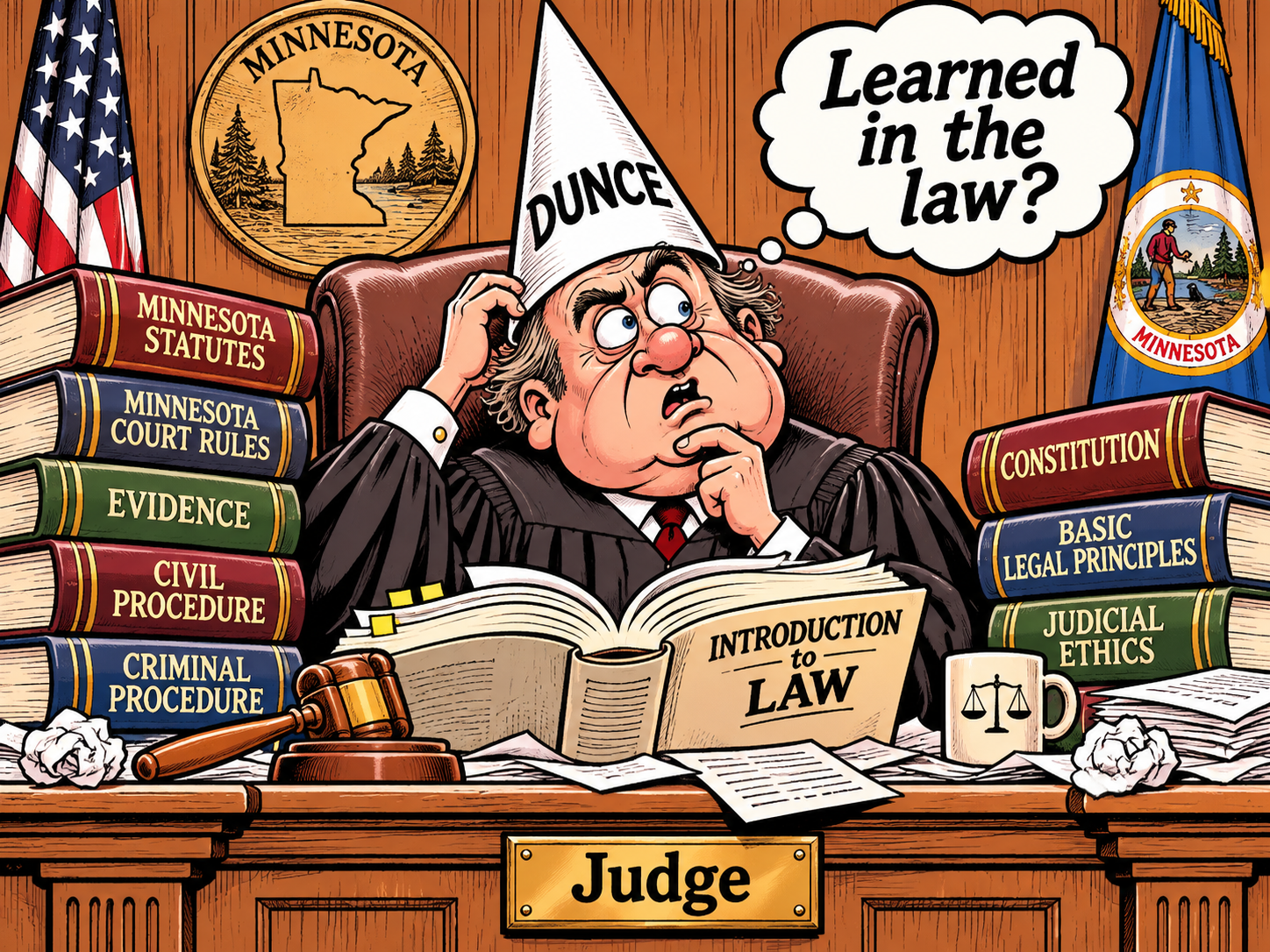
Now imagine discovering that Minnesota's constitutional qualification standard for its district court judges, Court of Appeals judges, and Supreme Court justices consists of five words:
"Shall be learned in the law."
That is the language of Article VI, Section 5 of the Minnesota Constitution.
The Constitution does not specify “x” years of legal practice. It does not require graduate research qualifications beyond a conventional law degree. It does not establish different academic requirements for trial and appellate judges.
Although Minnesota has a judicial selection process that considers professional experience, legal knowledge, integrity, and temperament, the standards remain largely qualitative.
Carlton County Watch believes Minnesota should demand considerably more from the individuals entrusted with exercising the judicial power of the state.
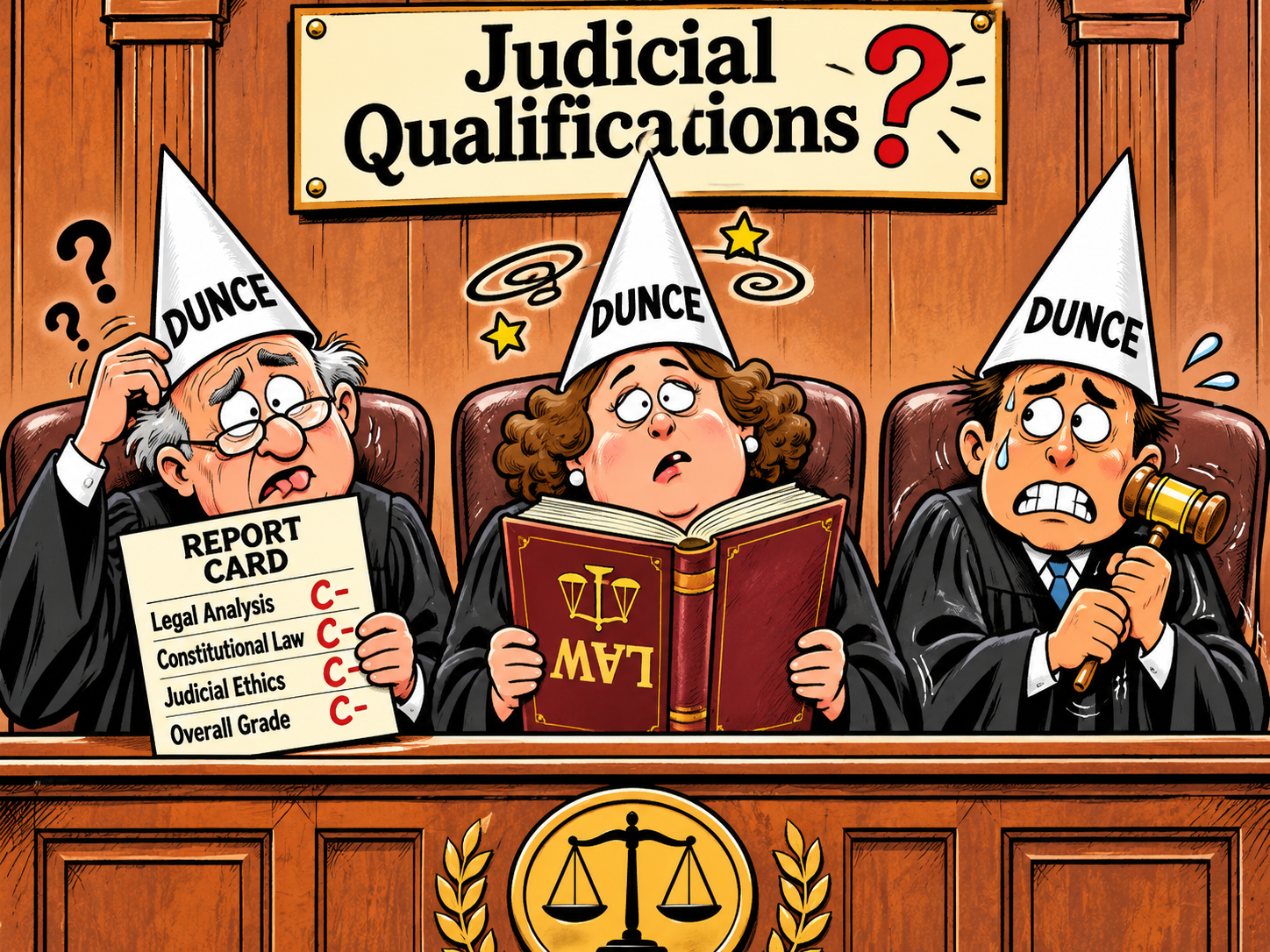
Minnesota's Judicial Elections: Democracy Without Competition?
Perhaps the most troubling aspect of Minnesota's judiciary is not simply who becomes a judge, but how rarely voters are presented with a meaningful alternative.
According to the Minnesota Secretary of State's official 2026 election statistics:
118 judicial races featured only an incumbent candidate.
Two incumbent judges faced challengers.
One judicial seat was open.
Of 121 judicial races, approximately 97.5% featured an unopposed incumbent.
Let that sink in.
Minnesota holds judicial elections every six years, yet nearly every judicial race in 2026 offered voters no competing candidate against the sitting judge.
The pattern is not unique to 2026. In 2024, the Secretary of State reported 94 incumbent-only judicial races, nine races with challengers, and no open seats.
A judicial election without opposition may satisfy the formal requirements of democracy, but how meaningfully does it allow the public to evaluate competing qualifications, judicial philosophies, and professional records?
An uncontested election does not establish that a judge is incompetent (though many are just that). But neither should it be mistaken for a meaningful public endorsement of that judge's qualifications.
When judicial elections routinely offer no alternative, the promise of electoral accountability begins to look more theoretical than real.
The Judicial Appointment System: Who Selects the Judges?
Under Minnesota's Constitution, judicial vacancies are filled by gubernatorial appointment until the next applicable election.
For district court vacancies, Minnesota Statutes § 480B.01 establishes a Commission on Judicial Selection.
The commission considers such factors as integrity, maturity, judicial temperament, diligence, legal knowledge, ability, professional experience, and community service.
These are reasonable considerations. But rarely enforced.
But the statute does not establish a mandatory “x” number of years of legal practice requirement or advanced research-degree standard. Why?
The commission ordinarily recommends between three and five candidates for each vacancy. Their names become public.
Importantly, the statute also permits the governor, under specified circumstances, to choose someone outside the commission's recommendations.
Appointments to the Minnesota Court of Appeals and Supreme Court are made by the governor, without being subject to the same statutory district court commission process.
This raises questions worthy of public debate.
Who determines whether an applicant possesses sufficient professional expertise? How are competing candidates ranked? How much weight is given to professional relationships, political considerations, academic achievements, or demonstrated courtroom proficiency?
And should any individual governor possess this much influence over the composition of Minnesota's judiciary without stronger statutory qualification requirements?
The judiciary is supposed to be independent of political pressure. Its selection process should be designed to promote that independence rather than merely presume it exists.
Where Are the Judges' Academic and Professional Credentials?
Some Minnesota judges have publicly available biographies containing their educational backgrounds, employment histories, and professional affiliations.
That information is valuable, and its existence should be acknowledged.
However, a brief biography is not the same as a standardized, comprehensive record of professional qualifications.
The public should be able to determine far more than where a judge attended law school or which organizations employed that individual.
Minnesotans should know:
How many years did the judge actively practice law before taking the bench?
What types of cases did the judge handle, and what was the extent of that experience?
What advanced degrees, research credentials, publications, or specialized legal qualifications does the judge possess?
What significant appellate decisions has the judge authored, and what is the documented appellate history of the judge's trial-court rulings?
What publicly reportable disciplinary findings, professional sanctions, or conflicts of interest are associated with the judge?
Minnesota law already makes certain governmental employment and applicant information public, including education, training, and professional history under Minn. Stat. § 13.43. Although Minnesota Statutes § 13.90 exempts the judiciary from the Minnesota Government Data Practices Act, the Minnesota Supreme Court has established separate rules governing public access to judicial records.
Under Rule 5 of the Rules of Public Access to Records of the Judicial Branch, certain personnel information, including educational background, professional experience, and honors and awards, is expressly accessible to the public.
Carlton County Watch believes these existing disclosure provisions should be supplemented by a requirement that every Minnesota judge maintain a standardized, publicly accessible professional qualification profile, allowing voters to evaluate the education, experience, and accomplishments of the individuals exercising judicial authority.
Carlton County Watch proposes going further.
Every Minnesota judge should have a comprehensive, standardized professional qualification profile, publicly accessible through a centralized state database.
The profiles should be updated regularly and available to citizens online.
Judicial independence should never become an excuse for withholding information necessary for meaningful public accountability.
A Proposal for Mandatory Judicial Qualifications
Carlton County Watch believes Minnesota's Legislature should consider a fundamental restructuring of judicial eligibility requirements.
Our proposed standards would distinguish between district court judges, who primarily conduct trials and decide factual and legal disputes, and appellate judges, whose responsibilities include interpreting statutes, reviewing legal decisions, and developing legal precedent.
District Court Judges: A Minimum of 20 Years of Legal Experience
Candidates for Minnesota district court judgeships should be required to possess:
1. A law degree and authorization to practice law. Candidates should possess a recognized legal education and satisfy applicable professional licensing and good-standing requirements.
2. At least 20 years of full-time legal practice. The experience should be documented and independently verified, with clearly defined qualifying categories of legal work.
3. A thesis-based master's degree in law. Beyond the conventional Juris Doctor degree, candidates should complete graduate-level legal study involving substantial independent research and a defended thesis or equivalent original scholarly work.
Why require these qualifications?
Because legal judgment is not developed through classroom education alone.
It develops through years of confronting complicated evidence, evaluating conflicting interpretations of law, resolving difficult questions, and understanding the practical consequences of legal decisions.
A judge should arrive on the bench with extensive professional knowledge, not use the bench as the primary location for developing it.
Court of Appeals and Supreme Court: Require Research Doctorates
Minnesota's appellate judges perform an even more consequential role.
Their decisions can establish precedent affecting thousands, sometimes millions, of Minnesotans.
A single appellate interpretation may influence criminal prosecutions, civil rights, property disputes, governmental authority, and constitutional protections for years.
For these positions, Carlton County Watch proposes requiring:
A recognized law degree and professional legal eligibility.
At least 20 years of verified full-time legal experience.
A research-based Ph.D. in law or a closely related legal discipline, involving original scholarship and a defended doctoral dissertation.
A conventional J.D. is a professional doctoral degree (equivalent of a masters degree); it is not the same educational credential as a research Ph.D.
A research doctorate demands sustained investigation, critical analysis of existing scholarship, original contributions to knowledge, and the ability to defend conclusions against rigorous examination.
Those are intellectual disciplines directly relevant to the interpretation and development of law.
Of course, an advanced degree alone does not establish excellent judgment, integrity, or constitutional fidelity. Research credentials would need to complement, not replace, demonstrated legal ability and judicial temperament.
Nevertheless, should the people entrusted with shaping Minnesota law be expected to demonstrate extraordinary intellectual preparation?
We believe the answer deserves serious legislative consideration.
Are the Best Attorneys Even Interested in Becoming Judges?
Another uncomfortable question deserves examination.
Why do so few attorneys challenge incumbent judges?
Is the compensation insufficient to attract highly successful private-practice attorneys?
Does the professional culture discourage attorneys from challenging individuals before whom they may later appear?
Do political relationships and the appointment process discourage competition?
Or does the existing system simply provide insufficient incentives for accomplished attorneys to pursue judicial office?
These possibilities should be investigated rather than presumed.
A particularly important concern is whether the system attracts attorneys who have demonstrated exceptional legal ability or instead rewards professional connections and familiarity with the judicial establishment.
We should also ask whether judges with comparatively limited legal experience could be more susceptible to erroneous arguments advanced by experienced litigators.
That possibility does not establish that Minnesota judges are routinely manipulated (though they are) or that attorneys deliberately seek weak judges (they do).
But the underlying public-policy question remains legitimate:
Shouldn't Minnesota build a system in which every judge possesses the professional knowledge and intellectual independence to critically evaluate even the most accomplished attorney appearing before the court?
We believe it should.
Judicial Term Limits: Twelve Years Should Be Enough
Minnesota judges currently serve six-year terms and may seek reelection without a fixed limit on the number of terms, subject to the state's retirement rules.
Minnesota law generally establishes mandatory judicial retirement at age 70.
But mandatory retirement is not the same as term limits.
Carlton County Watch proposes a strict limitation of two six-year terms, with a maximum of 12 years of cumulative judicial service, whether service begins through appointment or election.
Service across district and appellate courts should count toward the same lifetime limit.
No judge should be allowed to circumvent the limitation by moving between judicial positions, and temporary appointed service should count toward the permitted maximum.
Once the limit is reached, the individual should be permanently ineligible for another Minnesota judicial appointment or election.
Why?
Because public institutions should not become permanent professional possessions.
Judicial careers lasting decades may produce valuable expertise, but extended tenure can also raise concerns about institutional insularity, resistance to change, and limited opportunities for new candidates.
Term limits would create regular opportunities for new judicial leadership and encourage more experienced legal professionals to participate.
Critics will reasonably argue that term limits can remove highly capable judges and deprive courts of institutional expertise.
That is a real tradeoff.
But the public also has an interest in ensuring that judicial authority is periodically renewed rather than indefinitely retained.
Make Judicial Performance Measurable — and Public
Educational qualifications and professional experience are only part of the equation.
Judges should also be evaluated on their actual performance.
Carlton County Watch proposes that the Minnesota Judicial Branch publish annual performance information for every sitting judge, including case-processing statistics, significant procedural delays, and appellate outcomes.
For trial judges, records should identify decisions reversed, vacated, or remanded on appeal, while distinguishing substantive legal error from other grounds for reversal.
Nevertheless, transparent, contextualized data would provide citizens with a stronger factual basis for evaluating judicial performance.
Public judicial oversight should involve more than the ability to read an abbreviated biography and see a familiar name on an uncontested ballot.
The Legislature Must Act — and the Constitution May Need to Change
These proposals cannot all be accomplished by simple administrative changes.
Because Minnesota's Constitution addresses judicial qualifications, election terms, and appointments in Article VI, fundamental revisions — particularly term limits — should be pursued through a constitutional amendment.
Under Article IX, Section 1, the Legislature may propose constitutional amendments for voter approval.
The Legislature could also consider implementing statutory changes concerning judicial selection procedures, professional disclosure requirements, public reporting, and candidate evaluation, consistent with constitutional limitations.
The people of Minnesota should ultimately have the opportunity to decide whether their judiciary needs stronger eligibility standards and meaningful limits on tenure.
The Judiciary Belongs to the People — Not the Legal Profession
Judges do not own their courtrooms. Though most believe they do.
They do not own their judicial offices. Again, most believe they do.
And the legal profession does not own Minnesota's judicial system.
Judicial authority exists to serve the people under the Minnesota and United States Constitutions.
Carlton County Watch is not arguing that every Minnesota judge is incompetent (though we believe the majority are; especially the suspected drug addict judge who’s addictions most likely contributed to the death of his teenaged child via illegal drug overdose), or that advanced degrees automatically produce competent jurists.
We are arguing that the public deserves demonstrable professional qualifications, meaningful transparency, competitive elections, and enforceable accountability.
When nearly 98% of judicial races feature an unopposed incumbent, it is reasonable to question whether the electoral system is working as intended.
When the constitutional qualification standard is simply "learned in the law," it is reasonable to debate whether more specific standards are appropriate.
And when a judge can exercise extraordinary governmental authority for decades, it is reasonable to question whether lifetime limits on service would better protect the public interest.
Minnesota should expect its judges to be among the most capable and accomplished members of the legal profession.
It should also give citizens the information necessary to determine whether that expectation is being met.
The Legislature should begin a comprehensive public review of judicial qualifications, appointment practices, election competitiveness, transparency requirements, and judicial term limits.
The people of Minnesota deserve nothing less.