The City confirms public land has been transferred to Ideal Homes — but says Barnum itself will impose no liens, resale restrictions, or affordability rules beyond ordinary zoning
By Carlton County Watch
The land has now changed hands.
On September 3, the City of Barnum finally provided Carlton County Watch with answers to questions first submitted on August 4 concerning the City's five-home housing development involving Carlton County and Ideal Homes MN, Inc.
Those answers establish several important new facts.
Barnum says Tracts 2 and 5 of Parcel 13-120-0020 were conveyed to Ideal Homes on August 25, 2026, and Ideal Homes now owns the property.
The City says there have been “no new appraisals.”
It says Ideal Homes will pay or reimburse all project-related expenses and that the City will have what Clerk-Treasurer Kris Asperheim characterized as “ZERO cost” for the project.
And Barnum says it rejected a $26,000 offer for one of the tracts because the City believed five new affordable homes and the resulting property-tax base would provide greater long-term value. But provides no math to support this position.
But perhaps the most consequential answer concerned something else entirely:
What guarantees that these publicly supported homes will remain affordable?
According to Barnum, those protections will not come from the City.

The Land Has Been Transferred
Carlton County Watch's original reporting examined a proposed collaboration involving Barnum, Carlton County and Ideal Homes to construct five houses on City-owned property.
At the time, significant details remained unclear, including whether the property had actually been conveyed and what contractual protections accompanied the transaction.
We now know more.
Barnum says the property changed hands on August 25, 2026 and identifies the affected property as Tracts 2 and 5 of Parcel 13-120-0020.
Ideal Homes now owns those lots.
That confirmation moves the project beyond the theoretical.
A public asset has now been transferred into private ownership.
The question is no longer whether Barnum might convey the property.
It has.
The remaining question is:
On what terms?
What Did Ideal Homes Pay for the Land?
That seemingly simple question remains unclear.
Barnum previously described the City's contribution to the project as the transfer of the land to Ideal Homes and stated that a purchase agreement requires Ideal Homes to comply with the funding requirements and stipulations associated with the project.
But the City's September 3 response does not identify a cash purchase price paid by Ideal Homes for Tracts 2 and 5.
That distinction matters.
Until Carlton County Watch obtains the executed purchase agreement, deed and related conveyance records, we are not going to characterize the transaction beyond what the documents presently establish.
The City transferred the property.
Ideal Homes now owns it.
What consideration was paid for that property — monetary or otherwise — remains a question for the underlying records.
What Was the Property Worth?
Carlton County Watch also asked whether Barnum obtained an appraisal, assessor valuation, market analysis or other estimate of the property's fair-market value.
The City's answer was:
“There have been no new appraisals.”
That answer raises another question.
It does not tell residents what the land was worth on August 25.
It does not say whether an older appraisal exists.
It does not identify an assessed value.
It does not identify a prior listing price.
It does not identify the value the City itself assigned to the property when deciding whether transferring the land was a reasonable public investment.
And it does not explain why the word “new” was included in the response.
The public should be able to determine what municipal property was worth before evaluating whether the consideration received in exchange represented a sound transaction.
That is why the valuation records matter.
“ZERO Cost” — Except for the Land?
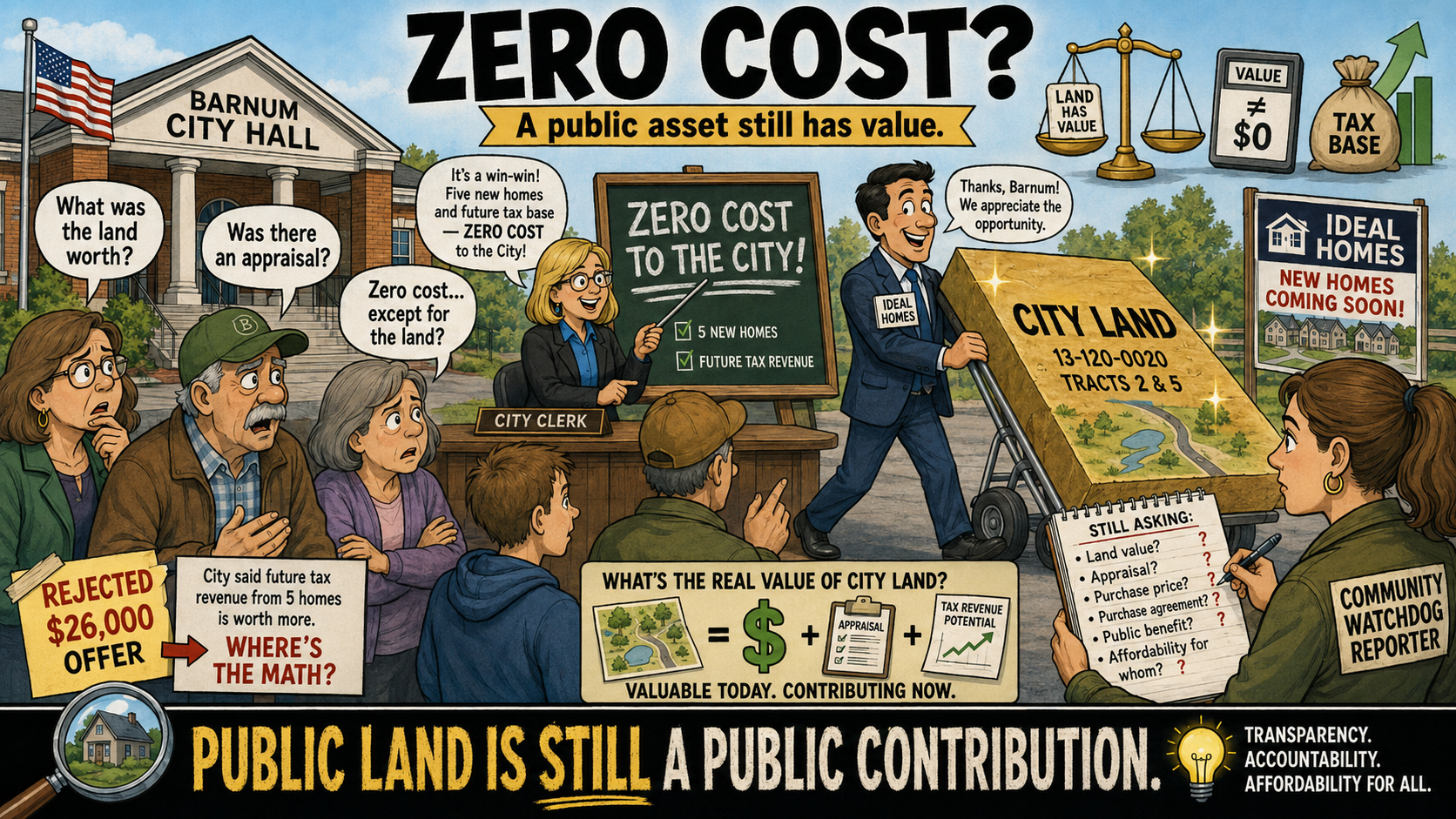
Barnum also told Carlton County Watch that Ideal Homes will pay all project costs or reimburse the City for any expenses incurred.
According to the City:
“the City will have ZERO cost for this project.”
If Ideal Homes pays the surveying, engineering, utilities, construction and related expenses, that is certainly important information.
But there is another side to the equation.
Barnum has also acknowledged that its contribution to the development is the land itself.
Those are two different concepts.
A project may require no additional cash expenditure from the City's treasury while still involving the contribution of a public asset carrying real economic value.
If Barnum transferred property worth tens of thousands of dollars, that contribution does not cease to have value merely because the City did not write a check.
The relevant public-policy question therefore isn't simply:
How much money did Barnum spend?
It is:
How much public value did Barnum contribute?
Until the value of Tracts 2 and 5 is established, describing the City's contribution as having “ZERO cost” tells only part of the story.
Why Reject $26,000?
Barnum did provide a more detailed explanation for the Council's rejection of Charles Young's $26,000 offer for Tract 2.
According to the City, Young had initially asked about purchasing the property approximately nine years earlier but did not return with an offer until the Ideal Homes project was proceeding.
Barnum says the Council ultimately determined that five new homes were more important to the community than accepting the $26,000 offer.
The City further stated:
“The tax base for 5 new homes out weighs the $26,000 after a few years.”
That is a legitimate policy argument.
But where is the math?
A City Council is certainly entitled to conclude that new housing, new residents and future property-tax revenue are more valuable to the community than an immediate cash payment.
But once the comparison is presented in financial terms, taxpayers should reasonably be able to see the numbers behind it.
What taxable value did the City assume for the five houses?
How much annual property-tax revenue will actually accrue to the City of Barnum, as opposed to Carlton County, the school district and other taxing jurisdictions?
How many years constitute “a few”?
Was that analysis performed before the $26,000 offer was rejected?
Did the Council rely upon an actual calculation, or was the statement simply a general policy judgment?
Perhaps there is a written fiscal analysis answering those questions.
If so, Carlton County Watch wants to see it.
If no such analysis exists, that is useful information too.
Then Comes the Biggest Question
The most important portion of Barnum's response may be what it said about long-term affordability.
Carlton County Watch specifically asked whether the development would contain protections such as:
owner-occupancy requirements;
rental restrictions;
minimum occupancy periods;
anti-flipping provisions;
resale-price restrictions;
requirements applicable to subsequent purchasers;
subsidy repayment or recapture;
liens;
rights of first refusal; or
affordability covenants.
Barnum directed those questions to Ideal Homes and Carlton County.
The City then added:
“the City will imply no liens or rules of any kind other than following current Zoning Ordinances”
That is significant.
Barnum says it transferred its land because the community needs affordable housing.
But Barnum itself apparently intends to impose no continuing affordability protections upon the properties beyond ordinary zoning requirements.
That does not necessarily mean protections do not exist.
They may exist through Carlton County's funding agreement.
They may be imposed through the public funding program.
They may appear in agreements with Ideal Homes.
They may be recorded against the properties through some other legal instrument.
But according to Barnum's answer, Barnum itself isn't imposing them.
Which brings us directly back to the question with which this investigation began.
Affordable Today — But Affordable Tomorrow?

Suppose a qualifying buyer purchases one of these publicly supported homes.
What happens two years later?
Can that buyer sell the home at unrestricted market value?
Can it become a rental property?
Can it be purchased by an investor?
Can the owner retain whatever economic benefit was created through the public subsidy?
Does any portion of the subsidy have to be repaid?
Does an income restriction apply to the next purchaser?
Does the affordable-housing requirement last five years?
Ten years?
Twenty years?
Or only until the first sale closes?
Those questions aren't hypothetical academic details.
They determine who ultimately receives the economic benefit of the public investment.
If the public contributes land and housing assistance that makes a $250,000 home possible, but all affordability restrictions disappear after the first purchaser takes title, then the subsidy may eventually become private equity rather than a continuing affordable-housing resource.
That may or may not be what Carlton County's program allows.
We don't know yet.
And Barnum has now told us that those answers lie elsewhere.
Carlton County Now Holds the Key
Barnum repeatedly directed Carlton County Watch's questions concerning sales prices, buyer eligibility, affordability requirements and resale restrictions to Carlton County and Ideal Homes.
That makes the County's funding documents central to the next phase of reporting.
Carlton County Watch will seek the government records establishing:
how much public funding is being contributed;
how the expected home prices were calculated;
the income limits applicable to purchasers;
how buyers will be selected;
whether purchasers must occupy the homes;
whether the properties can become rentals;
whether homes may be quickly resold;
whether the public subsidy must be repaid upon resale;
whether deed restrictions or affordability covenants exist;
how long those restrictions remain in force;
how Ideal Homes is compensated; and
who will monitor and enforce compliance after closing.
Those aren't peripheral questions.
They are the heart of whether the development actually functions as an affordable-housing program.
And the Documents in Barnum Matter Too
Carlton County Watch has also moved from asking Barnum questions to requesting the underlying records.
Those records include the executed purchase agreement, deed, Resolution 2026-10, property valuations, records surrounding the rejected $26,000 offer, documents supporting the City's projected tax-base benefit and records establishing Ideal Homes' obligation to reimburse project costs.
Those documents should allow the public to evaluate the transaction based upon contemporaneous government records rather than after-the-fact explanations.
Interestingly, the next transparency dispute has already begun.
The City has instructed Carlton County Watch to complete Barnum's particular data-request form before proceeding.
The policy document Barnum previously provided bears a July 11, 2011 adoption date and expressly contemplates written public-data requests made without using the City's form.
Carlton County Watch has asked the City to process the detailed written request already submitted and to identify any legal authority it believes makes its particular form mandatory.
That procedural disagreement should not distract from the larger issue.
The records concern public land.
The public should be able to see them.
There May Be Excellent Answers
None of this means the housing project is a bad idea.
Maybe Barnum needs housing. Maybe it doesn’t.
New residents can strengthen a community.
New construction expands the tax base.
Affordable homeownership can provide families with long-term stability and help communities attract and retain workers.
And perhaps the County's agreements contain exactly the safeguards taxpayers would expect.
Perhaps there is a meaningful affordability period.
Perhaps buyers must occupy the homes.
Perhaps resale profits are limited.
Perhaps subsidies are recaptured.
Perhaps subsequent buyers must also meet income requirements.
Perhaps Ideal Homes is operating under strict financial controls.
If those protections exist, Carlton County Watch will gladly report them.
But the public shouldn't have to assume they exist.
Government transparency means showing the public what its contribution purchased.
The Question Has Changed
When Carlton County Watch first examined this project, the central question was:
Affordable to whom?
Barnum's new answers add another.
The City has transferred the land.
Ideal Homes owns the property.
Barnum says five affordable homes and future tax revenue justify that contribution.
And Barnum says it will impose no liens or restrictions of its own beyond zoning requirements.
So now the question becomes:
Affordable to whom — and for how long?
The answer should be somewhere in the public records.
Carlton County Watch intends to find it.