No Record of Criminal Review: Sheriff Lake’s Response Raises New Questions About the 2018 Soderstrom Incident
Eight years after a Carlton County sheriff’s deputy was reprimanded for an off-duty confrontation involving threatening and intimidating conduct, Sheriff Kelly Lake says her office has no data documenting that the incident was ever investigated or reviewed as potential criminal conduct. Now, with Lake retiring and voters choosing her successor, Carlton County Watch is asking both candidates a straightforward question: What should happen when potentially criminal conduct is alleged against one of the Sheriff’s Office’s own employees?
By Carlton County Watch
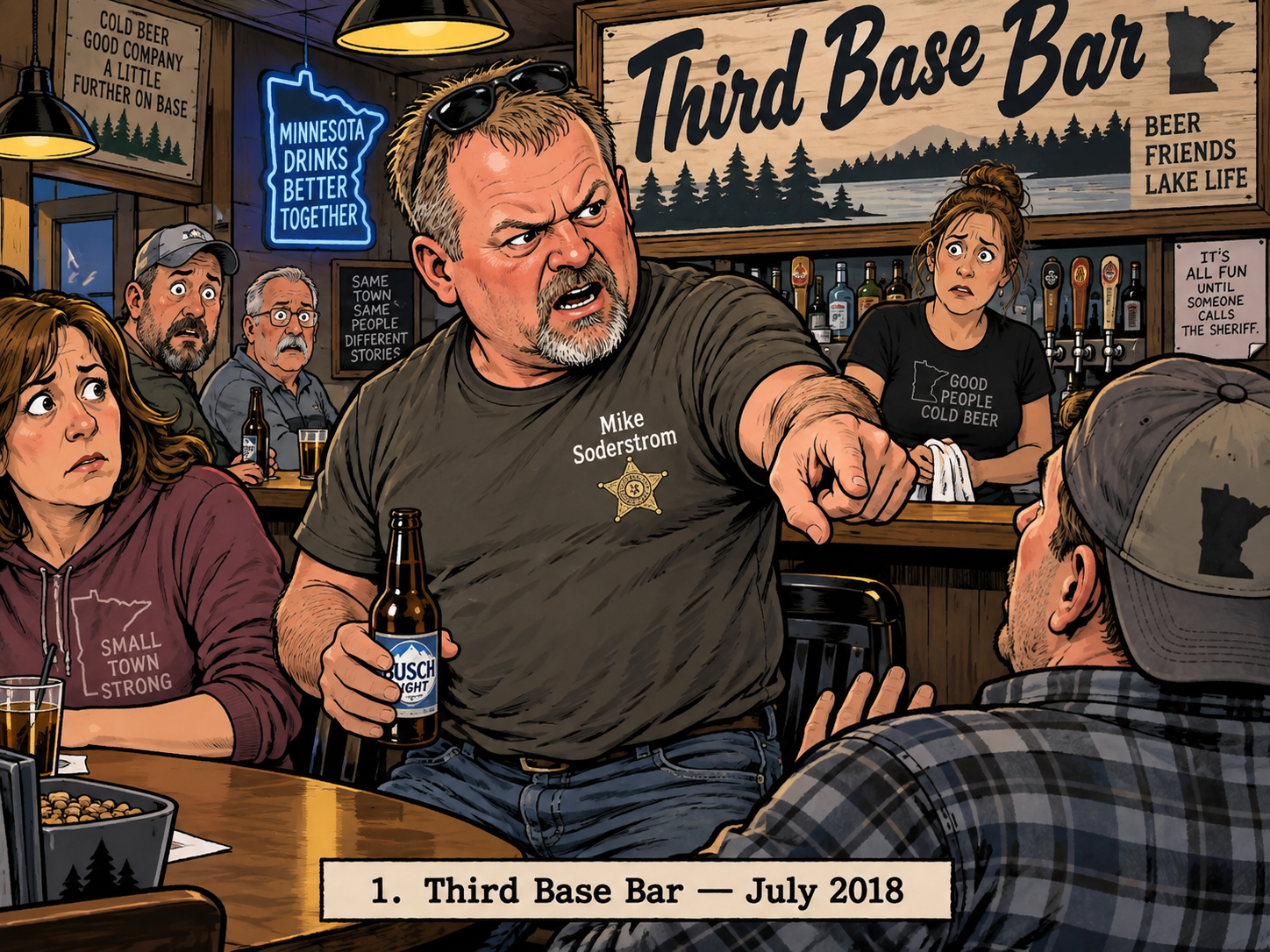
The records previously obtained and reported by Carlton County Watch documented allegations that Soderstrom repeatedly told another person words to the effect of:
“I’m going to fucking bury you.”
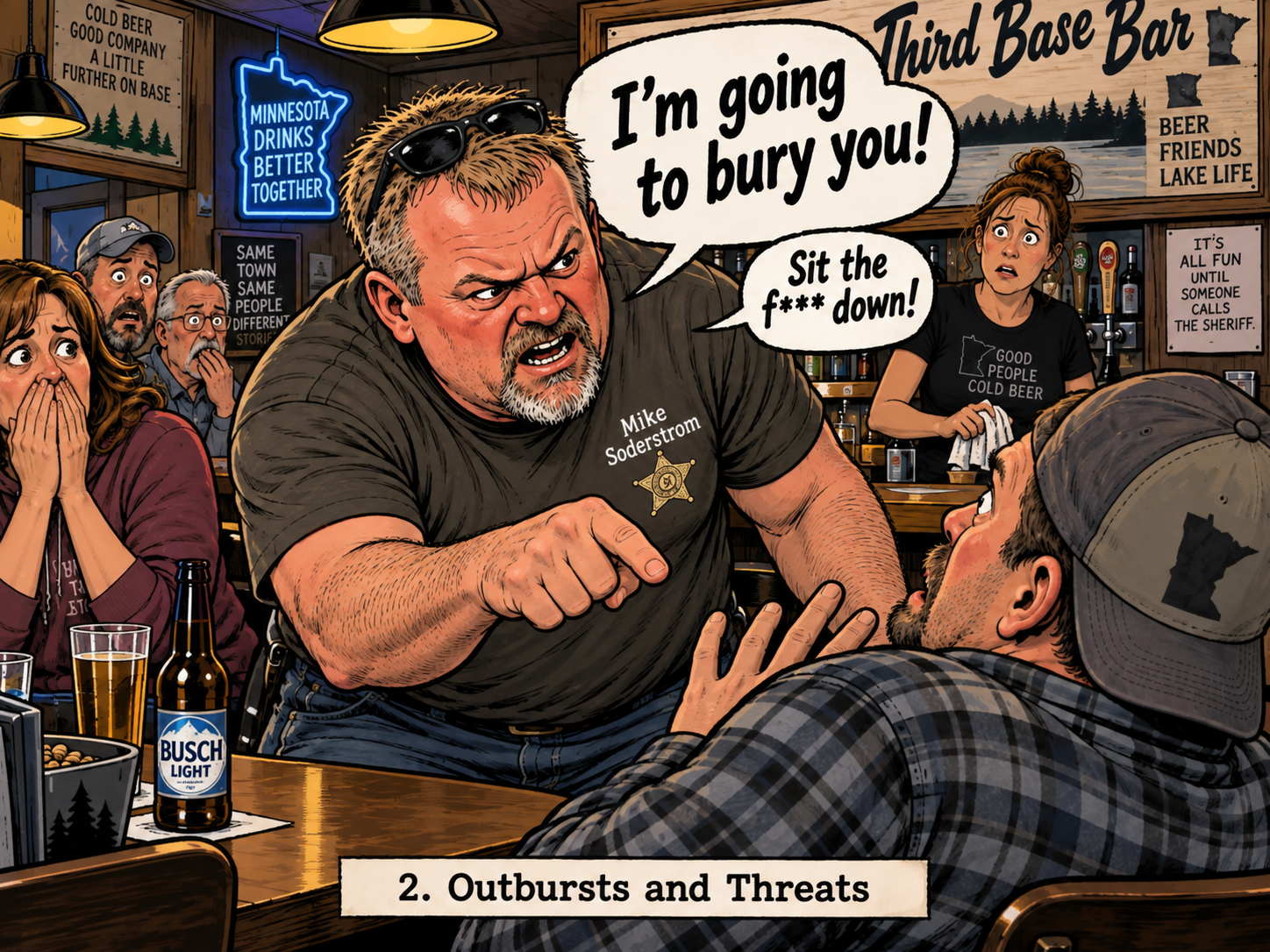
Multiple witnesses corroborated significant portions of the encounter.
The complainant told investigators that his concern extended beyond an ordinary confrontation in a bar. Because Soderstrom was a Carlton County sheriff’s deputy, the complainant expressed concern that Soderstrom could potentially use his law-enforcement authority against him.
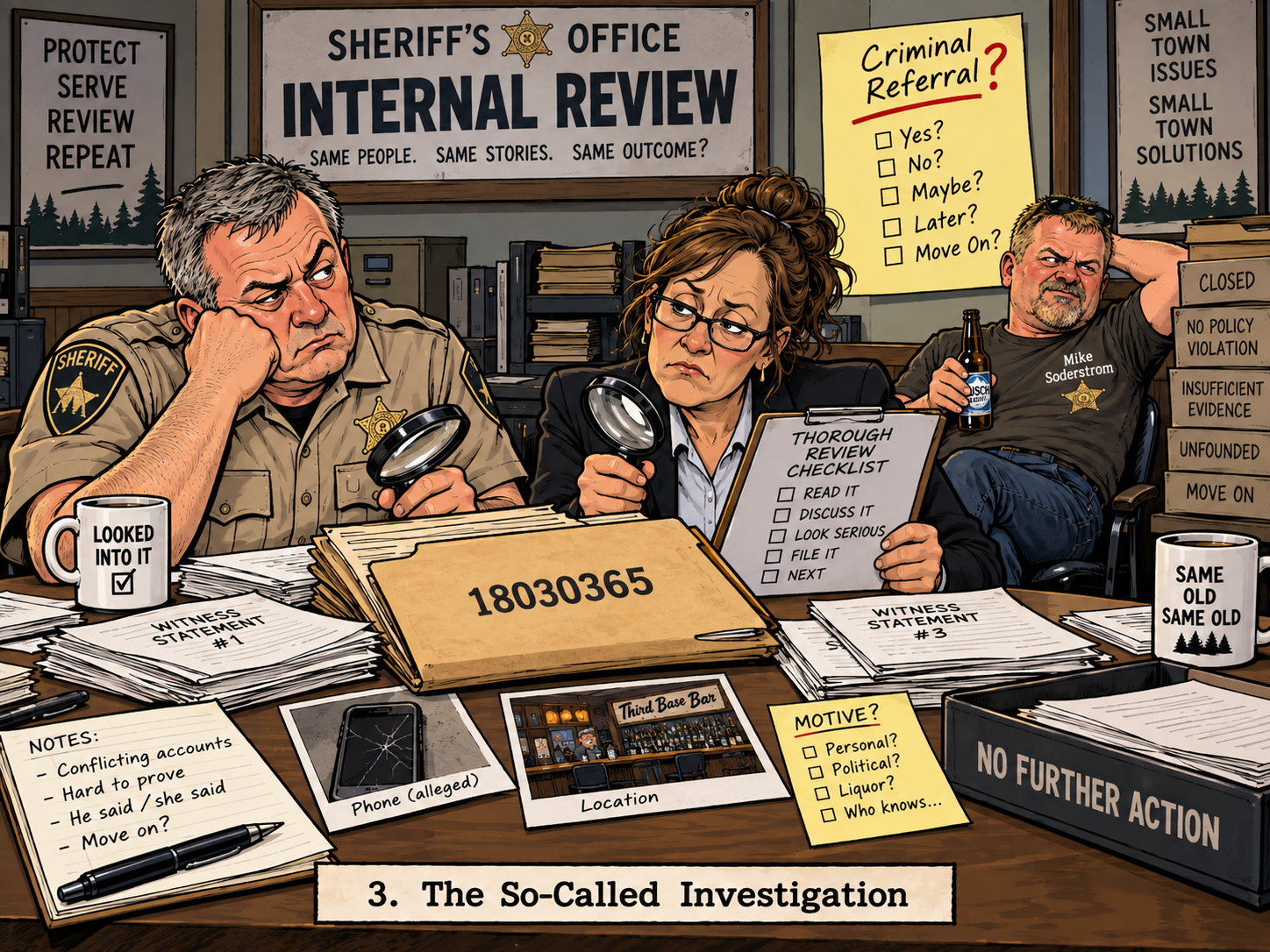
The Sheriff’s Office imposed only written discipline.
A written reprimand!
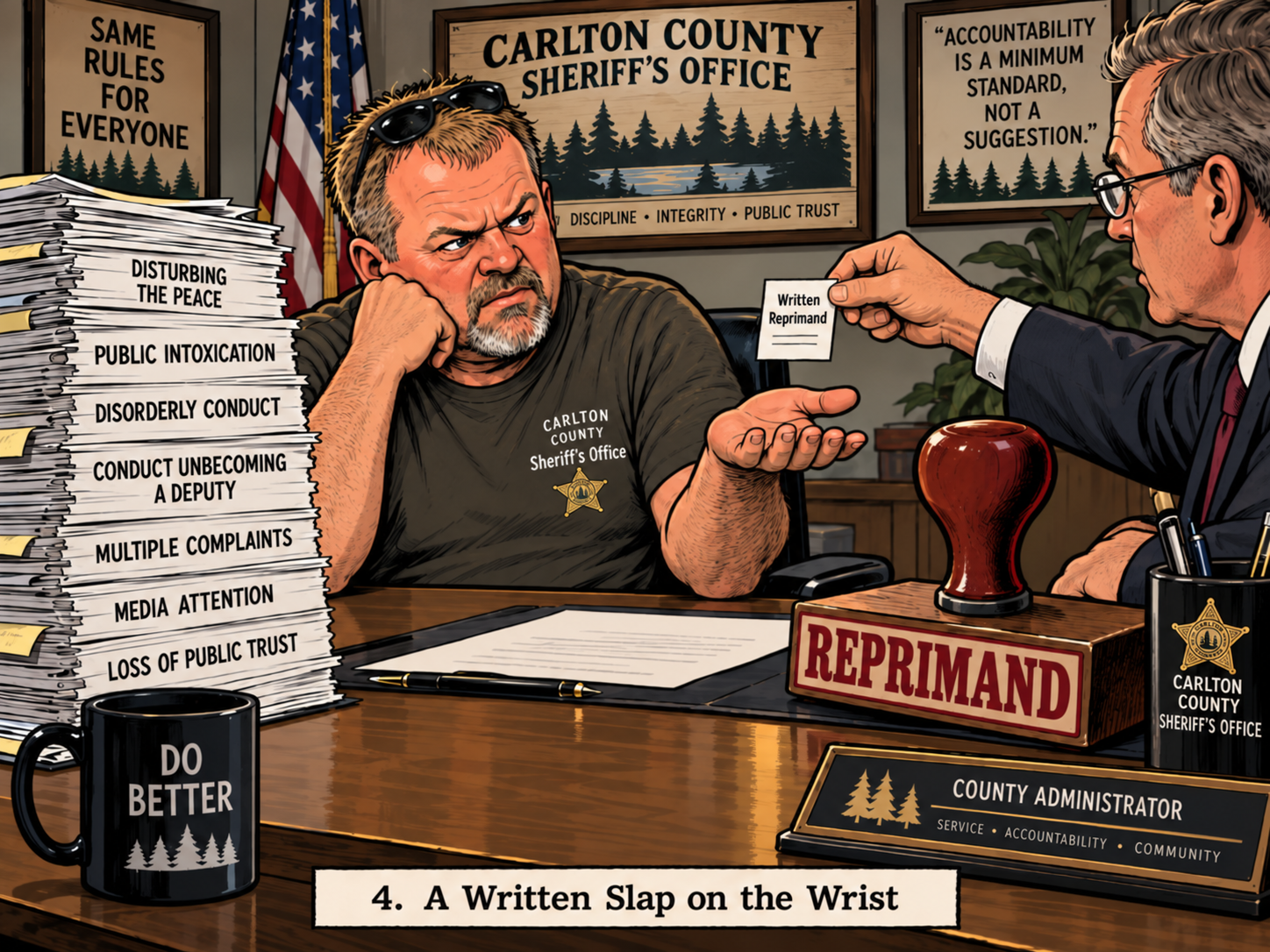
Soderstrom, who later became Mayor of the City of Carlton and remains listed by the city as its mayor, has previously toldCarlton County Watch that he apologized, learned from the incident and subsequently served for six additional years without another on-duty or off-duty complaint.
Those facts have already been reported.
But one important question remained:
Was the conduct ever reviewed as possible criminal conduct?
Carlton County Watch decided not to speculate.
We asked.
A Broad Records Request
On July 29, 2026, Carlton County Watch submitted a Minnesota Government Data Practices Act request to Carlton County Sheriff Kelly Lake.
The request did not simply ask whether Soderstrom had been criminally charged.
It sought public government data documenting whether the July 26, 2018 incident had ever been investigated or reviewed as potential criminal conduct.
Among other categories, Carlton County Watch specifically requested:
referrals, reports or requests for charging consideration sent to the Carlton County Attorney’s Office;
referrals to any other prosecutor or law-enforcement agency;
communications concerning whether Soderstrom’s conduct could constitute disorderly conduct, threats, assault, harassment or another offense;
criminal incident reports or separate case files;
charging-review documents and prosecutorial screening records;
declination notices;
records documenting any decision not to open a criminal investigation;
records documenting any decision not to refer the matter for prosecution;
identification of officials participating in such decisions;
final determinations explaining why criminal investigation or prosecution was or was not pursued; and
Sheriff’s Office policies governing referral of suspected criminal conduct by employees or licensed peace officers.
The request even supplied the internal matter number — No. 18030365 — and search terms including “Michael Soderstrom,” “Mike Soderstrom,” “Third Base Bar,” “bury you,” “criminal referral,” “charging review,” “County Attorney,” “disorderly conduct” and “July 26, 2018.”
Carlton County Watch specifically asked that, if no responsive data existed concerning a criminal investigation, prosecutorial consultation or referral, the Sheriff’s Office confirm that fact in writing.
The Sheriff’s Office acknowledged the request on July 30.
Then we waited.
On August 31, Carlton County Watch requested a status update.
Four days later, Sheriff Lake answered.
“No Data Responsive to Your Request”
On September 4, 2026, Sheriff Kelly Lake wrote:
“A search for your request for data ‘documenting whether the July 26, 2018 conduct of [Former] Carlton County Deputy Michael ‘Mike’ Soderstrom was investigated or reviewed as potential criminal conduct,’ revealed my Office has no data responsive to your request.”
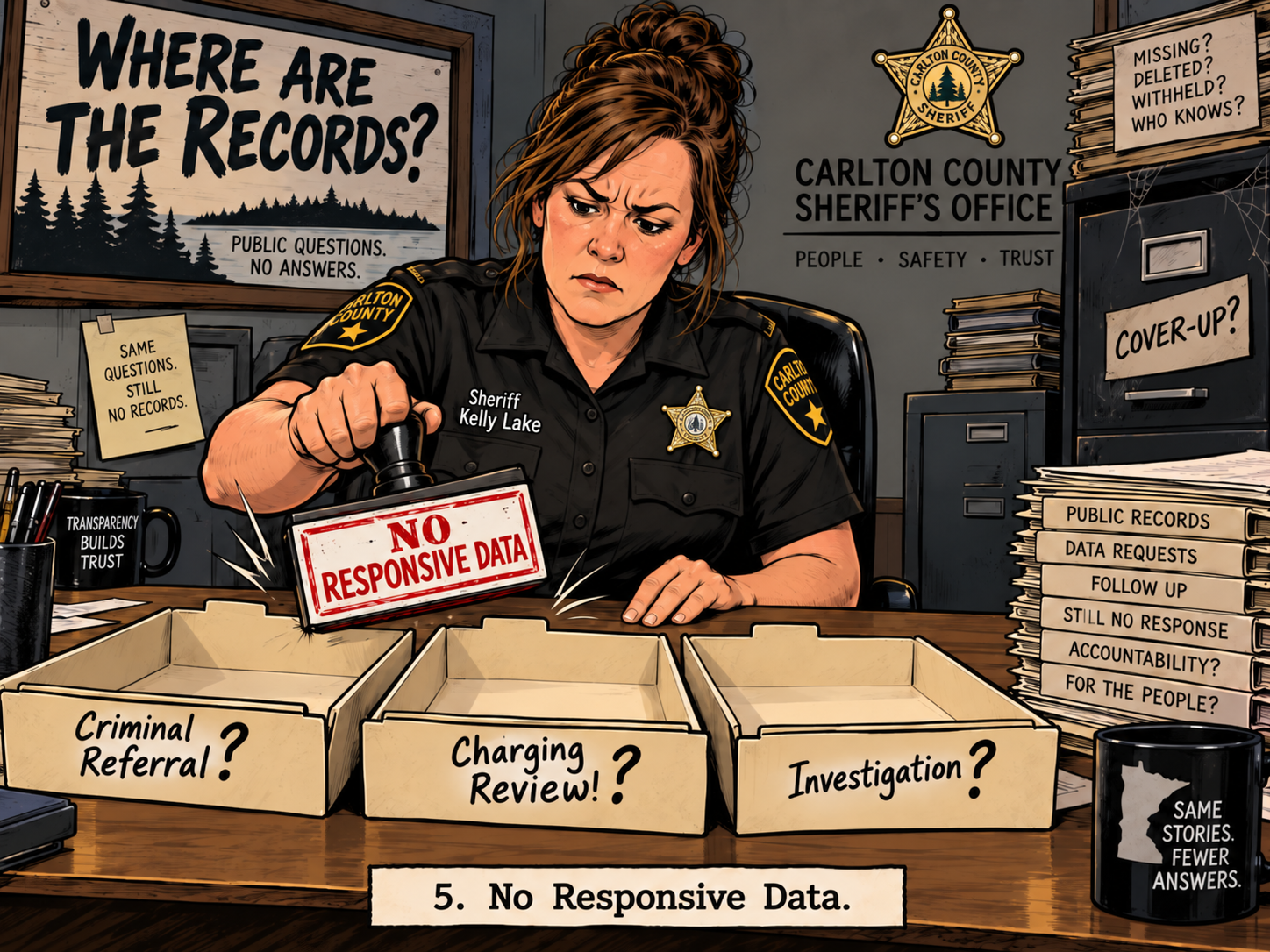
That response is significant.
It does not necessarily prove that no conversation about possible criminal charges ever occurred.
It does not establish what records may or may not exist at the Carlton County Attorney’s Office.
It does not establish whether another agency was contacted informally.
And it does not tell us whether records that once existed may have subsequently been destroyed pursuant to a lawful records-retention schedule.
Carlton County Watch intends to pursue those questions separately.
But Sheriff Lake's response does establish something important:
The Carlton County Sheriff’s Office says that it presently possesses no responsive data documenting that the incident was investigated or reviewed as potential criminal conduct.
That means the Sheriff’s Office has produced no criminal referral.
No charging-review request.
No prosecutorial declination.
No separate criminal incident report.
No written determination explaining why criminal investigation was unnecessary.
No documentation identifying officials who decided against referral.
And, based upon Lake’s response to the request as written, no responsive record showing that criminal screening occurred at all.
That deserves an explanation.
This Was More Than an Employee Being Rude
It is worth remembering why Carlton County Watch asked the criminal-referral question in the first place.
The underlying records did not merely describe a disagreement between coworkers or an employee using poor judgment in private.
The investigative records described a public confrontation involving an Carlton County Sheriff’s Department senior law-enforcement officer.
The complainant reported repeated statements that Soderstrom was going to “bury” him.
Witnesses corroborated significant portions of Soderstrom’s angry behavior.
The complainant reported being concerned not only about physical confrontation but also about possible retaliation through Soderstrom’s authority as a sheriff’s deputy.
And Soderstrom himself ultimately acknowledged that his behavior had been unacceptable.
Whether those facts would ultimately have supported a criminal charge is a separate question.
That decision belongs to the appropriate investigative and prosecutorial authorities, subject to Minnesota law and constitutional limitations.
But the absence of documentation showing that the question was even asked is precisely what now warrants scrutiny.
What About Disorderly Conduct?
Minnesota’s disorderly-conduct statute in effect in 2018 provided that a person could commit misdemeanor disorderly conduct in a public or private place by engaging in specified conduct while knowing, or having reasonable grounds to know, that the conduct would or would tend to alarm, anger or disturb others or provoke an assault or breach of the peace.
The statute included, among other things, certain offensive, abusive, boisterous or noisy conduct. Constitutional limitations also apply to enforcement of the statute, particularly when speech is involved.
Carlton County Watch is not declaring that Soderstrom was legally guilty of disorderly conduct.
That determination was not ours to make in 2018, and it is not ours to make today.
The relevant question is more basic:
Did anyone charged with enforcing Minnesota law formally examine whether the documented conduct potentially violated it?
According to Sheriff Lake's September 4 response, her office possesses no responsive record showing that such criminal review occurred.
That distinction matters.
What Would Have Happened to an Ordinary Citizen?
This case also raises an unavoidable public-policy question.
Imagine that the person involved had not been a Carlton County sheriff’s deputy.
Imagine an ordinary citizen in a Carlton bar becoming angry, repeatedly making threatening statements toward another patron, frightening people around him and generating multiple witness statements.
Would law enforcement have generated a criminal incident report?
Would the matter have been forwarded for prosecutorial review?
Would someone have documented why charges were or were not appropriate?
We cannot answer those questions by assumption.
But the public is entitled to ask them.
Equal application of the law depends not only upon the ultimate charging decision.
It also depends upon having procedures capable of assuring the public that allegations involving law-enforcement personnel are evaluated under the same legal standards applied to everyone else.
That is why documentation matters.
And Then There Was the Home Visit
Another aspect of the case also deserves continued scrutiny.
After the incident became the subject of investigation, Soderstrom went personally to the complainant’s home.
Soderstrom has described the visit as an effort to apologize and has stated that the complainant was someone he knew and considered a friend. These claims have not been verified. That context is relevant and should not be ignored.
But it does not eliminate the broader policy question.
When a law-enforcement employee is the subject of a complaint, should that employee personally contact the complainant while the matter is being reviewed?
Should such contact occur through supervisors instead?
Should it be documented?
Should a policy prohibit or regulate such contact to protect both the complainant and the employee under investigation?
Those are institutional questions, not conclusions about Soderstrom’s subjective intention.
Carlton County Watch does not know whether Soderstrom went to the residence solely to apologize, whether the complainant perceived the visit differently, or whether something else motivated the encounter.
The available records do not allow us to answer that question conclusively.
That is precisely why responsible reporting should distinguish what the records establish from what they leave unresolved.
Now the Question Goes to the Candidates for Sheriff
The timing of Sheriff Lake’s response gives the issue additional public significance.
Lake is retiring after her current term.
She has endorsed Carlton County Chief Deputy Dan Danielson, who has served in the Sheriff’s Office for approximately 26 years and currently serves as Lake’s second-in-command.
Danielson and Chad Walsh advanced from the August 11 primary and are the two candidates for Carlton County Sheriff in the November 3, 2026 general election.
Carlton County Watch believes both candidates should be given exactly the same opportunity to address the issue.
This is not about asking either candidate to retry an eight-year-old personnel investigation.
It is about asking how the next Carlton County Sheriff would handle a comparable situation.
Carlton County Watch has therefore asked both Danielson and Walsh, through their public campaign social-media presence, to address the accountability issues raised by our Soderstrom reporting.
As of publication, Carlton County Watch has received no substantive response from either candidate to those questions.
The invitation remains open.
And the questions are straightforward.
Questions for Dan Danielson and Chad Walsh
If elected Carlton County Sheriff:
1. If credible allegations suggest that a Carlton County deputy may have engaged in criminal conduct, would you require the matter to be independently evaluated as a potential criminal case rather than treating it exclusively as an internal personnel matter?
2. When allegations involve a Sheriff’s Office employee, who should decide whether the matter is referred to an outside investigative agency or prosecutor?
3. Should that referral decision — including a decision not to refer — be documented in writing?
4. Should Carlton County have a written policy requiring outside review of potentially criminal conduct involving Sheriff’s Office personnel?
5. Should an employee under investigation be permitted to contact a complainant personally while that investigation is pending?
6. If criminal referral is considered but rejected, should the Sheriff’s Office maintain a record sufficient to demonstrate that the allegation was reviewed and why referral was deemed unnecessary?
7. Most importantly: Would an ordinary citizen accused of substantially similar conduct receive the same treatment?
Neither candidate needs to agree with Carlton County Watch's analysis.
But voters are entitled to know how the people seeking command of the county's principal law-enforcement agency would answer those questions.
Danielson has publicly emphasized his experience throughout the Sheriff’s Office and his current responsibility for daily operations, personnel and budgets as chief deputy.
Walsh, meanwhile, has publicly campaigned as an alternative to the current administration and has stated that the sheriff should answer directly to the public.
The Soderstrom matter provides both candidates with a concrete opportunity to explain what those approaches would mean in practice.
Carlton County Watch will publish any substantive response received from either candidate.
What Comes Next
Sheriff Lake’s September 4 response answers one question while creating several others.
Carlton County Watch will now seek clarification concerning whether her statement that the Sheriff’s Office possesses “no data responsive” also means:
no responsive written referral policy was located;
no responsive records were destroyed pursuant to a records-retention schedule;
no prosecutorial consultation occurred that generated records elsewhere; and
no other agency was asked to evaluate the incident.
Carlton County Watch also intends to submit a separate request to the Carlton County Attorney’s Office seeking data documenting whether the July 26, 2018 incident or Sheriff’s Office matter No. 18030365 was ever presented for criminal review, charging consideration or prosecutorial consultation.
Those records may provide additional answers.
If they do, we will report them.
If they do not, that absence will also be relevant.
This Is Bigger Than Mike Soderstrom
Mike Soderstrom has acknowledged his conduct was unacceptable.
He received so-called written discipline.
He has also stated that he learned from the incident and subsequently completed additional years in law enforcement without another complaint. Those facts belong in the public record alongside the allegations against him.
But this story is no longer primarily about whether an individual deputy behaved badly during one night in 2018.
It is about the system surrounding that deputy.
When allegations involving potentially criminal conduct are made against a law-enforcement officer:
Who investigates?
Who decides whether criminal review is appropriate?
Who documents that decision?
What safeguards prevent personal or institutional relationships from affecting the process?
And eight years later, should the public be able to see some record demonstrating that the question was considered?
On September 4, Sheriff Kelly Lake provided Carlton County Watch with an important answer.
Her office says it has no responsive data documenting that Soderstrom's 2018 conduct was investigated or reviewed as potential criminal conduct.
That answer does not prove criminal wrongdoing.
It does not prove corruption.
It does not prove a cover-up.
But it does leave Carlton County residents with a legitimate and important question:
Why is there apparently no documented criminal review at all?
And with a new sheriff taking office next year, there is another question voters can reasonably ask both candidates:
If something similar happens again, will the next Sheriff of Carlton County handle it differently?
Carlton County Watch will continue following the records wherever they lead.