Minnesota’s $2.4 Billion School Fund: What Voters Are Actually Being Asked to Change
Before Minnesotans vote on changing the Permanent School Fund, here is where the money came from, how the fund works today, and what the proposed constitutional amendment would actually do.
by Carlton County Watch
Article 1 in a Carlton County Watch series examining Minnesota school funding, spending and student achievement
On November 3, 2026, Minnesota voters will encounter a constitutional amendment with a relatively simple title:
“Increasing funding to school districts.”
The ballot question asks whether Minnesota should increase funding flowing to school districts from the state's Permanent School Fund, beginning July 1, 2027. It specifically notes that the fund supports schools without raising individual income or property taxes. It is the only proposed constitutional amendment appearing on Minnesota's 2026 statewide ballot.
That sounds straightforward.
But behind those few words is a considerably larger question.
Minnesota is not merely deciding whether schools should receive some additional money.
Voters are being asked to change the constitutional rules governing an approximately $2.4 billion public endowment whose origins stretch back to Minnesota statehood — and ultimately to one of the earliest land policies of the United States.
The proposed amendment would alter how much of that endowment may be distributed today, how the fund is protected for future generations and how future legislatures may establish its distribution policy.
Before deciding what that means, it helps to understand how Minnesota acquired this extraordinary asset in the first place.

AN IDEA OLDER THAN MINNESOTA
The concept behind Minnesota's Permanent School Fund dates to the earliest years of the United States.
The federal Land Ordinance of 1785 established the practice of reserving land within newly surveyed townships to support public education. When Minnesota became a state in 1858, the federal government granted sections 16 and 36 of townships — or equivalent lands — to Minnesota “for the use of schools.”
Additional federal grants followed.
Altogether, Minnesota ultimately received approximately 8.1 million acres through four federal land grants that became part of the state's school-trust system.
The theory was remarkably simple:
Land had value.
Resources beneath and upon that land had value.
Rather than spending all that value immediately, Minnesota would hold or convert those assets for the long-term benefit of public education.
Minnesota therefore became, in effect, the trustee of an enormous educational inheritance.
The beneficiaries were — and remain — the state's public schools and both current and future generations of Minnesota students.

WHAT HAPPENED TO 8.1 MILLION ACRES?
Minnesota no longer owns all of the original school-trust acreage.
During the late 1800s, state policy generally favored selling trust lands into private ownership, especially valuable agricultural property in southern Minnesota. By 1900, much of the original acreage had been sold.
The state's philosophy later changed toward selectively retaining lands and natural resources that could continue producing long-term revenue.
Today, Minnesota's school-trust portfolio includes approximately:
2.5 million acres of land, plus
1 million additional acres of severed mineral interests.
More than 90% of the remaining school-trust land is concentrated in ten northern Minnesota counties.
That makes this trust particularly relevant to residents of northern Minnesota.
HOW DO THESE LANDS MAKE MONEY?
School-trust lands are public lands, but they are not managed exactly like a state park or wildlife area.
They are held in trust with a specific financial purpose: to generate support for Minnesota's public schools.
Revenue generally comes from three broad categories:
Minerals — including mineral leases and royalty payments.
Timber — primarily through timber sales.
Real estate — including leases, easements, utility licenses, campground fees, land sales and other transactions.
After deductions authorized by law, revenues generated from school-trust assets are deposited into the Permanent School Fund.
That money then joins the financial assets managed by the Minnesota State Board of Investment.
The Permanent School Fund therefore operates something like a very large endowment.
Money from land and natural resources becomes financial principal.
The principal is invested.
The investments generate returns.
And some of those returns support Minnesota schools.

HOW LARGE IS THE FUND?
Very large — and growing.
According to the Minnesota Office of School Trust Lands, the Permanent School Fund's market value increased from approximately $1.3 billion in 2017 to $2.4 billion as of March 31, 2026.
The State Board of Investment currently invests the fund across equities, fixed-income securities and cash.
The target asset allocation is approximately:
50% equities
48% fixed income
2% cash.
Those investments produce both income — such as dividends and interest — and changes in the underlying value of the investments themselves.
That distinction is central to the amendment voters will consider this fall.
HOW MUCH MONEY CURRENTLY GOES TO SCHOOLS?
During the 2025–26 school year, Minnesota distributed a record $63.8 million from the Permanent School Fund to 329 public school districts and 169 charter schools and academies.
That was more than double the approximately $30 million distributed in 2017.
Every Minnesota public school district and charter school receives a distribution.
The distributions are based primarily on enrollment and the income produced by the fund, and they come in addition to Minnesota's regular general-education funding.
The money is not restricted to one narrow classroom purpose. The state says Permanent School Fund distributions may support educational services ranging from instructional materials and curriculum to salaries, extracurricular activities and school facilities.
So the Permanent School Fund already provides meaningful annual support to Minnesota schools.
The 2026 amendment concerns whether substantially more of the fund's investment return should be made available.
THE WORDS THAT MATTER
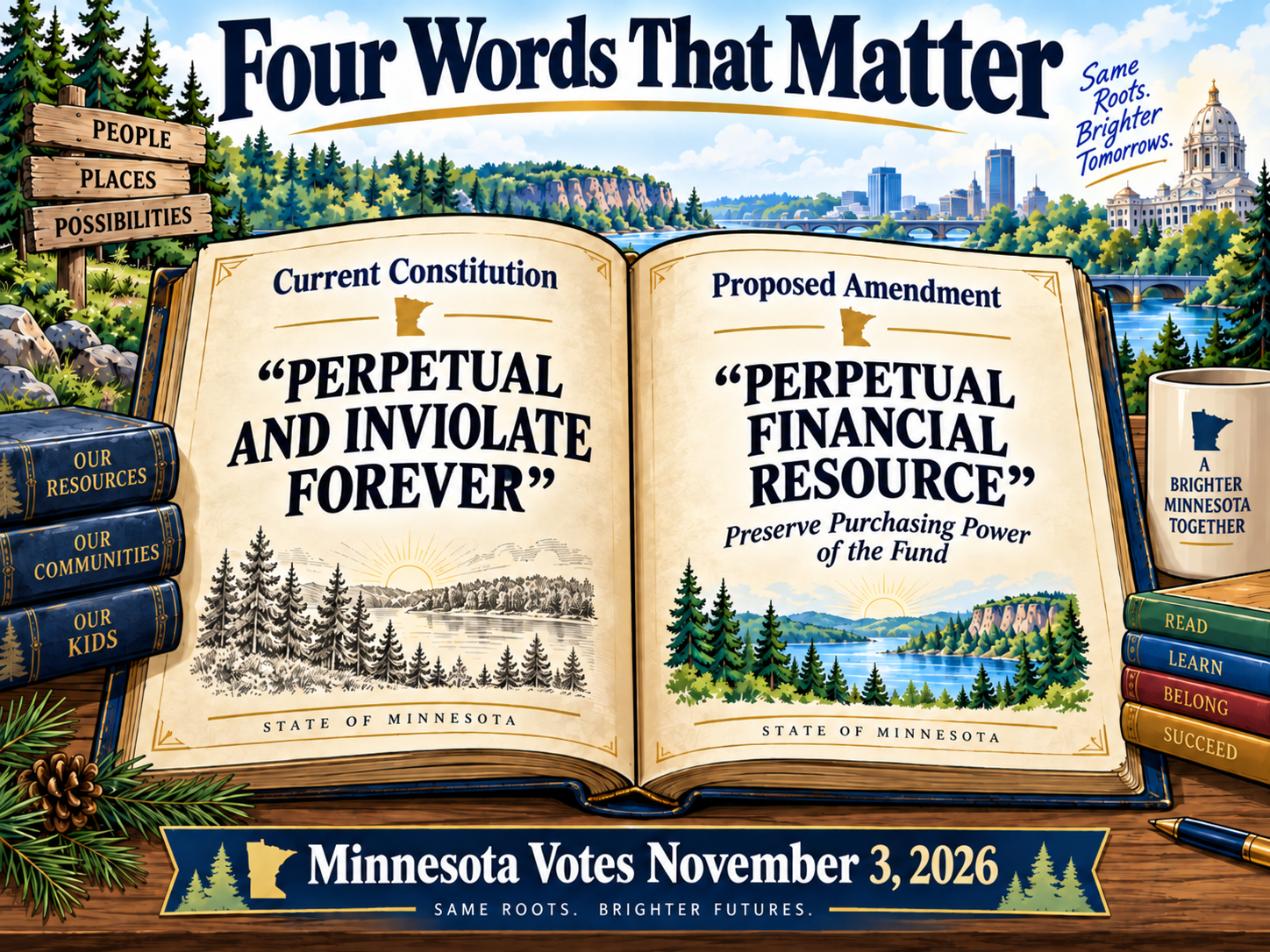
Minnesota's current Constitution contains an unusually strong protection for the fund.
Article XI, Section 8 declares:
“perpetual and inviolate forever.”
Those words describe the Permanent School Fund's principal.
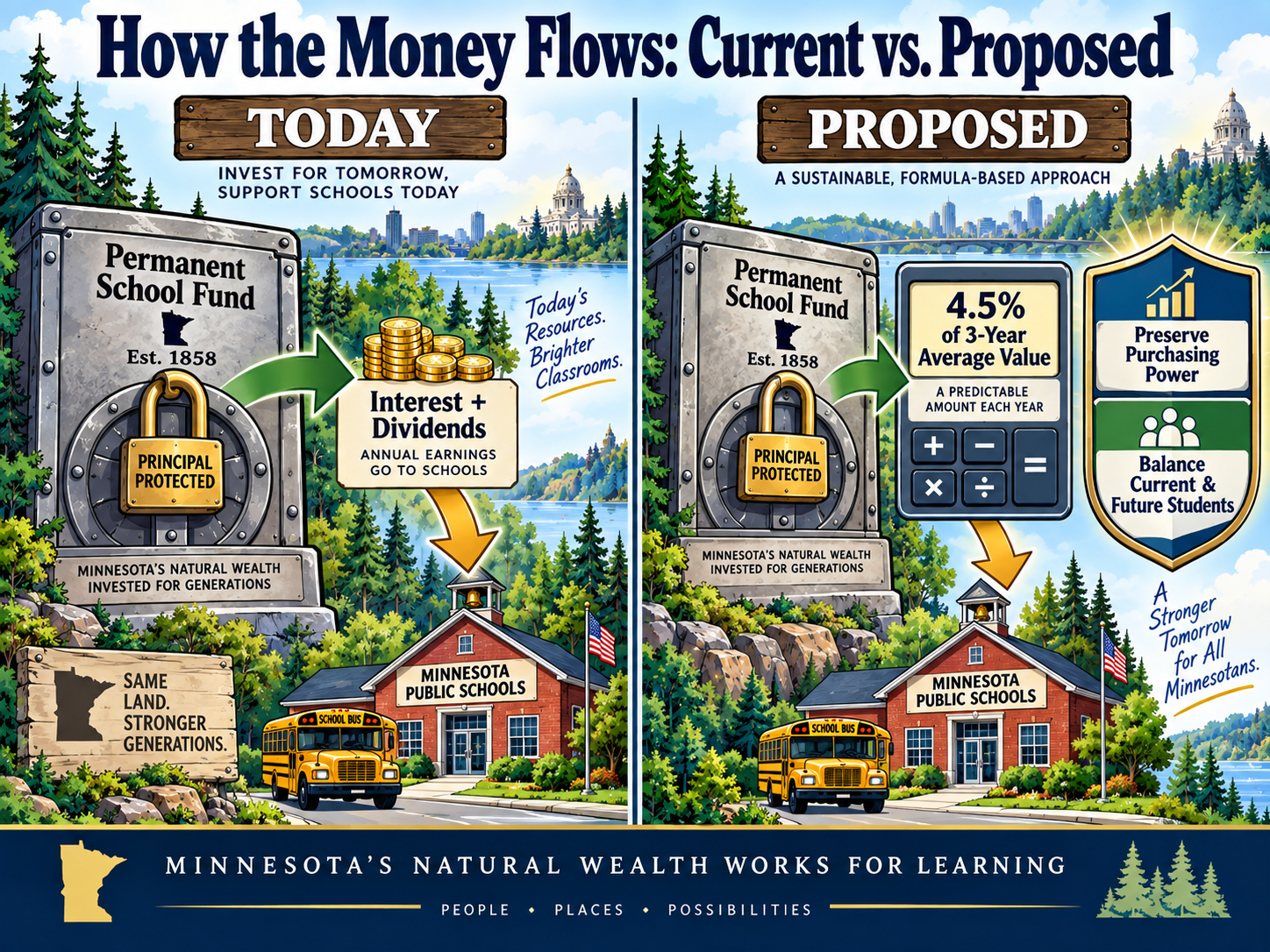
Under today's constitutional structure, the fund is invested while maintaining its perpetuity, while net interest and dividends are distributed to Minnesota school districts.
That structure reflects a traditional endowment philosophy:
Protect the corpus. Spend the income.
The problem identified by policymakers and the state's Permanent School Fund Task Force is that modern investment portfolios generate returns in ways that do not necessarily appear as dividends or interest.
Stocks, for example, may appreciate substantially in value while producing comparatively modest dividends.
According to the Task Force, the fund produced average annual investment returns of approximately 8% during the preceding decade, while interest and dividend distributions averaged only about 2.5% of fund value.
The remaining appreciation stayed in the fund, benefiting future beneficiaries rather than being distributed to current students.
That led policymakers to ask a fundamental question:
Has Minnesota become too successful at preserving the endowment — and too restrictive about using it?
WHAT WOULD THE AMENDMENT CHANGE?
The proposal would remove the Constitution's existing language declaring the principal “perpetual and inviolate forever.”
In its place, the Constitution would require the Permanent School Fund to be:
managed as a perpetual financial resource
while preserving its purchasing power over time and balancing the needs of current and future beneficiaries.
That is not the same thing as eliminating protection for future generations.
The proposed Constitution would still specifically require preservation of the fund's purchasing power over time.
But it represents a different financial philosophy.
Instead of constitutionally distinguishing so sharply between untouchable principal and spendable investment income, Minnesota would manage the portfolio on a total-return basis.
And the Legislature would prescribe the distribution policy consistent with those constitutional principles.
THE 4.5% FORMULA
If voters approve the amendment, legislation already enacted would establish the new distribution formula.
Each year's distributable amount would equal:
4.5% of the Permanent School Fund's average net asset value at the end of the preceding three fiscal years.
The statutory changes would take effect July 1, 2027, for aid payable during fiscal year 2028.
The three-year average is important.
Instead of calculating a distribution using only the value of the fund on one particular day, Minnesota would average three years of values.
That is intended to smooth some of the effects of rapidly rising or falling investment markets.
The Permanent School Fund Task Force studied a range of distribution models and concluded that 4.5% using a three-year rolling average offered what it viewed as the best balance between increased current distributions and preserving the fund over time.
The Task Force estimated that the approach could nearly double expected near-term distributions compared with the existing income-based method while offering better long-term growth prospects than a 5% withdrawal rate.
THIS IS NOT SIMPLY “2.5% VERSUS 4.5%”
One shorthand description of the amendment is that Minnesota would increase Permanent School Fund distributions from roughly 2.5% to 4.5%.
That is directionally useful — but incomplete.
Current distributions have generally represented about 2% to 2.5% of fund value during the past decade, because distributions are tied principally to interest and dividends.
The proposal would instead establish a fixed statutory spending formula based on 4.5% of average total fund value.
So voters are considering two changes at once:
How much gets distributed, and
how Minnesota defines what is available for distribution.
That distinction may be the most important part of the entire ballot question.
WHY SUPPORTERS FAVOR THE CHANGE
There are several substantive arguments supporting the proposal.
First, the Permanent School Fund exists to benefit Minnesota students. Supporters contend that current students should receive a larger share of the economic return being produced by assets held specifically for their benefit.
Second, modern institutional endowments commonly use total-return spending policies rather than limiting withdrawals to dividends and interest.
A stock does not become more economically valuable simply because its return appears as a dividend instead of price appreciation.
Third, the three-year averaging method may provide more predictable distributions than relying exclusively on annual investment income.
Fourth, the Task Force concluded after modeling multiple scenarios that 4.5% offered a reasonable balance between increased distributions today and protecting future beneficiaries.
And importantly, the proposal does not itself increase individual income or property taxes.
It changes the distribution of assets Minnesota already holds in trust.
The proposal also attracted broad bipartisan legislative support. The Minnesota House approved an earlier version of the measure 133–0 before House and Senate negotiators produced the final legislation.
WHY VOTERS MIGHT STILL ASK QUESTIONS
There are also legitimate questions on the other side of the ledger.
What happens to compounding?
Every additional dollar distributed today is a dollar that is no longer invested inside the Permanent School Fund.
That does not necessarily make the higher distribution unsustainable — the Task Force concluded otherwise under its modeling — but it does mean today's spending comes with an opportunity cost.
Investment returns retained today can themselves generate investment returns tomorrow.
Over decades, compounding matters enormously.
What happens during bad markets?
A three-year average reduces short-term volatility, but it cannot eliminate investment risk.
During a prolonged downturn or period of unusually high inflation, preserving the fund's purchasing power while simultaneously distributing 4.5% could become more difficult.
The Task Force modeled adverse scenarios and still recommended 4.5%, but financial projections are estimates, not guarantees.
Why remove “perpetual and inviolate forever”?
The current Constitution provides an unmistakably strong restriction on the fund's principal.
The proposed Constitution would replace that wording with broader requirements that the fund remain a “perpetual financial resource” and that its purchasing power be preserved.
Both approaches are designed to protect future students.
But they are not identical.
Voters may reasonably consider whether they prefer the existing bright-line protection or the greater flexibility of the proposed endowment model.
How much authority should future legislatures have?
The Constitution currently dictates much of the fundamental framework.
Under the amendment, the distribution policy would be prescribed by law, subject to the constitutional principles of perpetuity, purchasing-power preservation and balancing current and future beneficiaries.
That gives elected lawmakers more flexibility to shape policy.
Whether that flexibility is viewed as an advantage or a concern is ultimately a question for voters.
WHAT ABOUT ADMINISTRATIVE COSTS?
There is another provision voters may not notice from reading the ballot question.
The proposed constitutional language expressly states that:
reasonable and necessary administrative costs
associated with managing the Permanent School Fund or school-trust lands may be paid from the fund in a manner prescribed by law.
Some trust-land management expenses are already deducted from revenues under existing statutes before net proceeds reach the fund, so administrative expenses are not a wholly new concept.
Nevertheless, expressly incorporating administrative costs into the constitutional language is a substantive provision worth knowing about.
It also creates an obvious accountability question:
How much will administration cost, who will determine what expenses are “reasonable and necessary,” and how transparently will those costs be reported?
That is an issue Carlton County Watch intends to follow.
WHAT THE BALLOT QUESTION DOES — AND DOES NOT — SAY
The November ballot will describe this primarily as increasing funding to Minnesota school districts.
That is true.
But voters will actually be deciding something broader.
They will be deciding whether Minnesota should replace a traditional income-only endowment structure with a total-return spending model that permits larger annual distributions while requiring preservation of the fund's purchasing power.
The question is therefore not merely:
Should schools receive more money?
It is also:
How much of a permanent educational endowment should Minnesota use for students today, and how much should remain invested for students tomorrow?
Those are different questions.
And both deserve consideration.
One procedural point is also important: under Minnesota law, a constitutional amendment must receive a majority of all ballots cast in the election. Leaving the constitutional-amendment question blank therefore has the same practical effect as voting “No.”
AN ENDOWMENT FOR GENERATIONS
There is something remarkable about the Permanent School Fund that can easily disappear amid debates about school budgets and tax policy.
The people who established Minnesota's school-trust system in the nineteenth century did not create an account intended to last until the next legislative session.
They created an asset intended to benefit people they would never meet.
Land became timber revenue.
Land became mineral royalties.
Land became investments.
Those investments became billions of dollars.
And generations later, Minnesota is still deciding how to balance two groups of beneficiaries:
the child sitting in a Minnesota classroom today
and
the child who may sit in that classroom 30, 50 or 100 years from now.
That is ultimately the stewardship question behind the 2026 amendment.
But it raises another question that the amendment itself cannot answer.

MORE MONEY — BUT WHAT RESULTS?
If Minnesota begins distributing substantially more money from the Permanent School Fund, what should Minnesotans expect in return?
Does spending more per pupil reliably produce higher academic achievement?
How much does Minnesota already spend?
How does spending vary from one school district to another?
And are the school districts spending the most money producing the strongest educational outcomes?
Those questions move beyond the mechanics of the Permanent School Fund and into the much larger debate over educational spending and accountability.
That is where this Carlton County Watch investigation goes next.
COMING NEXT: FOLLOWING THE MONEY — AND THE RESULTS

Article 2 — Carlton County: What Do We Spend, and What Do Students Achieve?
We will begin at home.
Carlton County Watch will compare per-pupil operating expenditures with reading and mathematics proficiency in Esko, Cloquet, Carlton, Barnum, Moose Lake, Cromwell-Wright and Wrenshall.
The early numbers reveal enormous differences in both spending and academic performance.
But rather than assume one causes the other, we will examine enrollment, poverty, special education, district size and other factors that can influence both costs and student achievement.
Article 3 — Minnesota's Highest- and Lowest-Achieving School Districts
Next, we will broaden the analysis statewide.
What do Minnesota's highest-achieving districts spend per pupil?
What do its lowest-achieving districts spend?
Do high-spending districts consistently outperform lower-spending districts?
And what can—and cannot—reasonably be concluded from those comparisons?
This installment will also examine why raw spending figures can be misleading for very small districts and districts serving unusually high-need student populations.
Article 4 — Minnesota Versus the Other 49 States
State achievement tests cannot fairly be compared across state lines because states establish different standards and proficiency thresholds.
The National Assessment of Educational Progress — or NAEP — provides a common measuring stick.
We will compare Minnesota's per-pupil spending with all 49 other states and examine Minnesota's fourth- and eighth-grade reading and mathematics performance on the same national assessment.
That analysis has already produced an important finding:
Minnesota is not among America's highest-spending states, while its students perform particularly well nationally in mathematics.
That deserves a closer look.
Article 5 — America Versus the Developed World
Finally, we will move beyond the United States.
Using OECD education-spending statistics and the international PISA assessment, Carlton County Watch will examine a frequently repeated claim:
Does the United States spend substantially more on education while producing comparatively poor academic results?
Parts of that claim are supported by the evidence.
Other parts are not.
We will examine the numbers rather than the slogans.
AND THEN: BACK TO THE BALLOT
After examining Carlton County, Minnesota, the other states and comparable developed countries, we intend to return to where this series began:
Minnesota's Permanent School Fund.
At that point, readers should have considerably more information with which to consider the broader policy questions surrounding the amendment.
How much does Minnesota spend on education?
What educational results are being produced?
Where does additional spending appear to make a difference?
Where does it apparently not?
What explains unusually successful districts?
And if Minnesota distributes more of a permanent endowment each year, what measures — if any — should taxpayers and citizens use to determine whether those additional dollars are improving student outcomes?
Carlton County Watch will not make that constitutional decision for its readers.
But before Minnesotans are asked to change the rules governing a $2.4 billion educational inheritance, they deserve to know what the fund is, where the money came from, what is changing — and what the numbers actually show.
Article 2: Coming next — “Carlton County Schools: What Are We Spending, and What Are We Getting?”
SOURCES & FURTHER READING
Carlton County Watch relied primarily on official Minnesota government sources in preparing this article. Readers who would like to review the underlying materials themselves can find them here:
Minnesota Secretary of State — 2026 Constitutional Amendment
Official ballot language, proposed constitutional text, voting instructions and information explaining that failure to vote on a constitutional amendment has the same effect as voting “No.”
https://www.sos.mn.gov/elections-voting/whats-on-my-ballot/constitutional-amendments/Minnesota Constitution — Article XI, Section 8
Current constitutional language governing the Permanent School Fund, including the requirement that its principal remain “perpetual and inviolate forever.”
https://www.revisor.mn.gov/constitution/2026 Laws of Minnesota, Chapter 114
The legislation authorizing the proposed constitutional amendment and establishing the 4.5% distribution formula if voters approve the amendment.
https://www.revisor.mn.gov/laws/2026/0/Session%2BLaw/Chapter/114/Minnesota House Research — H.F. 3900 Conference Committee Report Bill Summary
Nonpartisan legislative explanation of the proposal, including the current approximately 2%–2.5% distribution range, the proposed 4.5% three-year-average formula and the changes to Article XI, Section 8.
https://www.house.mn.gov/hrd/bs/94/hf3900.pdfMinnesota Office of School Trust Lands — Overview
Background on Minnesota's school-trust lands, including the approximately 2.5 million acres of land and 1 million acres of severed mineral interests remaining in the trust.
https://mn.gov/school-trust-lands/lands/overview/Minnesota Office of School Trust Lands — Generating Revenue
Explanation of how school-trust lands generate revenue through minerals, timber, leases, easements, real-estate transactions and other activities.
https://mn.gov/school-trust-lands/lands/generating-revenue/Minnesota Office of School Trust Lands — A Trustee's Duties
Explanation of Minnesota's fiduciary responsibilities in managing school-trust assets for current and future public-school beneficiaries.
https://mn.gov/school-trust-lands/management/trustee-duties/Minnesota Office of School Trust Lands — Whole Trust
Additional information about the land, mineral and financial assets that make up Minnesota's school-trust system.
https://mn.gov/school-trust-lands/management/whole-trust/Minnesota Office of School Trust Lands — The Trust Principal
Current information about the Permanent School Fund's market value, investment structure and growth over time.
https://mn.gov/school-trust-lands/beneficiaries/trust-principal/Minnesota Office of School Trust Lands — Revenue Distribution
Information regarding annual Permanent School Fund payments to Minnesota school districts and charter schools, including the record $63.8 million distributed during the 2025–26 school year.
https://mn.gov/school-trust-lands/beneficiaries/revenue-distribution/Minnesota Permanent School Fund Task Force — Final Report
The Task Force's analysis of alternative distribution formulas, investment returns, long-term fund preservation and its recommendation for a 4.5% distribution based upon a three-year average of fund value.
https://education.mn.gov/mdeprod/idcplg?IdcService=GET_FILE&Rendition=primary&RevisionSelectionMethod=latestReleased&dDocName=PROD098794Minnesota House of Representatives — “Bipartisan bill aims to boost distribution of dollars from state's Permanent School Fund”
Legislative background on the proposal and its bipartisan consideration by the Minnesota House.
https://www.house.mn.gov/sessiondaily/Story/19144Minnesota Statutes § 11A.16 — Permanent School Fund
Existing statutory framework governing establishment, management, investment and calculation of Permanent School Fund income.
https://www.revisor.mn.gov/statutes/cite/11A.16
Historical Reference
Minnesota Management and Budget — Permanent School Fund Report to the Legislature
Historical background regarding Permanent School Fund earnings, investment management and transfers to Minnesota schools.
https://education.mn.gov/mdeprod/idcplg?IdcService=GET_FILE&Rendition=primary&RevisionSelectionMethod=latestReleased&dDocName=PROD059293
Carlton County Watch encourages readers to review the underlying source documents and reach their own conclusions regarding the proposed constitutional amendment.