Carlton County Approved $327,900 for Barnum Housing. The Records Still Leave Key Affordability Questions Unanswered
County records say five new homes would carry an 80% income restriction. The documents produced so far do not show how that restriction will be imposed, verified, or enforced.
by Carlton County Watch
Carlton County Watch has received a substantial new production of government data concerning the five-home housing project involving Carlton County, the City of Barnum and Ideal Homes MN, Inc.
The records help fill in portions of the project’s history.
They also raise an important question that remains unanswered:
What, exactly, makes these homes “affordable,” and how will that affordability requirement be enforced after hundreds of thousands of dollars in public housing funds are committed to the project?
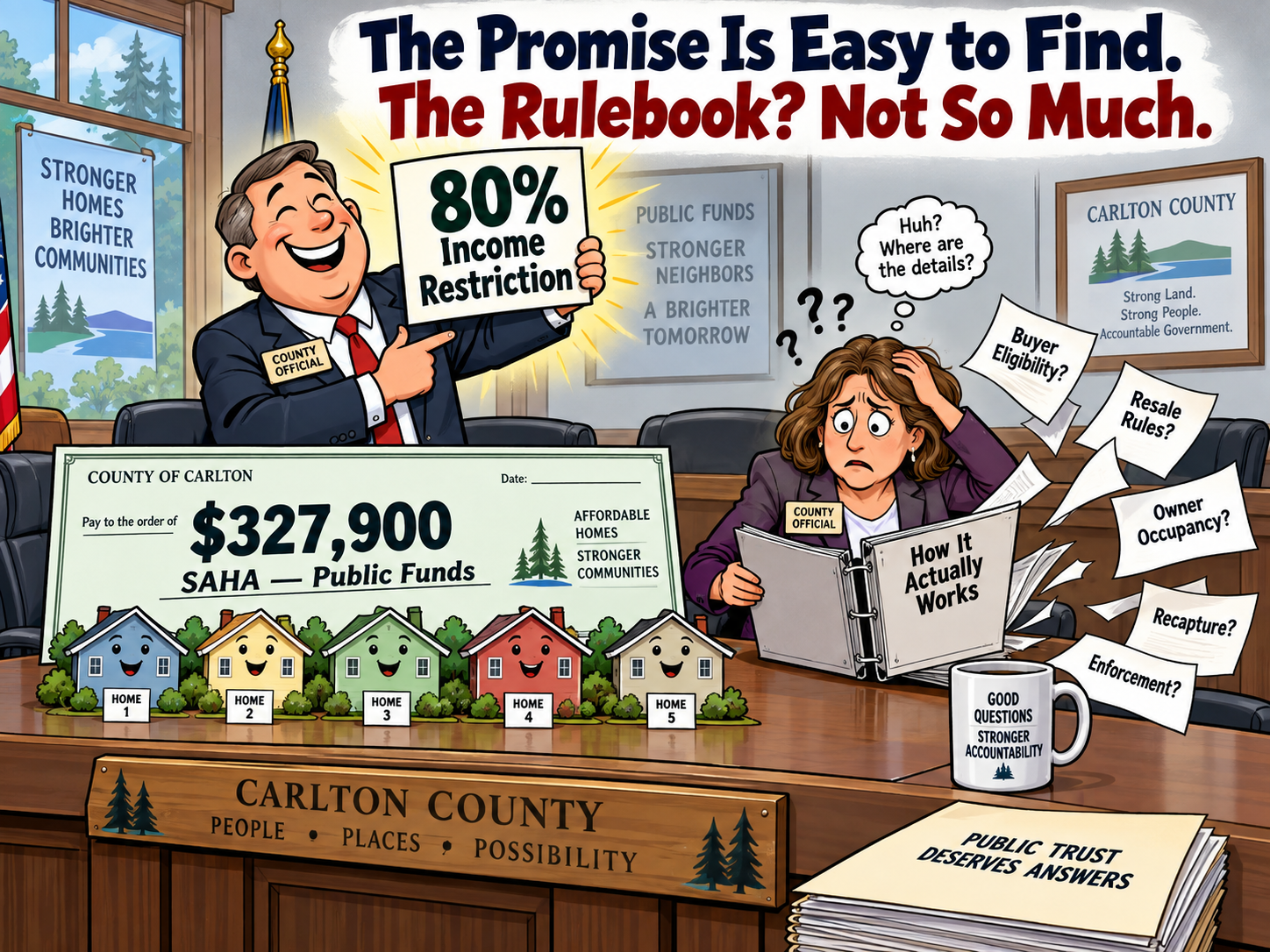
That question matters because Carlton County’s own April 2026 Board materials were explicit.
In an April 14, 2026 Information for Commissioners document titled State Affordable Housing Aide Funds Allocation Barnum Project, County officials reported that Carlton County had received $327,900 in State Affordable Housing Aid, or SAHA, and recommended allocating the remaining SAHA funds to a project involving five new housing units in Barnum.
The document concluded with an important representation:
“Income restrictions would be in place for these homes at 80 percent of the State Median Income.”
That statement is straightforward.
The difficult part is finding the documents that show how it will actually work.
The Public Investment Is Significant
The County’s Housing Trust Fund records show hundreds of thousands of dollars in State Affordable Housing Aid flowing into the County housing account before the Barnum project was approved. The accounting records identify SAHA deposits totaling $269,884 through the period ending April 1, 2026.
The April Board document subsequently identified the total SAHA received by the County as $327,900 and recommended using the remaining funds for the Barnum project.
The records also include a December 2025 proposal from Ideal Homes for site work associated with five lots. That proposal included lot preparation, driveways, parking, culverts, utility stub-outs, sand and gravel, waterline and sewer work and other site preparation, with an estimated total of $224,475.55. Electrical wire and architectural and engineering drawing fees were specifically excluded from that estimate.
By late July, County personnel were also discussing the mechanics required before Economic Development submitted a voucher for disbursement of the SAHA funds to Ideal Homes.
In other words, this is not simply a conceptual housing proposal. It involves a substantial commitment of public housing money to a specific private development project.
What Does Minnesota's SAHA Law Require?
The distinction between a project being called “affordable” and the actual statutory rules governing SAHA is important.
Under Minnesota Statutes § 477A.36, a qualifying homeownership project may provide affordable housing to households whose incomes do not exceed 115 percent of the greater of state or area median income, as determined by the U.S. Department of Housing and Urban Development.
The same statute directs recipients to prioritize homeownership projects serving households at or below 80 percent of the greater of state or area median income.
Minnesota Housing describes the program similarly: homeownership projects must be affordable to households below the applicable 115% threshold, while recipients must prioritize projects serving households below the 80% threshold.
That creates an interesting detail in Carlton County’s own description.
The County told commissioners that:
“Income restrictions would be in place for these homes at 80 percent of the State Median Income.”
But the statutory language refers to the greater of state or area median income.
That does not, by itself, establish that anything improper occurred. It does, however, make it important to know exactly which income calculation the County intends to use and what documents actually impose that requirement on purchasers.
The Missing Piece: How Is the 80% Restriction Enforced?
Carlton County Watch’s original data request specifically sought records explaining the affordability structure of the project, including the meaning of “affordable,” purchaser eligibility, income restrictions, owner-occupancy requirements, resale restrictions, rental restrictions, anti-flipping provisions, recapture provisions, liens, deed restrictions and the duration of any affordability requirement.
The recent production contains extensive emails, project documents, manufactured-home information, financial records and other material.
But based upon the records produced and reviewed to date, Carlton County Watch has not located a complete set of documents answering several basic questions:
How will a prospective buyer prove that the buyer satisfies the promised income restriction?
Who verifies the buyer's income?
What income table will be used?
What will each home sell for?
Must the purchaser actually live in the home?
Can the purchaser immediately rent it?
Can the purchaser buy the subsidized home and resell it shortly afterward?
Does the affordability restriction continue after the first sale?
Is there a lien, mortgage, covenant or deed restriction securing the public investment?
Does Carlton County have any right to recapture the subsidy if the affordability conditions are violated?
And how long does the promised affordability restriction last?
Those are not minor administrative details.
They are the mechanics that determine whether an “income restriction” exists as an enforceable condition rather than simply as a description of the project.
Then There Is the “Signed Agreement”
One of the most significant pieces of the latest production may actually be a document that does not appear to have been included with the records reviewed by Carlton County Watch.
A June 2026 email regarding the project states:
“Here is the signed agreement!”
The same correspondence discusses coordinating receipt of County funding with Ideal Homes’ construction financing.
Yet the actual signed agreement referenced in that correspondence does not appear among the project documents produced to Carlton County Watch.
That could have a simple explanation. An attachment may have been omitted, separated during production or maintained elsewhere.
But the agreement itself could be extremely important.
If it contains the promised income restriction, purchaser requirements, sale-price limitations, owner-occupancy provisions, recapture rights or other affordability protections, it may answer many of the questions that remain open.
Carlton County Watch has therefore specifically requested the complete signed agreement, including all attachments, exhibits, revisions and subsequent amendments.
The City of Barnum Is a Separate Piece of the Puzzle
The records also demonstrate why it is important not to confuse two different sets of restrictions.
The City of Barnum has been involved with transferring municipal property for the project, while Carlton County is providing the SAHA funding.
A development agreement protecting the City's interest in donated property is not necessarily the same thing as an agreement protecting the County's affordable-housing investment.
For example, an agreement requiring Ideal Homes to construct five houses by a certain deadline might prevent the developer from simply holding the land without developing it.
But that provision alone would not answer whether the completed houses must be sold to income-qualified buyers, whether those buyers must occupy the properties, or whether the homes must remain affordable after their initial sale.
Those are different questions requiring potentially different contractual or recorded protections.
Carlton County Watch Is Seeking the Missing Records
Carlton County Watch is now submitting a focused supplemental Data Practices Act request seeking the records necessary to answer these remaining questions.
The request seeks, among other things, the referenced June 2026 signed agreement; any executed County–Ideal Homes SAHA funding agreement; purchaser-income verification procedures; buyer-selection criteria; anticipated sale prices and affordability calculations; owner-occupancy requirements; rental and anti-flipping restrictions; resale requirements; subsidy recapture provisions; liens or affordability covenants; and documents establishing how long any affordability restriction lasts.
Importantly, the request also asks Carlton County to state explicitly when it maintains no responsive government datafor a particular category.
That distinction could be critical.
There is an enormous difference between an affordability restriction that exists in a document Carlton County simply has not yet produced and an affordability restriction for which no implementing documentation exists.
At this point, the records do not justify assuming either conclusion.
This Is Not Yet a Story About Whether the Project Is Good or Bad
Adding five homes to Barnum may provide real benefits to the community.
Likewise, using public funds to help create housing affordable to working households is precisely the type of purpose contemplated by Minnesota's affordable-housing statutes.
The accountability question is narrower.
Carlton County told the public and its commissioners that income restrictions would be in place.
With $327,900 in State Affordable Housing Aid associated with the project, the public should be able to see what those restrictions are, who must follow them, how long they last and what happens if they are violated.
Perhaps the missing signed agreement answers every one of those questions.
Perhaps additional documents will show a detailed affordability and enforcement structure that was simply absent from the County's first production.
Or perhaps the next round of records will show that some of those protections were never created.
Carlton County Watch will report what the documents show.
For now, the County's own records establish the promise:
Five homes. Public affordable-housing money. An 80% income restriction.
The unanswered question is how that promise becomes an enforceable requirement rather than simply a sentence in a County Board document.
Carlton County Watch has asked Carlton County to provide the answer.