Carlton County Commissioners’ Compensation: Salaries, Benefits, Per Diems — and an Incomplete Public Accounting
An examination of county financial records raises questions about rising per diem expenditures, taxpayer-funded benefits, and the time required to obtain supporting documentation.
by Carlton County Watch
How much does it actually cost Carlton County taxpayers to compensate their five county commissioners?
The answer is more complicated than the annual salary published by the County Board.
Commissioners receive a base salary, may qualify for additional per diem compensation for authorized activities, and may receive taxpayer-funded health insurance, retirement contributions, life insurance, and other benefits. The County also pays or reimburses certain expenses associated with official duties.

Financial records obtained by Carlton County Watch reveal increases in commissioner per diem spending and changes in authorized payment rates. They also raise a separate question: Why has obtaining a complete, individual accounting required months of correspondence?
What Commissioners Are Authorized to Receive
Under Minnesota Statutes § 375.055, county commissioners may receive annual salaries, authorized per diem payments, and reimbursement for necessary expenses incurred in performing their duties.
The Carlton County Board establishes these amounts by resolution.
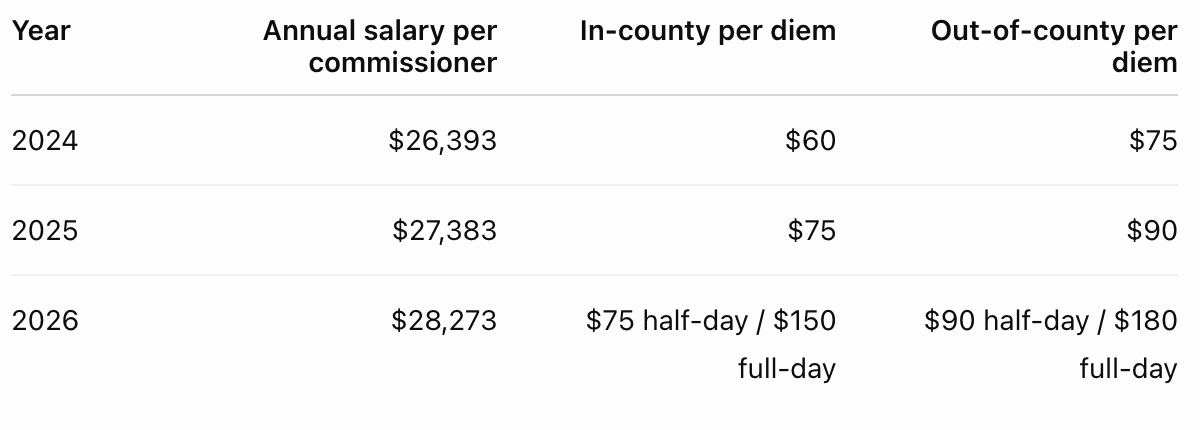
Between 2024 and 2026, the authorized annual salary increased approximately 7.1%.
The more notable change occurred in the per diem structure.
For 2026, the Board expressly established full-day per diem payments of $150 for in-county activities and $180 for out-of-county activities, alongside the lower half-day rates.
These amounts are paid in addition to base salary, subject to the applicable authorization and eligibility requirements.
Per Diem Spending Already Exceeded the 2026 Annual Budget
The County's budget reports reveal the following expenditures:
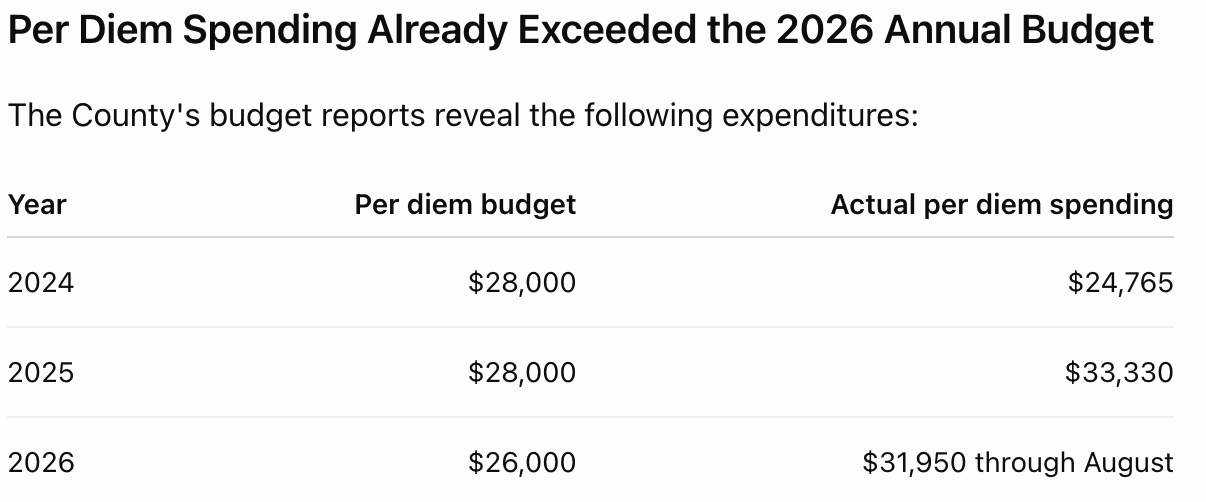
In 2025, actual per diem spending increased approximately 34.6% over 2024 and exceeded the annual budget.
By August 2026, spending had already reached $31,950 — approximately 22.9% above the entire year's $26,000 budget.
These figures establish that expenditures exceeded their budgeted amounts.
The critical unanswered questions concern which commissioners received the payments, what activities supported the claims, and how eligibility was documented. The County has refused to provide this data.

Benefits Add to the Cost of Commissioner Compensation
Base salaries and per diem payments are only part of the financial picture.
The County's employer-benefit records identify expenditures for health coverage, Voluntary Employees' Beneficiary Association (VEBA) contributions, retirement contributions, and life insurance.
For example, the County's 2025 records identify $11,018.64 in employer-paid medical premiums and $2,000 in VEBA contributions for each of Commissioners Marvin Bodie, Thomas Proulx, and Susan Zmyslony.
Employer-paid PERA contributions and life insurance premiums added further amounts for these commissioners.
Other commissioners received different benefit amounts. These differences may reflect enrollment elections, coverage eligibility, or other applicable rules rather than inconsistent treatment.
An accurate compensation accounting must distinguish the benefits actually funded for each official from benefits merely offered under a County plan.
It must also avoid counting the same insurance or retirement expenditure twice when reconciling individual benefit records with general-ledger totals.
Public Service or a Taxpayer-Funded Career? Should Elected Commissioners Receive Employment Benefits?
Public office is supposed to be about serving the people. But at what point does an elected position begin to resemble a taxpayer-funded employment package?
Carlton County commissioners receive an annual salary of $28,273 in 2026. They may also receive additional per diem payments for authorized meetings and activities, along with reimbursement of necessary expenses.

But the financial records obtained by Carlton County Watch reveal another layer of compensation: taxpayer-funded health insurance premiums, retirement contributions, VEBA benefits, and life insurance.
Consider what the County's own policies provide:
Health insurance: Employer-funded premiums are available to eligible officials, with some commissioners receiving substantial taxpayer-funded coverage.
Retirement contributions: Eligible commissioners who participate in PERA's optional Defined Contribution Plan receive employer contributions equal to 5% of eligible compensation, in addition to their own contributions.
Life insurance: Carlton County's 2026 personnel policy expressly provides $85,000 in term life insurance coverage for elected officials, with premiums paid by the County.
VEBA benefits: County policies provide annual employer-funded contributions of $2,000 for eligible single coverage and $4,000 for eligible family coverage.
Not every commissioner necessarily receives every benefit. The County's records show variations among individual officials, which is why a complete accounting matters.
Minnesota law permits county commissioners to participate in government-sponsored insurance programs and provides retirement options for eligible elected officials. Therefore, these benefits are not inherently unlawful.
But legality and fiscal responsibility are two entirely different questions.
County commissioner is an elected public office, not an ordinary civil-service position. Commissioners are accountable to the voters, not hired through the County's regular employment system.
Should commissioners receive taxpayer-funded health insurance when they already receive an annual salary and potentially thousands of dollars in additional per diem payments? Should taxpayers contribute to retirement plans for elected officials? Is employer-paid life insurance an appropriate public expense? What would the County save if some benefits were reduced, eliminated, or funded directly by participating commissioners?
And perhaps the most fundamental question:
Should elected public service increasingly resemble a career with the compensation and benefits traditionally associated with regular government employment?
There is no universal answer. But Carlton County taxpayers deserve the opportunity to evaluate those choices using accurate financial information.
The commissioners themselves vote on annual salary and per diem resolutions. That arrangement is permitted by Minnesota law, but it makes public transparency and independent scrutiny especially important.
Carlton County Watch believes the Board should publish an annual, commissioner-by-commissioner accounting of total compensation, identifying salaries, per diem payments, taxpayer-funded insurance premiums, retirement contributions, VEBA funding, and expense reimbursements separately.
Voters can then decide whether the full compensation package represents a reasonable investment in effective county government — or an expense that deserves reconsideration.
Public service should never come with a blank check. Taxpayers deserve to know the full cost of the officials they elect.
Mileage and Travel Expenses
The County's records show private automobile mileage reimbursements of approximately $9,809 in 2024 and $13,413 in 2025.
In 2025, the general ledger identifies $6,435.31 in mileage reimbursements paid to Commissioner Daniel Reed and $3,912.28 paid to Commissioner Marvin Bodie.
These payments represent reimbursement of claimed travel expenses, not additional salary.
The County's ledger identifies payment amounts and sometimes describes the travel periods or activities. However, the underlying mileage documentation is needed to determine the distances traveled, purposes of individual trips, and applicable approvals.
A Public Records Request — and Months of Correspondence
On July 29, 2026, Carlton County Watch submitted a Minnesota Government Data Practices Act request seeking existing records of salaries, per diem payments, employer-paid benefits, expense reimbursements, and payments associated with service on outside governmental organizations.
The request sought individual records for commissioners serving since January 1, 2024.
Carlton County acknowledged the request on July 30.
On August 31, County Administrator Dennis Genereau indicated that the County anticipated needing another 30 days because of the volume of records.
The County subsequently produced several categories of information, including employer-benefit spreadsheets, compensation resolutions, governing policies, and accounting reports.
In a September 29 email, Genereau identified additional expense-reimbursement and outside-board records as outstanding. He indicated that some documents appeared to exist in paper form and would need to be made available for inspection.
On October 14, Auditor/Treasurer Kevin DeVriendt explained that property-tax collection and election-related work were taking priority, while stating that the office would work overtime to finish the request.
Carlton County Watch again requested the outstanding records on October 19.
As of that correspondence, the production remained incomplete.
Why?
Minnesota Statutes § 13.03 requires government entities to establish procedures for appropriate and prompt responses to public-data requests. The statute does not establish a universal fixed deadline for such requests; a reasonable response period can depend on the circumstances, including the volume and complexity of the records.
The question is whether the County's response in this instance has been reasonably prompt, particularly for records routinely used to authorize, process, and account for public expenditures.
The Outstanding Questions
Several questions remain before a complete commissioner-by-commissioner accounting can be published.
Which commissioners received each per diem payment, and for what activity? Were the meetings classified as half-day or full-day events? Who reviewed and approved the claims? How were payments associated with outside governmental organizations recorded, and what procedures prevented duplicate reimbursement? Can each commissioner's benefits, gross compensation, and reimbursements be reconciled with the County's accounting system?
The financial records obtained so far do not establish misconduct. They establish spending amounts, compensation rules, and gaps in the supporting information available for review.
Carlton County Watch will continue seeking those records and welcomes clarification from County officials regarding payment authorization, accounting procedures, and the remaining production schedule.
Transparency Means More Than Publishing a Salary
Commissioners perform work that extends beyond regular Board meetings. Regional assignments, constituent responsibilities, and other governmental activities can require substantial commitments of time and travel.
The public should be able to evaluate those responsibilities alongside the compensation and expenses associated with them.
Carlton County taxpayers deserve a clear accounting of what is authorized, what is actually paid, and how those payments are documented.
Editor's note: The 2026 figures are partial-year amounts. Budget and accounting reports may contain items not attributable to individual commissioner compensation. This article distinguishes verified expenditures from questions requiring additional records.