Before You Ask for Our Vote, Answer Two Questions
Term Limits. And a 25% Budget Reduction Plan.
by Carlton County Watch
Election season has arrived.
Soon, candidates will tell us they believe in fiscal responsibility.
They will tell us they believe in accountability.
They will tell us they want to serve the people.
Fine.
At Carlton County Watch, we think voters should ask every candidate for public office two very simple questions before Election Day.
Not twenty questions.
Not a political questionnaire requiring twelve pages of carefully rehearsed answers.
Two questions.
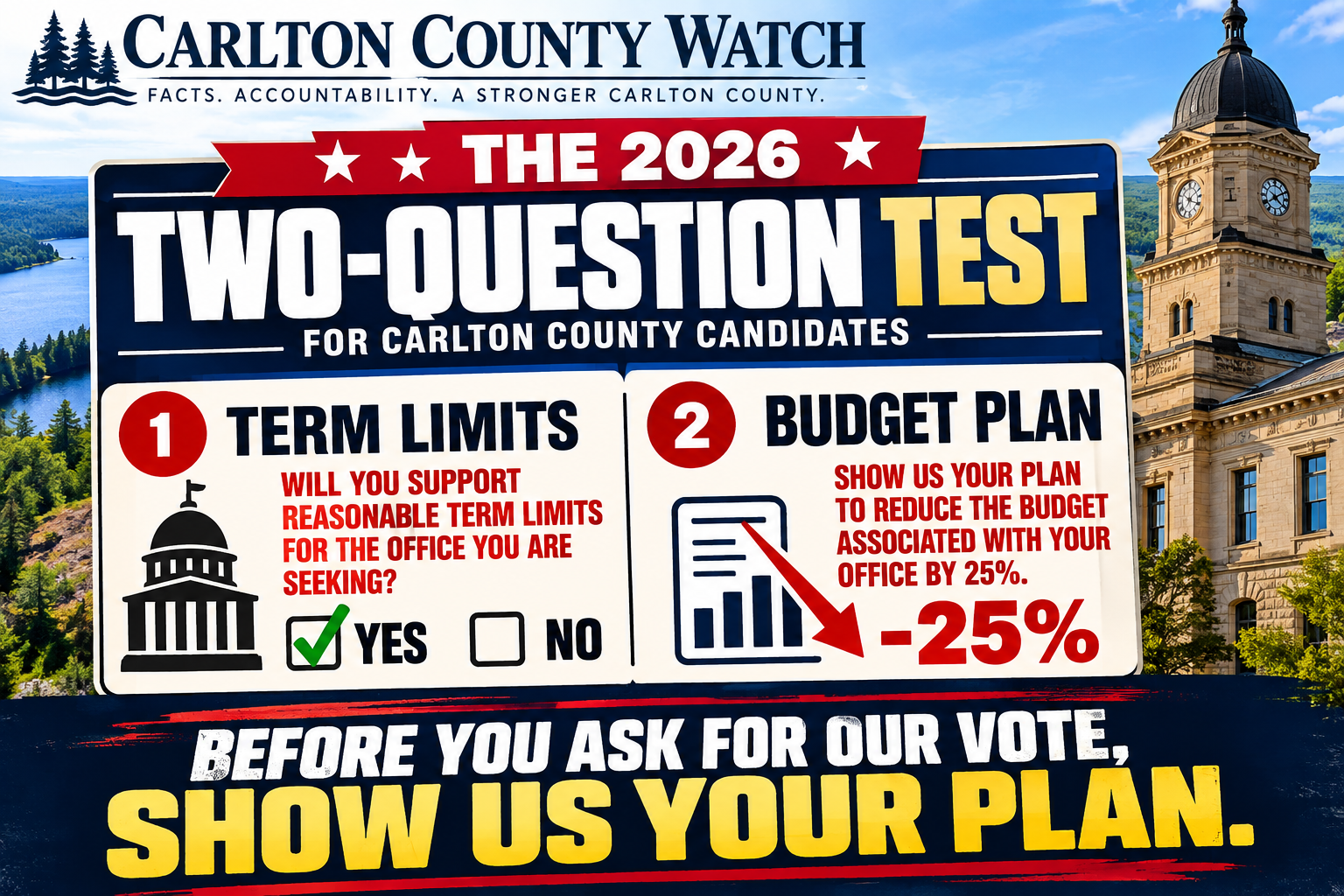
Question #1: Will You Support Term Limits?
Public office should not become a lifetime occupation.
Minnesota county government already gives elected officials substantial job security. County commissioners generally serve four-year terms. Sheriffs and county attorneys also serve four-year terms.
Four years is plenty of time to demonstrate leadership.
Eight years is plenty of time to leave a mark.
Twelve years?
Sixteen years?
Twenty years?
At some point, we believe public service risks becoming something very different: institutional ownership of a public office.
That is why Carlton County Watch believes candidates should tell voters whether they support reasonable term limits for elected county offices.
For example:
Two consecutive four-year terms.
Serve eight years.
Do the job. Implement your ideas. Develop the next generation of leadership. Then step aside and allow somebody else to serve.
That does not mean experienced officials have nothing to contribute. It means voters should have a serious discussion about whether elected offices benefit from regular turnover.
New people bring new questions. New people challenge old assumptions. New people may notice problems that become invisible to people who have spent years inside the same institution.
And perhaps most importantly:
No elected official should ever begin believing that a public office belongs to them.
It belongs to the people.
Question #2: Show Us Your Plan to Cut 25%
Here is the second question we would like every candidate to answer:
If elected, how would you reduce the budget associated with your office or area of responsibility by 25%?
Notice what we are not asking.
We aren't asking:
"Do you support fiscal responsibility?"
Everyone supports fiscal responsibility during an election.
We aren't asking:
"Will you eliminate waste?"
Every candidate promises to eliminate waste.
We aren't asking:
"Will you protect taxpayers?"
Of course they will say yes.
We want something considerably more difficult.
Show us the spreadsheet.
Take the current budget.
Multiply it by 0.75.
Now tell taxpayers how you would operate within that number.
What positions would you eliminate through attrition?
What vacant positions wouldn't you fill?
What contracts could be renegotiated?
What equipment purchases could be postponed?
What programs could be consolidated?
What administrative expenses could be reduced?
What technology could make employees more productive?
What services could be shared with neighboring counties or municipalities?
What expenses have continued year after year simply because nobody has seriously questioned them?
And, importantly, what would you refuse to cut because doing so would compromise a legally required or genuinely essential public service?
That last question matters.
A 25% exercise should not be an invitation to invent numbers or recklessly eliminate essential services.
It should be a test of whether candidates actually understand the budgets they are asking taxpayers to finance.
"I Can't Cut Anything" Is Also an Answer
Perhaps a candidate studies the numbers and concludes that reducing the budget by 25% would be irresponsible.
Fine.
Then show us why.
Show taxpayers the numbers. Identify the statutory obligations. Identify the staffing requirements. Identify the services that would disappear. Explain the consequences.
Maybe voters will agree.
But saying "we need more money" without explaining what could first be eliminated, consolidated, postponed, automated or performed differently should receive considerably more scrutiny.
Before asking taxpayers for another dollar, candidates should demonstrate that they understand where the dollars already being collected are going.
Imagine the Candidate Forum
Imagine a Carlton County candidate forum where every candidate receives the same two questions:
1. Will you support term limits for the office you are seeking?
2. Please identify how you would reduce the budget associated with that office by 25%.
Suddenly, the conversation changes.
We aren't talking about slogans anymore. We aren't talking about campaign signs. We aren't talking about who has the most endorsements. We're talking about governing.
One candidate might propose reducing management positions. Another might identify unnecessary contracts. Another might propose regional cooperation. Another might argue that certain spending cannot responsibly be reduced and provide documentation showing why.
Excellent.
Now voters have something substantive to compare.
The 25% Challenge
So Carlton County Watch proposes something simple for the 2026 election:
The 25% Challenge.
We invite candidates for Carlton County offices to publicly provide voters with a proposed budget showing what their office would look like with expenditures reduced by 25%.
Not a slogan.
Not a promise.
A plan.
Tell voters what you would cut. Tell voters what you would preserve. Tell voters how much each proposal saves. And tell voters what the consequences would be.
Candidates should be free to conclude that some or all of the reduction would be unwise. But if that is their conclusion, they should explain it with the same level of specificity.
Two Questions Before Election Day
The questions could hardly be simpler:
Will you support reasonable term limits?
And:
Can you show taxpayers what a 25% smaller budget would actually look like?
The answers could tell voters considerably more about a candidate than another campaign flyer promising leadership, accountability and fiscal responsibility.
Because public accountability doesn't begin after the election.
It begins before we cast the ballot.
Carlton County Watch invites every 2026 candidate for Carlton County office to answer these questions publicly. Candidate responses can be published in full so voters can read the answers and draw their own conclusions.